

Mathematical Air Pollution Models: Eulerian Models
141
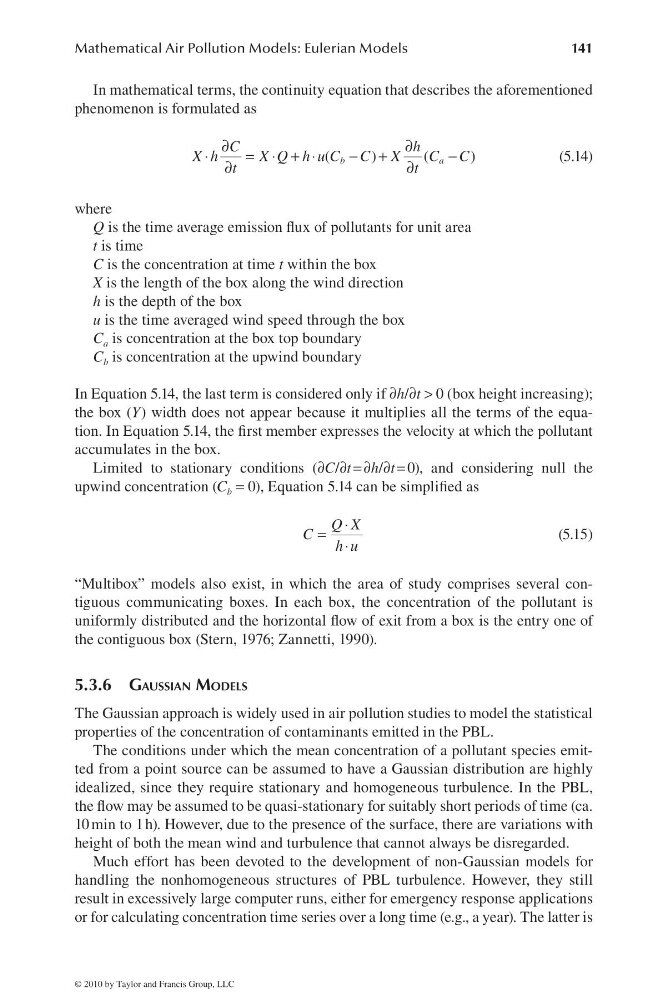
In mathematical terms, the continuity equation that describes the aforementioned
phenomenon is formulated as
(
)
(
)
b
a
C
h
X h
X Q h u C C X
C C
t
t
∂
∂
⋅
= ⋅ + ⋅
− +
−
∂
∂
(5.14)
where
Q is the time average emission fl ux of pollutants for unit area
t is time
C is the concentration at time t within the box
X is the length of the box along the wind direction
h is the depth of the box
u is the time averaged wind speed through the box
C a is concentration at the box top boundary
C b is concentration at the upwind boundary
In Equation 5.14, the last term is considered only if ∂h/∂t > 0 (box height increasing);
the box (Y) width does not appear because it multiplies all the terms of the equation. In Equation 5.14, the fi rst member expresses the velocity at which the pollutant
accumulates in the box.
Limited to stationary conditions (∂C/∂t = ∂h/∂t = 0), and considering null the
upwind concentration (C b = 0), Equation 5.14 can be simplifi ed as
Q X
C
h u
⋅
= ⋅
(5.15)
“Multibox” models also exist, in which the area of study comprises several contiguous communicating boxes. In each box, the concentration of the pollutant is
uniformly distributed and the horizontal fl ow of exit from a box is the entry one of
the contiguous box (Stern, 1976; Zannetti, 1990).
5.3.6 GAUSSIAN MODELS
The Gaussian approach is widely used in air pollution studies to model the statistical
properties of the concentration of contaminants emitted in the PBL.
The conditions under which the mean concentration of a pollutant species emitted from a point source can be assumed to have a Gaussian distribution are highly
idealized, since they require stationary and homogeneous turbulence. In the PBL,
the fl ow may be assumed to be quasi-stationary for suitably short periods of time (ca.
10 min to 1 h). However, due to the presence of the surface, there are variations with
height of both the mean wind and turbulence that cannot always be disregarded.
Much effort has been devoted to the development of non-Gaussian models for
handling the nonhomogeneous structures of PBL turbulence. However, they still
result in excessively large computer runs, either for emergency response applications
or for calculating concentration time series over a long time (e.g., a year). The latter is
© 2010 by Taylor and Francis Group, LLC
141
In mathematical terms, the continuity equation that describes the aforementioned
phenomenon is formulated as
(
)
(
)
b
a
C
h
X h
X Q h u C C X
C C
t
t
∂
∂
⋅
= ⋅ + ⋅
− +
−
∂
∂
(5.14)
where
Q is the time average emission fl ux of pollutants for unit area
t is time
C is the concentration at time t within the box
X is the length of the box along the wind direction
h is the depth of the box
u is the time averaged wind speed through the box
C a is concentration at the box top boundary
C b is concentration at the upwind boundary
In Equation 5.14, the last term is considered only if ∂h/∂t > 0 (box height increasing);
the box (Y) width does not appear because it multiplies all the terms of the equation. In Equation 5.14, the fi rst member expresses the velocity at which the pollutant
accumulates in the box.
Limited to stationary conditions (∂C/∂t = ∂h/∂t = 0), and considering null the
upwind concentration (C b = 0), Equation 5.14 can be simplifi ed as
Q X
C
h u
⋅
= ⋅
(5.15)
“Multibox” models also exist, in which the area of study comprises several contiguous communicating boxes. In each box, the concentration of the pollutant is
uniformly distributed and the horizontal fl ow of exit from a box is the entry one of
the contiguous box (Stern, 1976; Zannetti, 1990).
5.3.6 GAUSSIAN MODELS
The Gaussian approach is widely used in air pollution studies to model the statistical
properties of the concentration of contaminants emitted in the PBL.
The conditions under which the mean concentration of a pollutant species emitted from a point source can be assumed to have a Gaussian distribution are highly
idealized, since they require stationary and homogeneous turbulence. In the PBL,
the fl ow may be assumed to be quasi-stationary for suitably short periods of time (ca.
10 min to 1 h). However, due to the presence of the surface, there are variations with
height of both the mean wind and turbulence that cannot always be disregarded.
Much effort has been devoted to the development of non-Gaussian models for
handling the nonhomogeneous structures of PBL turbulence. However, they still
result in excessively large computer runs, either for emergency response applications
or for calculating concentration time series over a long time (e.g., a year). The latter is
© 2010 by Taylor and Francis Group, LLC