

112
Air Pollution and Turbulence: Modeling and Applications
assuming an eddy-diffusivity approach for the fl ux. Assuming that the turbulent
diffusion coeffi cient is simplifi ed to k = (1 − a)k d + ak c , where k d and k c are constants
and are respectively the turbulent diffusion coeffi cients for the dry and the cloudy
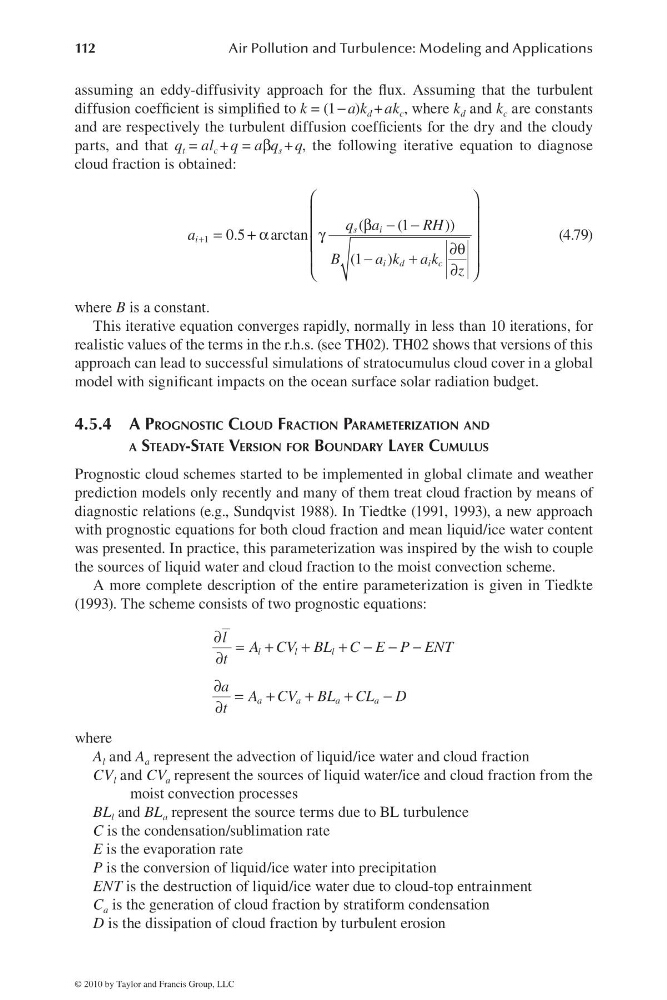
parts, and that q t = al c + q = aβq s + q, the following iterative equation to diagnose
cloud fraction is obtained:
1
(
(1
))
0.5
arctan
(1
)
s
i
i
i d
i c
q a
RH
a
B
a k ak
z
+
⎛
⎞
⎜
⎟
β − −
⎜
⎟
=
+α
γ
⎜
⎟
∂θ
−
+
⎜
⎟
∂
⎝
⎠
(4.79)
where B is a constant.
This iterative equation converges rapidly, normally in less than 10 iterations, for
realistic values of the terms in the r.h.s. (see TH02). TH02 shows that versions of this
approach can lead to successful simulations of stratocumulus cloud cover in a global
model with signifi cant impacts on the ocean surface solar radiation budget.
4.5.4 A PROGNOSTIC CLOUD FRACTION PARAMETERIZATION AND
A STEADY-STATE VERSION FOR BOUNDARY LAYER CUMULUS
Prognostic cloud schemes started to be implemented in global climate and weather
prediction models only recently and many of them treat cloud fraction by means of
diagnostic relations (e.g., Sundqvist 1988). In Tiedtke (1991, 1993), a new approach
with prognostic equations for both cloud fraction and mean liquid/ice water content
was presented. In practice, this parameterization was inspired by the wish to couple
the sources of liquid water and cloud fraction to the moist convection scheme.
A more complete description of the entire parameterization is given in Tiedkte
(1993). The scheme consists of two prognostic equations:
l
l
l
a
a
a
a
l A CV BL C E P ENT
t
a A CV BL CL D
t
∂ = +
+
+ − − −
∂
∂ = +
+
+
−
∂
where
A l and A a represent the advection of liquid/ice water and cloud fraction
CV l and CV a represent the sources of liquid water/ice and cloud fraction from the
moist convection processes
BL l and BL a represent the source terms due to BL turbulence
C is the condensation/sublimation rate
E is the evaporation rate
P is the conversion of liquid/ice water into precipitation
ENT is the destruction of liquid/ice water due to cloud-top entrainment
C a is the generation of cloud fraction by stratiform condensation
D is the dissipation of cloud fraction by turbulent erosion
© 2010 by Taylor and Francis Group, LLC
Air Pollution and Turbulence: Modeling and Applications
assuming an eddy-diffusivity approach for the fl ux. Assuming that the turbulent
diffusion coeffi cient is simplifi ed to k = (1 − a)k d + ak c , where k d and k c are constants
and are respectively the turbulent diffusion coeffi cients for the dry and the cloudy
parts, and that q t = al c + q = aβq s + q, the following iterative equation to diagnose
cloud fraction is obtained:
1
(
(1
))
0.5
arctan
(1
)
s
i
i
i d
i c
q a
RH
a
B
a k ak
z
+
⎛
⎞
⎜
⎟
β − −
⎜
⎟
=
+α
γ
⎜
⎟
∂θ
−
+
⎜
⎟
∂
⎝
⎠
(4.79)
where B is a constant.
This iterative equation converges rapidly, normally in less than 10 iterations, for
realistic values of the terms in the r.h.s. (see TH02). TH02 shows that versions of this
approach can lead to successful simulations of stratocumulus cloud cover in a global
model with signifi cant impacts on the ocean surface solar radiation budget.
4.5.4 A PROGNOSTIC CLOUD FRACTION PARAMETERIZATION AND
A STEADY-STATE VERSION FOR BOUNDARY LAYER CUMULUS
Prognostic cloud schemes started to be implemented in global climate and weather
prediction models only recently and many of them treat cloud fraction by means of
diagnostic relations (e.g., Sundqvist 1988). In Tiedtke (1991, 1993), a new approach
with prognostic equations for both cloud fraction and mean liquid/ice water content
was presented. In practice, this parameterization was inspired by the wish to couple
the sources of liquid water and cloud fraction to the moist convection scheme.
A more complete description of the entire parameterization is given in Tiedkte
(1993). The scheme consists of two prognostic equations:
l
l
l
a
a
a
a
l A CV BL C E P ENT
t
a A CV BL CL D
t
∂ = +
+
+ − − −
∂
∂ = +
+
+
−
∂
where
A l and A a represent the advection of liquid/ice water and cloud fraction
CV l and CV a represent the sources of liquid water/ice and cloud fraction from the
moist convection processes
BL l and BL a represent the source terms due to BL turbulence
C is the condensation/sublimation rate
E is the evaporation rate
P is the conversion of liquid/ice water into precipitation
ENT is the destruction of liquid/ice water due to cloud-top entrainment
C a is the generation of cloud fraction by stratiform condensation
D is the dissipation of cloud fraction by turbulent erosion
© 2010 by Taylor and Francis Group, LLC