

Parameterization of Convective Boundary Layer Turbulence and Clouds
113
The prognostic cloud scheme allows the ice and the liquid water to coexist (mixed
phase) based on a simple quadratic temperature dependence between 0°C and −23°C.
Here, we concentrate on the usefulness of this parameterization for BL shallow
cumulus situations. It has been shown (Teixeira and Miranda 2001) that, for cumulus, the prognostic cloud fraction equation of Tiedtke (1993) is typically dominated
by the production of clouds by detrainment from shallow convection and the erosion
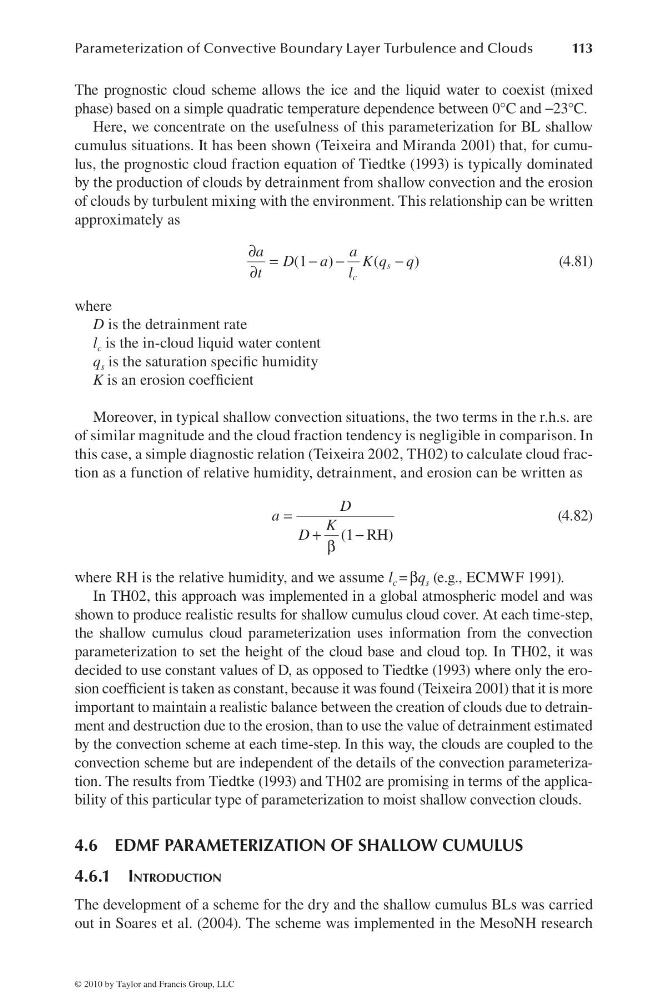
of clouds by turbulent mixing with the environment. This relationship can be written
approximately as
(1 )
(
)
s
c
a
a
D
a
K q q
t
l
∂ =
− −
−
∂
(4.81)
where
D is the detrainment rate
l c is the in-cloud liquid water content
q s is the saturation specifi c humidity
K is an erosion coeffi cient
Moreover, in typical shallow convection situations, the two terms in the r.h.s. are
of similar magnitude and the cloud fraction tendency is negligible in comparison. In
this case, a simple diagnostic relation (Teixeira 2002, TH02) to calculate cloud fraction as a function of relative humidity, detrainment, and erosion can be written as
(1 RH)
D
a
K
D
=
+
−
β
(4.82)
where RH is the relative humidity, and we assume l c = βq s (e.g., ECMWF 1991).
In TH02, this approach was implemented in a global atmospheric model and was
shown to produce realistic results for shallow cumulus cloud cover. At each time-step,
the shallow cumulus cloud parameterization uses information from the convection
parameterization to set the height of the cloud base and cloud top. In TH02, it was
decided to use constant values of D, as opposed to Tiedtke (1993) where only the erosion coeffi cient is taken as constant, because it was found (Teixeira 2001) that it is more
important to maintain a realistic balance between the creation of clouds due to detrainment and destruction due to the erosion, than to use the value of detrainment estimated
by the convection scheme at each time-step. In this way, the clouds are coupled to the
convection scheme but are independent of the details of the convection parameterization. The results from Tiedtke (1993) and TH02 are promising in terms of the applicability of this particular type of parameterization to moist shallow convection clouds.
4.6 EDMF PARAMETERIZATION OF SHALLOW CUMULUS
4.6.1 INTRODUCTION
The development of a scheme for the dry and the shallow cumulus BLs was carried
out in Soares et al. (2004). The scheme was implemented in the MesoNH research
© 2010 by Taylor and Francis Group, LLC
113
The prognostic cloud scheme allows the ice and the liquid water to coexist (mixed
phase) based on a simple quadratic temperature dependence between 0°C and −23°C.
Here, we concentrate on the usefulness of this parameterization for BL shallow
cumulus situations. It has been shown (Teixeira and Miranda 2001) that, for cumulus, the prognostic cloud fraction equation of Tiedtke (1993) is typically dominated
by the production of clouds by detrainment from shallow convection and the erosion
of clouds by turbulent mixing with the environment. This relationship can be written
approximately as
(1 )
(
)
s
c
a
a
D
a
K q q
t
l
∂ =
− −
−
∂
(4.81)
where
D is the detrainment rate
l c is the in-cloud liquid water content
q s is the saturation specifi c humidity
K is an erosion coeffi cient
Moreover, in typical shallow convection situations, the two terms in the r.h.s. are
of similar magnitude and the cloud fraction tendency is negligible in comparison. In
this case, a simple diagnostic relation (Teixeira 2002, TH02) to calculate cloud fraction as a function of relative humidity, detrainment, and erosion can be written as
(1 RH)
D
a
K
D
=
+
−
β
(4.82)
where RH is the relative humidity, and we assume l c = βq s (e.g., ECMWF 1991).
In TH02, this approach was implemented in a global atmospheric model and was
shown to produce realistic results for shallow cumulus cloud cover. At each time-step,
the shallow cumulus cloud parameterization uses information from the convection
parameterization to set the height of the cloud base and cloud top. In TH02, it was
decided to use constant values of D, as opposed to Tiedtke (1993) where only the erosion coeffi cient is taken as constant, because it was found (Teixeira 2001) that it is more
important to maintain a realistic balance between the creation of clouds due to detrainment and destruction due to the erosion, than to use the value of detrainment estimated
by the convection scheme at each time-step. In this way, the clouds are coupled to the
convection scheme but are independent of the details of the convection parameterization. The results from Tiedtke (1993) and TH02 are promising in terms of the applicability of this particular type of parameterization to moist shallow convection clouds.
4.6 EDMF PARAMETERIZATION OF SHALLOW CUMULUS
4.6.1 INTRODUCTION
The development of a scheme for the dry and the shallow cumulus BLs was carried
out in Soares et al. (2004). The scheme was implemented in the MesoNH research
© 2010 by Taylor and Francis Group, LLC