

Parameterization of Convective Boundary Layer Turbulence and Clouds
109
where the critical velocity ω c is −0.1 Pa s −1 . ω/ωc has to be always less or equal to 1
and if there is subsidence (ω > 0) this cloud fraction is zero.
The second class of BL clouds is usually associated with subsidence and BL
inversions. This is the part of the scheme that parameterizes stratocumulus. These
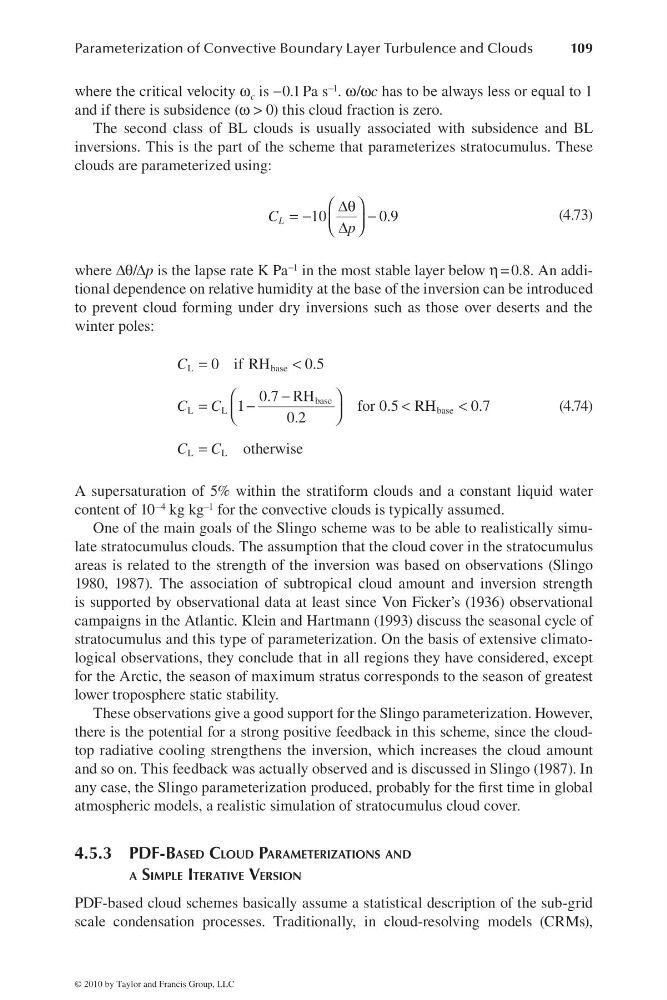
clouds are parameterized using:
10
0.9
L
C
p
⎛ ⎞
Δθ
= −
−
⎜ ⎟
Δ
⎝ ⎠
(4.73)
where Δθ/Δp is the lapse rate K Pa −1 in the most stable layer below η = 0.8. An additional dependence on relative humidity at the base of the inversion can be introduced
to prevent cloud forming under dry inversions such as those over deserts and the
winter poles:
L
b a s e
base
L
L
b a s e
L
L
0 if RH
0.5
0.7 RH
1
for 0.5 RH
0.7
0.2
otherwise
C
C
C
C
C
=
<
−
⎛
⎞
=
−
<
<
⎜
⎟
⎝
⎠
=
(4.74)
A supersaturation of 5% within the stratiform clouds and a constant liquid water
content of 10 −4 kg kg −1 for the convective clouds is typically assumed.
One of the main goals of the Slingo scheme was to be able to realistically simulate stratocumulus clouds. The assumption that the cloud cover in the stratocumulus
areas is related to the strength of the inversion was based on observations (Slingo
1980, 1987). The association of subtropical cloud amount and inversion strength
is supported by observational data at least since Von Ficker’s (1936) observational
campaigns in the Atlantic. Klein and Hartmann (1993) discuss the seasonal cycle of
stratocumulus and this type of parameterization. On the basis of extensive climatological observations, they conclude that in all regions they have considered, except
for the Arctic, the season of maximum stratus corresponds to the season of greatest
lower troposphere static stability.
These observations give a good support for the Slingo parameterization. However,
there is the potential for a strong positive feedback in this scheme, since the cloudtop radiative cooling strengthens the inversion, which increases the cloud amount
and so on. This feedback was actually observed and is discussed in Slingo (1987). In
any case, the Slingo parameterization produced, probably for the fi rst time in global
atmospheric models, a realistic simulation of stratocumulus cloud cover.
4.5.3 PDF-BASED CLOUD PARAMETERIZATIONS AND
A SIMPLE ITERATIVE VERSION
PDF-based cloud schemes basically assume a statistical description of the sub-grid
scale condensation processes. Traditionally, in cloud-resolving models (CRMs),
© 2010 by Taylor and Francis Group, LLC
109
where the critical velocity ω c is −0.1 Pa s −1 . ω/ωc has to be always less or equal to 1
and if there is subsidence (ω > 0) this cloud fraction is zero.
The second class of BL clouds is usually associated with subsidence and BL
inversions. This is the part of the scheme that parameterizes stratocumulus. These
clouds are parameterized using:
10
0.9
L
C
p
⎛ ⎞
Δθ
= −
−
⎜ ⎟
Δ
⎝ ⎠
(4.73)
where Δθ/Δp is the lapse rate K Pa −1 in the most stable layer below η = 0.8. An additional dependence on relative humidity at the base of the inversion can be introduced
to prevent cloud forming under dry inversions such as those over deserts and the
winter poles:
L
b a s e
base
L
L
b a s e
L
L
0 if RH
0.5
0.7 RH
1
for 0.5 RH
0.7
0.2
otherwise
C
C
C
C
C
=
<
−
⎛
⎞
=
−
<
<
⎜
⎟
⎝
⎠
=
(4.74)
A supersaturation of 5% within the stratiform clouds and a constant liquid water
content of 10 −4 kg kg −1 for the convective clouds is typically assumed.
One of the main goals of the Slingo scheme was to be able to realistically simulate stratocumulus clouds. The assumption that the cloud cover in the stratocumulus
areas is related to the strength of the inversion was based on observations (Slingo
1980, 1987). The association of subtropical cloud amount and inversion strength
is supported by observational data at least since Von Ficker’s (1936) observational
campaigns in the Atlantic. Klein and Hartmann (1993) discuss the seasonal cycle of
stratocumulus and this type of parameterization. On the basis of extensive climatological observations, they conclude that in all regions they have considered, except
for the Arctic, the season of maximum stratus corresponds to the season of greatest
lower troposphere static stability.
These observations give a good support for the Slingo parameterization. However,
there is the potential for a strong positive feedback in this scheme, since the cloudtop radiative cooling strengthens the inversion, which increases the cloud amount
and so on. This feedback was actually observed and is discussed in Slingo (1987). In
any case, the Slingo parameterization produced, probably for the fi rst time in global
atmospheric models, a realistic simulation of stratocumulus cloud cover.
4.5.3 PDF-BASED CLOUD PARAMETERIZATIONS AND
A SIMPLE ITERATIVE VERSION
PDF-based cloud schemes basically assume a statistical description of the sub-grid
scale condensation processes. Traditionally, in cloud-resolving models (CRMs),
© 2010 by Taylor and Francis Group, LLC