

Degradation of Pesticides in the Environment
81
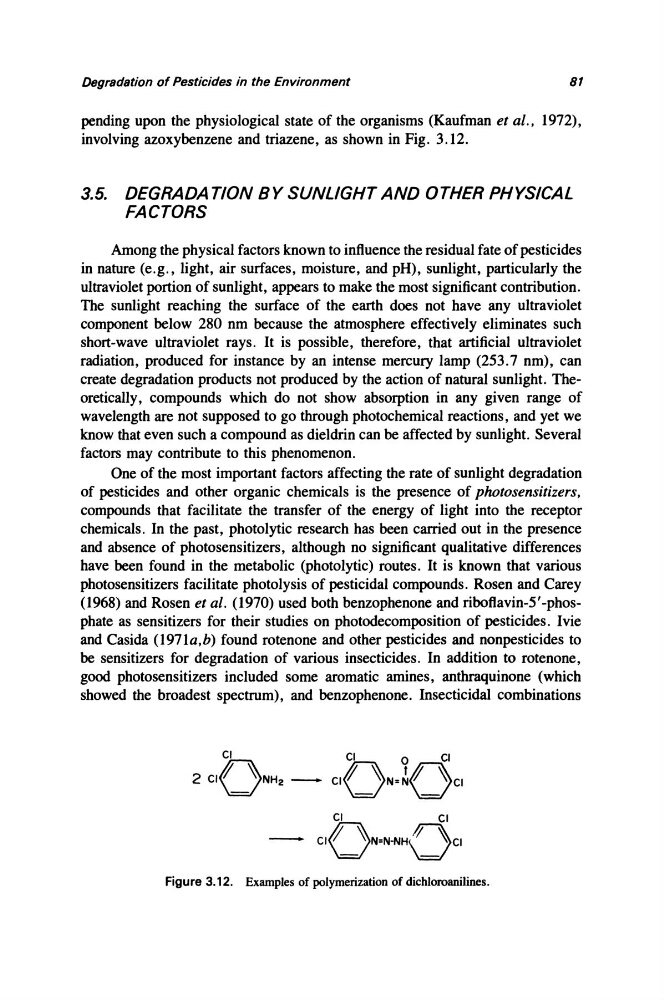
pending upon the physiological state of the organisms (Kaufman et al., 1972),
involving azoxybenzene and triazene, as shown in Fig. 3.12.
3.5. DEGRADATION BY SUNLIGHT AND OTHER PHYSICAL
FACTORS
Among the physical factors known to influence the residual fate of pesticides
in nature (e.g., light, air surfaces, moisture, and pH), sunlight, particularly the
ultraviolet portion of sunlight, appears to make the most significant contribution.
The sunlight reaching the surface of the earth does not have any ultraviolet
component below 280 nm because the atmosphere effectively eliminates such
short-wave ultraviolet rays. It is possible, therefore, that artificial ultraviolet
radiation, produced for instance by an intense mercury lamp (253.7 nm), can
create degradation products not produced by the action of natural sunlight. Theoretically, compounds which do not show absorption in any given range of
wavelength are not supposed to go through photochemical reactions, and yet we
know that even such a compound as dieldrin can be affected by sunlight. Several
factors may contribute to this phenomenon.
One of the most important factors affecting the rate of sunlight degradation
of pesticides and other organic chemicals is the presence of photosensitizers,
compounds that facilitate the transfer of the energy of light into the receptor
chemicals. In the past, photolytic research has been carried out in the presence
and absence of photosensitizers, although no significant qualitative differences
have been found in the metabolic (photolytic) routes. It is known that various
photosensitizers facilitate photolysis of pesticidal compounds. Rosen and Carey
(1968) and Rosen et al. (1970) used both benzophenone and riboflavin-5 ' -phosphate as sensitizers for their studies on photodecomposition of pesticides. Ivie
and Casida (1971a,b) found rotenone and other pesticides and nonpesticides to
be sensitizers for degradation of various insecticides. In addition to rotenone,
good photosensitizers included some aromatic amines, anthraquinone (which
showed the broadest spectrum), and benzophenone. Insecticidal combinations
Figure 3.12. Examples of polymerization of dichloroanilines.
81
pending upon the physiological state of the organisms (Kaufman et al., 1972),
involving azoxybenzene and triazene, as shown in Fig. 3.12.
3.5. DEGRADATION BY SUNLIGHT AND OTHER PHYSICAL
FACTORS
Among the physical factors known to influence the residual fate of pesticides
in nature (e.g., light, air surfaces, moisture, and pH), sunlight, particularly the
ultraviolet portion of sunlight, appears to make the most significant contribution.
The sunlight reaching the surface of the earth does not have any ultraviolet
component below 280 nm because the atmosphere effectively eliminates such
short-wave ultraviolet rays. It is possible, therefore, that artificial ultraviolet
radiation, produced for instance by an intense mercury lamp (253.7 nm), can
create degradation products not produced by the action of natural sunlight. Theoretically, compounds which do not show absorption in any given range of
wavelength are not supposed to go through photochemical reactions, and yet we
know that even such a compound as dieldrin can be affected by sunlight. Several
factors may contribute to this phenomenon.
One of the most important factors affecting the rate of sunlight degradation
of pesticides and other organic chemicals is the presence of photosensitizers,
compounds that facilitate the transfer of the energy of light into the receptor
chemicals. In the past, photolytic research has been carried out in the presence
and absence of photosensitizers, although no significant qualitative differences
have been found in the metabolic (photolytic) routes. It is known that various
photosensitizers facilitate photolysis of pesticidal compounds. Rosen and Carey
(1968) and Rosen et al. (1970) used both benzophenone and riboflavin-5 ' -phosphate as sensitizers for their studies on photodecomposition of pesticides. Ivie
and Casida (1971a,b) found rotenone and other pesticides and nonpesticides to
be sensitizers for degradation of various insecticides. In addition to rotenone,
good photosensitizers included some aromatic amines, anthraquinone (which
showed the broadest spectrum), and benzophenone. Insecticidal combinations
Figure 3.12. Examples of polymerization of dichloroanilines.