

82
Fumio Matsumura
which synergistically acted as sensitizers were Abateilli-dieldrin,
carbyne( 12E)-Sumithion®, phenothiazine-DDT, and rotenone-dieldrin. The
same authors (Ivie and Casida, 1971b) also reported that substituted 4-chromanones and rotenone-sensitized dieldrin converted to photodieldrin on bean leaves.
Chlorophyll from spinach chloroplasts plus rotenone acted as a sensitizer for
organophosphates, carbamates, pyrethroids, and dinitrophenol insecticides.
Another important factor affecting the nature of photochemical reactions
is the medium in which the reacting substance is dissolved or suspended. In
laboratory tests, the effect of solvents becomes an important factor in deciding
either the speed of the reaction or the nature of the reaction products. The medium
and the solvent can influence the outcome of photochemical reactions in two
different ways: (1) they can be photosensitizers or (2) they can act as the reaction
partner to the pesticide molecule energized by light. The difference may be best
expressed in the following equations:
Light
A + B - A + B* - (AB) - A' + B'
(1)
Light
A + B - A* + B - A' + B'
(2)
where A is a pesticide molecule and B is the substance which promotes photochemical reactions. In equation (1), B is the photosensitizer and therefore is
energized by light first. It in turn reacts with the pesticide to form the photochemical reaction product A'. In equation (2), B is the reacting agent (e.g.,
solvent or medium) for the pesticide that has been energized by light to produce
the product A' .
3.5.1. Hydrolysis: Nucleophilic Reaction
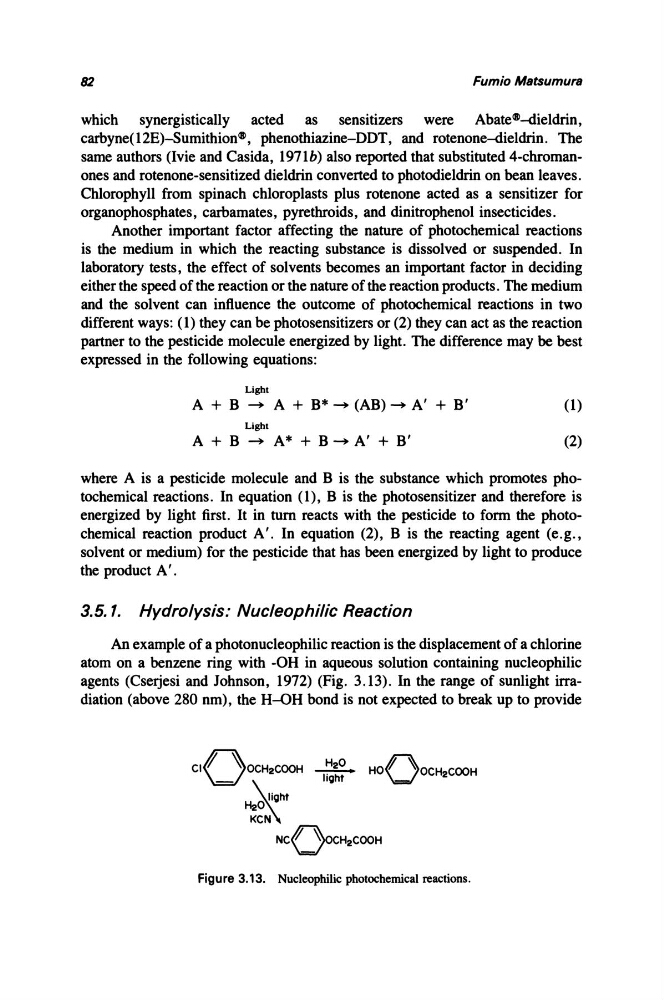
An example of a photonucleophilic reaction is the displacement of a chlorine
atom on a benzene ring with -OH in aqueous solution containing nucleophilic
agents (Cserjesi and Johnson, 1972) (Fig. 3.13). In the range of sunlight irradiation (above 280 nm), the H-OH bond is not expected to break up to provide
Figure 3.13. Nucleophilic photochemical reactions.
Fumio Matsumura
which synergistically acted as sensitizers were Abateilli-dieldrin,
carbyne( 12E)-Sumithion®, phenothiazine-DDT, and rotenone-dieldrin. The
same authors (Ivie and Casida, 1971b) also reported that substituted 4-chromanones and rotenone-sensitized dieldrin converted to photodieldrin on bean leaves.
Chlorophyll from spinach chloroplasts plus rotenone acted as a sensitizer for
organophosphates, carbamates, pyrethroids, and dinitrophenol insecticides.
Another important factor affecting the nature of photochemical reactions
is the medium in which the reacting substance is dissolved or suspended. In
laboratory tests, the effect of solvents becomes an important factor in deciding
either the speed of the reaction or the nature of the reaction products. The medium
and the solvent can influence the outcome of photochemical reactions in two
different ways: (1) they can be photosensitizers or (2) they can act as the reaction
partner to the pesticide molecule energized by light. The difference may be best
expressed in the following equations:
Light
A + B - A + B* - (AB) - A' + B'
(1)
Light
A + B - A* + B - A' + B'
(2)
where A is a pesticide molecule and B is the substance which promotes photochemical reactions. In equation (1), B is the photosensitizer and therefore is
energized by light first. It in turn reacts with the pesticide to form the photochemical reaction product A'. In equation (2), B is the reacting agent (e.g.,
solvent or medium) for the pesticide that has been energized by light to produce
the product A' .
3.5.1. Hydrolysis: Nucleophilic Reaction
An example of a photonucleophilic reaction is the displacement of a chlorine
atom on a benzene ring with -OH in aqueous solution containing nucleophilic
agents (Cserjesi and Johnson, 1972) (Fig. 3.13). In the range of sunlight irradiation (above 280 nm), the H-OH bond is not expected to break up to provide
Figure 3.13. Nucleophilic photochemical reactions.