

80
CI~ICI
CI
CI-- CI
o
isomerization
Endrin
Fumio Matsumura
CfE;(CICI
CI
CI H CI
o
b. - Ketoendrin
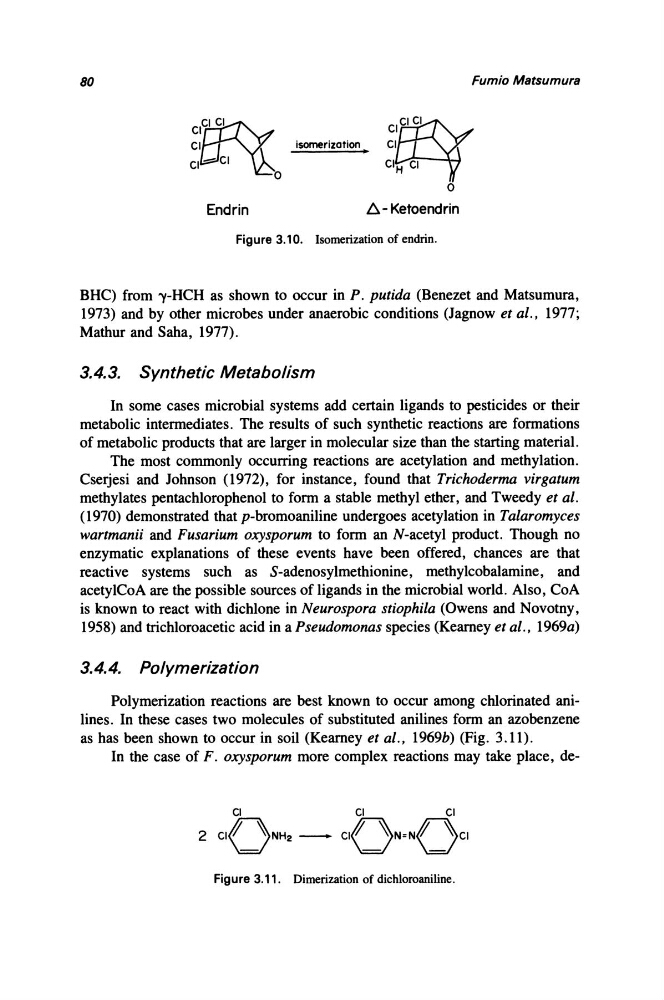
Figure 3.10. Isomerization of endrin.
BHC) from 'Y-HCH as shown to occur in P. putida (Benezet and Matsumura,
1973) and by other microbes under anaerobic conditions (Jagnow et al., 1977;
Mathur and Saha, 1977).
3.4.3. Synthetic Metabolism
In some cases microbial systems add certain ligands to pesticides or their
metabolic intermediates. The results of such synthetic reactions are formations
of metabolic products that are larger in molecular size than the starting material.
The most commonly occurring reactions are acetylation and methylation.
Cserjesi and Johnson (1972), for instance, found that Trichoderma virga tum
methylates pentachlorophenol to form a stable methyl ether, and Tweedy et al.
(1970) demonstrated that p-bromoaniline undergoes acetylation in Talaromyces
wartmanii and Fusarium oxysporum to form an N-acetyl product. Though no
enzymatic explanations of these events have been offered, chances are that
reactive systems such as S-adenosylmethionine, methylcobalamine, and
acetylCoA are the possible sources of ligands in the microbial world. Also, CoA
is known to react with dichlone in Neurospora stiophila (Owens and Novotny,
1958) and trichloroacetic acid in a Pseudomonas species (Kearney et al., 1969a)
3.4.4. Polymerization
Polymerization reactions are best known to occur among chlorinated anilines. In these cases two molecules of substituted anilines form an azobenzene
as has been shown to occur in soil (Kearney et al., 1969b) (Fig. 3.11).
In the case of F. oxysporum more complex reactions may take place, deFigure 3.11. Dimerization of dichloroaniline.
CI~ICI
CI
CI-- CI
o
isomerization
Endrin
Fumio Matsumura
CfE;(CICI
CI
CI H CI
o
b. - Ketoendrin
Figure 3.10. Isomerization of endrin.
BHC) from 'Y-HCH as shown to occur in P. putida (Benezet and Matsumura,
1973) and by other microbes under anaerobic conditions (Jagnow et al., 1977;
Mathur and Saha, 1977).
3.4.3. Synthetic Metabolism
In some cases microbial systems add certain ligands to pesticides or their
metabolic intermediates. The results of such synthetic reactions are formations
of metabolic products that are larger in molecular size than the starting material.
The most commonly occurring reactions are acetylation and methylation.
Cserjesi and Johnson (1972), for instance, found that Trichoderma virga tum
methylates pentachlorophenol to form a stable methyl ether, and Tweedy et al.
(1970) demonstrated that p-bromoaniline undergoes acetylation in Talaromyces
wartmanii and Fusarium oxysporum to form an N-acetyl product. Though no
enzymatic explanations of these events have been offered, chances are that
reactive systems such as S-adenosylmethionine, methylcobalamine, and
acetylCoA are the possible sources of ligands in the microbial world. Also, CoA
is known to react with dichlone in Neurospora stiophila (Owens and Novotny,
1958) and trichloroacetic acid in a Pseudomonas species (Kearney et al., 1969a)
3.4.4. Polymerization
Polymerization reactions are best known to occur among chlorinated anilines. In these cases two molecules of substituted anilines form an azobenzene
as has been shown to occur in soil (Kearney et al., 1969b) (Fig. 3.11).
In the case of F. oxysporum more complex reactions may take place, deFigure 3.11. Dimerization of dichloroaniline.