

78
Fumio Matsumura
CI
0+
COOH
CH3
COOH
I
I
HOCH
C~O
'CH("
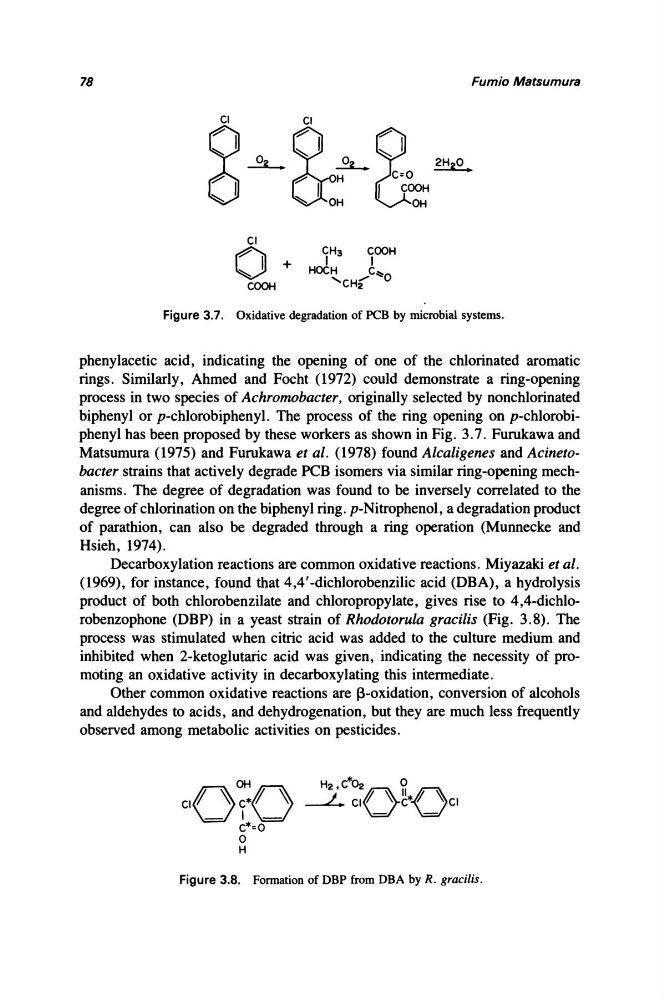
Figure 3.7. Oxidative degradation of PCB by microbial systems.
phenylacetic acid, indicating the opening of one of the chlorinated aromatic
rings. Similarly, Ahmed and Focht (1972) could demonstrate a ring-opening
process in two species of Achromobacter, originally selected by nonchlorinated
biphenyl or p-chlorobiphenyl. The process of the ring opening on p-chlorobiphenyl has been proposed by these workers as shown in Fig. 3.7. Furukawa and
Matsumura (1975) and Furukawa et al. (1978) found Alcaligenes and Acinetobacter strains that actively degrade PCB isomers via similar ring-opening mechanisms. The degree of degradation was found to be inversely correlated to the
degree of chlorination on the biphenyl ring. p-Nitrophenol, a degradation product
of parathion, can also be degraded through a ring operation (Munnecke and
Hsieh, 1974).
Decarboxylation reactions are common oxidative reactions. Miyazaki et al.
(1969), for instance, found that 4,4'-dichlorobenzilic acid (DBA), a hydrolysis
product of both chlorobenzilate and chloropropylate, gives rise to 4,4-dichlorobenzophone (DBP) in a yeast strain of Rhodotorula gracilis (Fig. 3.8). The
process was stimulated when citric acid was added to the culture medium and
inhibited when 2-ketoglutaric acid was given, indicating the necessity of promoting an oxidative activity in decarboxylating this intermediate.
Other common oxidative reactions are ~-oxidation, conversion of alcohols
and aldehydes to acids, and dehydrogenation, but they are much less frequently
observed among metabolic activities on pesticides.
OH
CIOrO
c*·o
o
H
Figure 3.8. Fonnation of DBP from DBA by R. gracilis.
Fumio Matsumura
CI
0+
COOH
CH3
COOH
I
I
HOCH
C~O
'CH("
Figure 3.7. Oxidative degradation of PCB by microbial systems.
phenylacetic acid, indicating the opening of one of the chlorinated aromatic
rings. Similarly, Ahmed and Focht (1972) could demonstrate a ring-opening
process in two species of Achromobacter, originally selected by nonchlorinated
biphenyl or p-chlorobiphenyl. The process of the ring opening on p-chlorobiphenyl has been proposed by these workers as shown in Fig. 3.7. Furukawa and
Matsumura (1975) and Furukawa et al. (1978) found Alcaligenes and Acinetobacter strains that actively degrade PCB isomers via similar ring-opening mechanisms. The degree of degradation was found to be inversely correlated to the
degree of chlorination on the biphenyl ring. p-Nitrophenol, a degradation product
of parathion, can also be degraded through a ring operation (Munnecke and
Hsieh, 1974).
Decarboxylation reactions are common oxidative reactions. Miyazaki et al.
(1969), for instance, found that 4,4'-dichlorobenzilic acid (DBA), a hydrolysis
product of both chlorobenzilate and chloropropylate, gives rise to 4,4-dichlorobenzophone (DBP) in a yeast strain of Rhodotorula gracilis (Fig. 3.8). The
process was stimulated when citric acid was added to the culture medium and
inhibited when 2-ketoglutaric acid was given, indicating the necessity of promoting an oxidative activity in decarboxylating this intermediate.
Other common oxidative reactions are ~-oxidation, conversion of alcohols
and aldehydes to acids, and dehydrogenation, but they are much less frequently
observed among metabolic activities on pesticides.
OH
CIOrO
c*·o
o
H
Figure 3.8. Fonnation of DBP from DBA by R. gracilis.