

Degradation of Pesticides in the Environment
PestiCide) ( Reduced )~Flavoprotein \
Reductive
:~zed \ Flavoprotein-H ~
Product
Flavin
Anaerobic
Condition
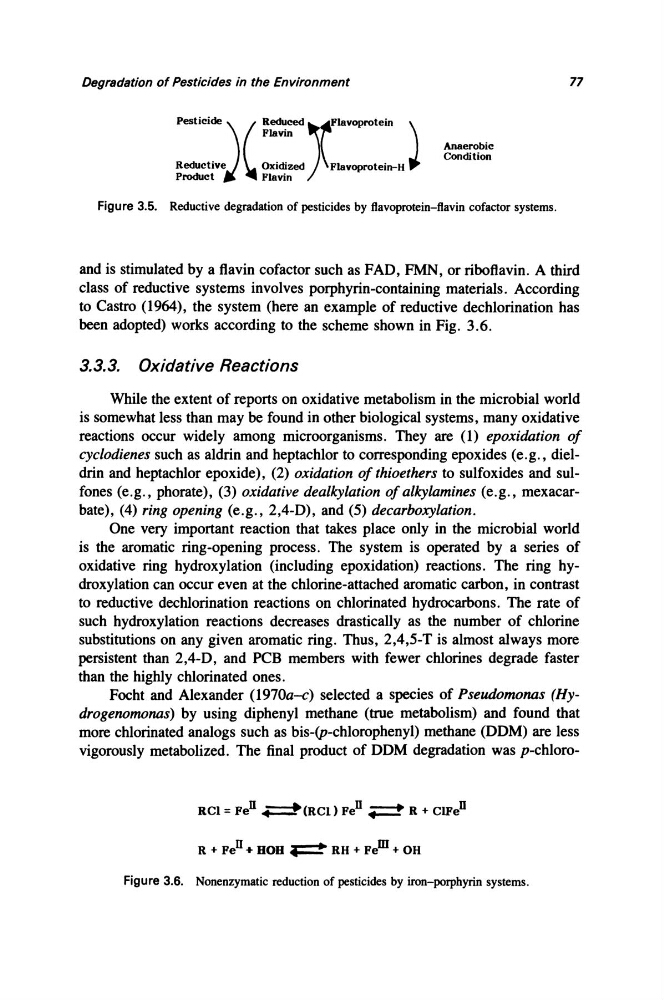
Figure 3.5. Reductive degradation of pesticides by flavoprotein-flavin cofactor systems.
77
and is stimulated by a flavin cofactor such as FAD, FMN, or riboflavin. A third
class of reductive systems involves porphyrin-containing materials. According
to Castro (1964), the system (here an example of reductive dechlorination has
been adopted) works according to the scheme shown in Fig. 3.6.
3.3.3. Oxidative Reactions
While the extent of reports on oxidative metabolism in the microbial world
is somewhat less than may be found in other biological systems, many oxidative
reactions occur widely among microorganisms. They are (1) epoxidation of
cyclodienes such as aldrin and heptachlor to corresponding epoxides (e. g., dieldrin and heptachlor epoxide), (2) oxidation of thioethers to sulfoxides and sulfones (e.g., phorate), (3) oxidative dealkylation of alkylamines (e.g., mexacarbate), (4) ring opening (e.g., 2,4-D), and (5) decarboxylation.
One very important reaction that takes place only in the microbial world
is the aromatic ring-opening process. The system is operated by a series of
oxidative ring hydroxylation (including epoxidation) reactions. The ring hydroxylation can occur even at the chlorine-attached aromatic carbon, in contrast
to reductive dechlorination reactions on chlorinated hydrocarbons. The rate of
such hydroxylation reactions decreases drastically as the number of chlorine
substitutions on any given aromatic ring. Thus, 2,4,5-T is almost always more
persistent than 2,4-D, and PCB members with fewer chlorines degrade faster
than the highly chlorinated ones.
Focht and Alexander (1970a-c) selected a species of Pseudomonas (Hydrogenomonas) by using diphenyl methane (true metabolism) and found that
more chlorinated analogs such as bis-(p-chlorophenyl) methane (DDM) are less
vigorously metabolized. The final product of DDM degradation was p-chloroR + Fell .. HOH ~ RH + Fe m + OH
Figure 3.6. Nonenzymatic reduction of pesticides by iron-porphyrin systems.
PestiCide) ( Reduced )~Flavoprotein \
Reductive
:~zed \ Flavoprotein-H ~
Product
Flavin
Anaerobic
Condition
Figure 3.5. Reductive degradation of pesticides by flavoprotein-flavin cofactor systems.
77
and is stimulated by a flavin cofactor such as FAD, FMN, or riboflavin. A third
class of reductive systems involves porphyrin-containing materials. According
to Castro (1964), the system (here an example of reductive dechlorination has
been adopted) works according to the scheme shown in Fig. 3.6.
3.3.3. Oxidative Reactions
While the extent of reports on oxidative metabolism in the microbial world
is somewhat less than may be found in other biological systems, many oxidative
reactions occur widely among microorganisms. They are (1) epoxidation of
cyclodienes such as aldrin and heptachlor to corresponding epoxides (e. g., dieldrin and heptachlor epoxide), (2) oxidation of thioethers to sulfoxides and sulfones (e.g., phorate), (3) oxidative dealkylation of alkylamines (e.g., mexacarbate), (4) ring opening (e.g., 2,4-D), and (5) decarboxylation.
One very important reaction that takes place only in the microbial world
is the aromatic ring-opening process. The system is operated by a series of
oxidative ring hydroxylation (including epoxidation) reactions. The ring hydroxylation can occur even at the chlorine-attached aromatic carbon, in contrast
to reductive dechlorination reactions on chlorinated hydrocarbons. The rate of
such hydroxylation reactions decreases drastically as the number of chlorine
substitutions on any given aromatic ring. Thus, 2,4,5-T is almost always more
persistent than 2,4-D, and PCB members with fewer chlorines degrade faster
than the highly chlorinated ones.
Focht and Alexander (1970a-c) selected a species of Pseudomonas (Hydrogenomonas) by using diphenyl methane (true metabolism) and found that
more chlorinated analogs such as bis-(p-chlorophenyl) methane (DDM) are less
vigorously metabolized. The final product of DDM degradation was p-chloroR + Fell .. HOH ~ RH + Fe m + OH
Figure 3.6. Nonenzymatic reduction of pesticides by iron-porphyrin systems.