

76
Fumio Matsumura
reactions recently found to be active are N-desmethylation and sulfones to give
sulfides. The example of the former case is mexacarbate, which has been shown
to undergo 4-N-desmethylation by preparations from Anacystis nudilans and
Pseudomonas putida under anaerobic conditions (Esaac and Matsumura, 1979).
The occurrence of the latter type of reaction has not been documented in the
microbial world, but it has been shown to occur in an animal system (DeBaun
and Menn, 1976).
Although the mechanisms of all the reductive systems active in degrading
pesticides have not been elucidated, at least three major classes of reactions
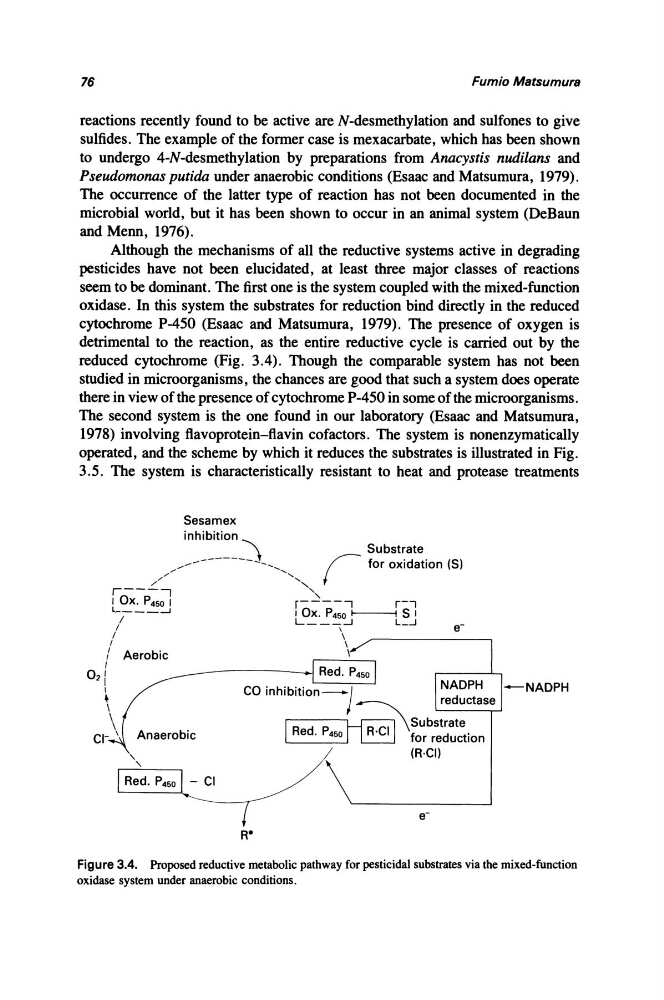
seem to be dominant. The first one is the system coupled with the mixed-function
oxidase. In this system the substrates for reduction bind directly in the reduced
cytochrome P-4S0 (Esaac and Matsumura, 1979). The presence of oxygen is
detrimental to the reaction, as the entire reductive cycle is carried out by the
reduced cytochrome (Fig. 3.4). Though the comparable system has not been
studied in microorganisms, the chances are good that such a system does operate
there in view of the presence of cytochrome P-4S0 in some of the microorganisms.
The second system is the one found in our laboratory (Esaac and Matsumura,
1978) involving flavoprotein-flavin cofactors. The system is nonenzymatically
operated, and the scheme by which it reduces the substrates is illustrated in Fig.
3.5. The system is characteristically resistant to heat and protease treatments
Sesamex
- CI
RO
Substrate
/
for oxidation (5)
-NADPH
Figure 3.4. Proposed reductive metabolic pathway for pesticidal substrates via the mixed-function
oxidase system under anaerobic conditions.
Fumio Matsumura
reactions recently found to be active are N-desmethylation and sulfones to give
sulfides. The example of the former case is mexacarbate, which has been shown
to undergo 4-N-desmethylation by preparations from Anacystis nudilans and
Pseudomonas putida under anaerobic conditions (Esaac and Matsumura, 1979).
The occurrence of the latter type of reaction has not been documented in the
microbial world, but it has been shown to occur in an animal system (DeBaun
and Menn, 1976).
Although the mechanisms of all the reductive systems active in degrading
pesticides have not been elucidated, at least three major classes of reactions
seem to be dominant. The first one is the system coupled with the mixed-function
oxidase. In this system the substrates for reduction bind directly in the reduced
cytochrome P-4S0 (Esaac and Matsumura, 1979). The presence of oxygen is
detrimental to the reaction, as the entire reductive cycle is carried out by the
reduced cytochrome (Fig. 3.4). Though the comparable system has not been
studied in microorganisms, the chances are good that such a system does operate
there in view of the presence of cytochrome P-4S0 in some of the microorganisms.
The second system is the one found in our laboratory (Esaac and Matsumura,
1978) involving flavoprotein-flavin cofactors. The system is nonenzymatically
operated, and the scheme by which it reduces the substrates is illustrated in Fig.
3.5. The system is characteristically resistant to heat and protease treatments
Sesamex
- CI
RO
Substrate
/
for oxidation (5)
-NADPH
Figure 3.4. Proposed reductive metabolic pathway for pesticidal substrates via the mixed-function
oxidase system under anaerobic conditions.