

Degradation of Pesticides in the Environment
(EtO)Z P{S)OphN0z microorganisms. (EtO)2 P{S)OphN"z
(EtO)2 P(S)OphN0 2 animals. (EtO)2 P{O)OphN0 2
animals. (EtO) P{S)OH
2
Figure 3.2. Comparison of metabolic patterns between higher animals and microorganisms.
3.3.2. Reductive Systems
75
Another class of important microbial reactions on pesticidal chemicals is
the reductive processes. The work that first showed the importance of reductive
systems in microorganisms was done by Cook (1957), who demonstrated that
the major conversion product of parathion in microorganisms is aminoparathion,
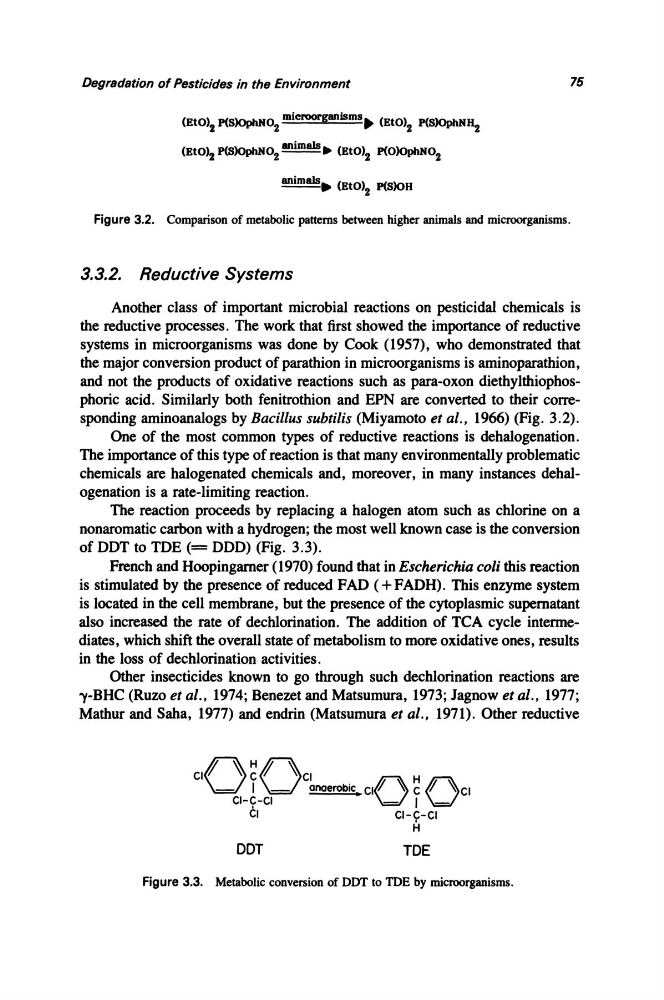
and not the products of oxidative reactions such as para-oxon diethylthiophosphoric acid. Similarly both fenitrothion and EPN are converted to their corresponding aminoanalogs by Bacillus subtilis (Miyamoto et al., 1966) (Fig. 3.2).
One of the most common types of reductive reactions is dehalogenation.
The importance of this type of reaction is that many environmentally problematic
chemicals are halogenated chemicals and, moreover, in many instances dehalogenation is a rate-limiting reaction.
The reaction proceeds by replacing a halogen atom such as chlorine on a
nonaromatic carbon with a hydrogen; the most well known case is the conversion
of DDT to TOE ( DOD) (Fig. 3.3).
French and Hoopingarner (1970) found that in Escherichia coli this reaction
is stimulated by the presence of reduced FAD (+ FADH). This enzyme system
is located in the cell membrane, but the presence of the cytoplasmic supernatant
also increased the rate of dechlorination. The addition of TCA cycle intermediates, which shift the overall state of metabolism to more oxidative ones, results
in the loss of dechlorination activities.
Other insecticides known to go through such dechlorination reactions are
'Y-BHC (Ruzo et al., 1974; Benezet and Matsumura, 1973; Jagnow et al., 1977;
Mathur and Saba, 1977) and endrin (Matsumura et al., 1971). Other reductive
CIO~~O~CI
H
-
I -
anaerobic, CIO' C 0' CI
CI-C;:-CI
-
I -
q
q-C-q
Ii
DDT
TDE
Figure 3.3. Metabolic conversion of DDT to TOE by microorganisms.
(EtO)Z P{S)OphN0z microorganisms. (EtO)2 P{S)OphN"z
(EtO)2 P(S)OphN0 2 animals. (EtO)2 P{O)OphN0 2
animals. (EtO) P{S)OH
2
Figure 3.2. Comparison of metabolic patterns between higher animals and microorganisms.
3.3.2. Reductive Systems
75
Another class of important microbial reactions on pesticidal chemicals is
the reductive processes. The work that first showed the importance of reductive
systems in microorganisms was done by Cook (1957), who demonstrated that
the major conversion product of parathion in microorganisms is aminoparathion,
and not the products of oxidative reactions such as para-oxon diethylthiophosphoric acid. Similarly both fenitrothion and EPN are converted to their corresponding aminoanalogs by Bacillus subtilis (Miyamoto et al., 1966) (Fig. 3.2).
One of the most common types of reductive reactions is dehalogenation.
The importance of this type of reaction is that many environmentally problematic
chemicals are halogenated chemicals and, moreover, in many instances dehalogenation is a rate-limiting reaction.
The reaction proceeds by replacing a halogen atom such as chlorine on a
nonaromatic carbon with a hydrogen; the most well known case is the conversion
of DDT to TOE ( DOD) (Fig. 3.3).
French and Hoopingarner (1970) found that in Escherichia coli this reaction
is stimulated by the presence of reduced FAD (+ FADH). This enzyme system
is located in the cell membrane, but the presence of the cytoplasmic supernatant
also increased the rate of dechlorination. The addition of TCA cycle intermediates, which shift the overall state of metabolism to more oxidative ones, results
in the loss of dechlorination activities.
Other insecticides known to go through such dechlorination reactions are
'Y-BHC (Ruzo et al., 1974; Benezet and Matsumura, 1973; Jagnow et al., 1977;
Mathur and Saba, 1977) and endrin (Matsumura et al., 1971). Other reductive
CIO~~O~CI
H
-
I -
anaerobic, CIO' C 0' CI
CI-C;:-CI
-
I -
q
q-C-q
Ii
DDT
TDE
Figure 3.3. Metabolic conversion of DDT to TOE by microorganisms.