

74
Fumio Matsumura
(I-naphthyl methylcarbamate) is I-naphthol (Matsumura, 1974) in contrast to
the mammalian metabolism of this insecticide.
In the case of organophosphates, which are largely degraded via hydrolytic
processes, this general trend is clearly observable. The major microbial degradation product of diazinon [O,O-diethyl O-(2-isopropyl-6-methyl-4-pyrimidinyl)phosphorothioate] is 2-isopropyl-6-methyl-4-hydroxypyrimidine, a product
of hydrolysis at the P-O bond, and not the hydroxylation products or the glutathione S-aryltransferase products that are prevalent in animal species. Indeed,
there have been almost no records of microbial activities to form P=O analogues
from P=S compounds, reactions extremely common throughout the animal and
plant kingdoms. Thus, in animals diazinon is expected to become diazoxon,
which is actually the toxic principle of the insecticide, owing to its high cholinesterase inhibitory property. The lack of reports of this effect in the microbial
world is indeed striking in view of the existence of a wide variety of biological
systems that carry out such a reaction.
Perhaps the reason for such hydrolytic reactions being common in the
microbial world is that many of the organisms excrete hydrolytic enzymes outside
the cells (exoenzymes), particularly the fungi. Nearly all the exoenzymes liberated
by microorganisms seem to be related to the metabolism of large molecules, so
that such compounds may be reduced to smaller fragments to permit their passage
through the cell membrane. Various soils also contain exoenzymes that are
hydrolytic in nature. Thus by definition most of the hydrolytic reactions belong
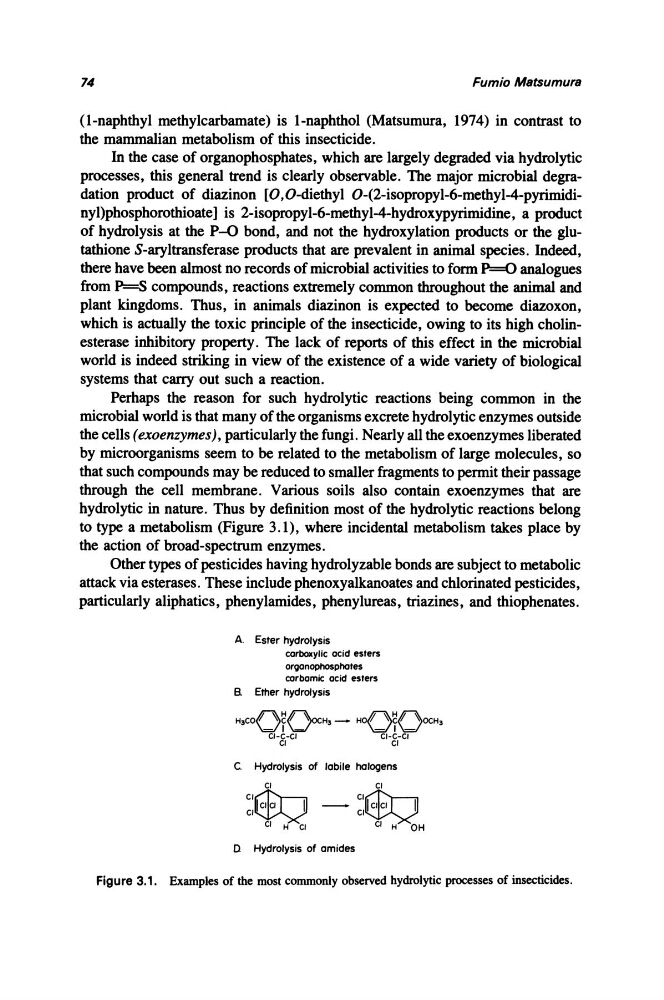
to type a metabolism (Figure 3.1), where incidental metabolism takes place by
the action of broad-spectrum enzymes.
Other types of pesticides having hydrolyzable bonds are subject to metabolic
attack via esterases. These include phenoxyalkanoates and chlorinated pesticides,
particularly aliphatics, phenylamides, phenylureas, triazines, and thiophenates.
A. Ester hydrolysis
corboxylic acid esters
organophosphates
corbamic acid esters
a Ether hydrolysis
H'COO~ ~~H3 - H~O~OCH3
- I \-I""
-"=/i -
CI-C-CI
CI-C-CI
CI
CI
C Hydrolysis of labile halogens
CI($,:QCI
CI~CI
CICI
I -
ICICI
I
CI
CI
CI
H CI
CI H
OH
D Hydrolysis of omides
Figure 3.1. Examples of the most commonly observed hydrolytic processes of insecticides.
Fumio Matsumura
(I-naphthyl methylcarbamate) is I-naphthol (Matsumura, 1974) in contrast to
the mammalian metabolism of this insecticide.
In the case of organophosphates, which are largely degraded via hydrolytic
processes, this general trend is clearly observable. The major microbial degradation product of diazinon [O,O-diethyl O-(2-isopropyl-6-methyl-4-pyrimidinyl)phosphorothioate] is 2-isopropyl-6-methyl-4-hydroxypyrimidine, a product
of hydrolysis at the P-O bond, and not the hydroxylation products or the glutathione S-aryltransferase products that are prevalent in animal species. Indeed,
there have been almost no records of microbial activities to form P=O analogues
from P=S compounds, reactions extremely common throughout the animal and
plant kingdoms. Thus, in animals diazinon is expected to become diazoxon,
which is actually the toxic principle of the insecticide, owing to its high cholinesterase inhibitory property. The lack of reports of this effect in the microbial
world is indeed striking in view of the existence of a wide variety of biological
systems that carry out such a reaction.
Perhaps the reason for such hydrolytic reactions being common in the
microbial world is that many of the organisms excrete hydrolytic enzymes outside
the cells (exoenzymes), particularly the fungi. Nearly all the exoenzymes liberated
by microorganisms seem to be related to the metabolism of large molecules, so
that such compounds may be reduced to smaller fragments to permit their passage
through the cell membrane. Various soils also contain exoenzymes that are
hydrolytic in nature. Thus by definition most of the hydrolytic reactions belong
to type a metabolism (Figure 3.1), where incidental metabolism takes place by
the action of broad-spectrum enzymes.
Other types of pesticides having hydrolyzable bonds are subject to metabolic
attack via esterases. These include phenoxyalkanoates and chlorinated pesticides,
particularly aliphatics, phenylamides, phenylureas, triazines, and thiophenates.
A. Ester hydrolysis
corboxylic acid esters
organophosphates
corbamic acid esters
a Ether hydrolysis
H'COO~ ~~H3 - H~O~OCH3
- I \-I""
-"=/i -
CI-C-CI
CI-C-CI
CI
CI
C Hydrolysis of labile halogens
CI($,:QCI
CI~CI
CICI
I -
ICICI
I
CI
CI
CI
H CI
CI H
OH
D Hydrolysis of omides
Figure 3.1. Examples of the most commonly observed hydrolytic processes of insecticides.