

Degradation of Pesticides by Animals
o
II
---+. -gFigure 1.10. Thioether oxidation of demeton.
Il
o
11
Sulfoxidation is a major metabolic route for carbamates such as aldicarb
(Kuhr and Dorough, 1976) and Croneton® (Nye et al., 1976). In rats, the
principal urinary metabolites of Croneton® (2-ethylthiomethylphenyl-N-methylcarbamate) were Croneton® sulfoxide, Croneton® sulfone, phenol sulfoxide,
and phenol sulfone after both a single oral dose and in long-term feeding studies.
Probably the most common type of reduction reaction of pesticides in animals is the reduction of a nitro group to an amino group. Diphenyl ethers such
as the herbicide nitrofen serve as excellent examples of pesticides having nitro
substituents which can be reduced (Hunt et al., 1977).
1.2.7. Isomerization
Reports of isomerization reactions in pesticide metabolism in animals are
rare. However, it has been shown that in vivo isomerization and Beckmann
rearrangement reactions are important in the metabolism of the insecticide methomyl in rats (Huhtanen and Dorough, 1976). The mechanism may also apply
to other thiohydroximate esters. Methomyl may exist in two geometric configurations, syn and anti, but the more stable syn isomer is the form applied as an
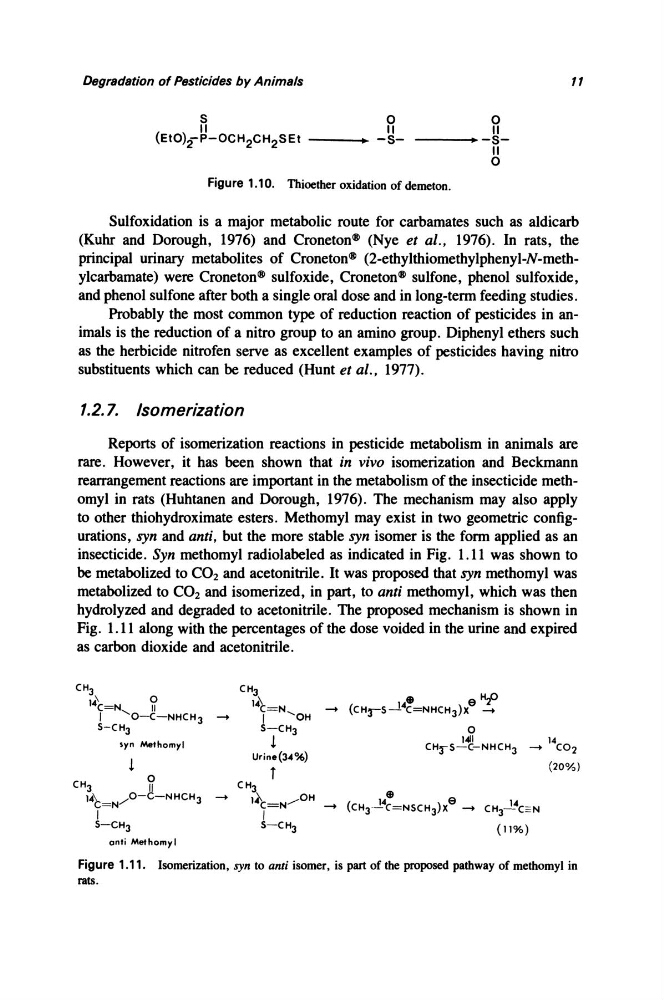
insecticide. Syn methomyl radiolabeled as indicated in Fig. 1.11 was shown to
be metabolized to CO2 and acetonitrile. It was proposed that syn methomyl was
metabolized to CO2 and isomerized, in part, to anti methomyl, which was then
hydrolyzed and degraded to acetonitrile. The proposed mechanism is shown in
Fig. 1.11 along with the percentages of the dose voided in the urine and expired
as carbon dioxide and acetonitrile.
CH 3
14~=N
~
I '0-C-NHCH3
S-CH3
,yo Melhomyl
!
CH 3
~
14t=N/0-C-NHCH3
I
S-CH3
aoli Methomyl
-+
-+
CH3
14~=N
I
'OH
s-CH3
!
Urioe(34%)
i
CH 3
I~C=N ....... OH
I
S-CH3
$
eHf>
-+ (CHrs-14c=NHCH3)X -+
0
1411
CH J S-C-NHCH 3 --+ 14C02
(20%)
-+
14$
e
(CH 3 -C=NSCH 3 )X -+ CH3-l4C=N
( 11%)
Figure 1.11. Isomerization, syn to anti isomer, is part of the proposed pathway of methomyl in
rats.
o
II
---+. -gFigure 1.10. Thioether oxidation of demeton.
Il
o
11
Sulfoxidation is a major metabolic route for carbamates such as aldicarb
(Kuhr and Dorough, 1976) and Croneton® (Nye et al., 1976). In rats, the
principal urinary metabolites of Croneton® (2-ethylthiomethylphenyl-N-methylcarbamate) were Croneton® sulfoxide, Croneton® sulfone, phenol sulfoxide,
and phenol sulfone after both a single oral dose and in long-term feeding studies.
Probably the most common type of reduction reaction of pesticides in animals is the reduction of a nitro group to an amino group. Diphenyl ethers such
as the herbicide nitrofen serve as excellent examples of pesticides having nitro
substituents which can be reduced (Hunt et al., 1977).
1.2.7. Isomerization
Reports of isomerization reactions in pesticide metabolism in animals are
rare. However, it has been shown that in vivo isomerization and Beckmann
rearrangement reactions are important in the metabolism of the insecticide methomyl in rats (Huhtanen and Dorough, 1976). The mechanism may also apply
to other thiohydroximate esters. Methomyl may exist in two geometric configurations, syn and anti, but the more stable syn isomer is the form applied as an
insecticide. Syn methomyl radiolabeled as indicated in Fig. 1.11 was shown to
be metabolized to CO2 and acetonitrile. It was proposed that syn methomyl was
metabolized to CO2 and isomerized, in part, to anti methomyl, which was then
hydrolyzed and degraded to acetonitrile. The proposed mechanism is shown in
Fig. 1.11 along with the percentages of the dose voided in the urine and expired
as carbon dioxide and acetonitrile.
CH 3
14~=N
~
I '0-C-NHCH3
S-CH3
,yo Melhomyl
!
CH 3
~
14t=N/0-C-NHCH3
I
S-CH3
aoli Methomyl
-+
-+
CH3
14~=N
I
'OH
s-CH3
!
Urioe(34%)
i
CH 3
I~C=N ....... OH
I
S-CH3
$
eHf>
-+ (CHrs-14c=NHCH3)X -+
0
1411
CH J S-C-NHCH 3 --+ 14C02
(20%)
-+
14$
e
(CH 3 -C=NSCH 3 )X -+ CH3-l4C=N
( 11%)
Figure 1.11. Isomerization, syn to anti isomer, is part of the proposed pathway of methomyl in
rats.