

12
H. Wyman Dorough and Sue K. Ballard
1.2.8. Nitrosation
There are many examples where nitrogen-containing pesticides react with
nitrite to fonn N-nitroso compounds (Elespuru and Lijinsky, 1973). Many of
these are potent mutagens. The reaction is a nonenzymatic synthesis which is
highly pH-dependent, and relatively strong acid conditions are generally required
to convert the nitrite into nitrous acid. Nitrous acid is further converted to active
nitrosating agents such as nitrous anhydride or nitrous acidium ion (Mirvish,
1975). Pesticides nitrosated under these conditions include those compounds that
contain an amine or amide moiety. Atrazine, a triazine herbicide, was converted
to a nitrosamine derivative when reacted with nitrite under acid conditions (Wolfe
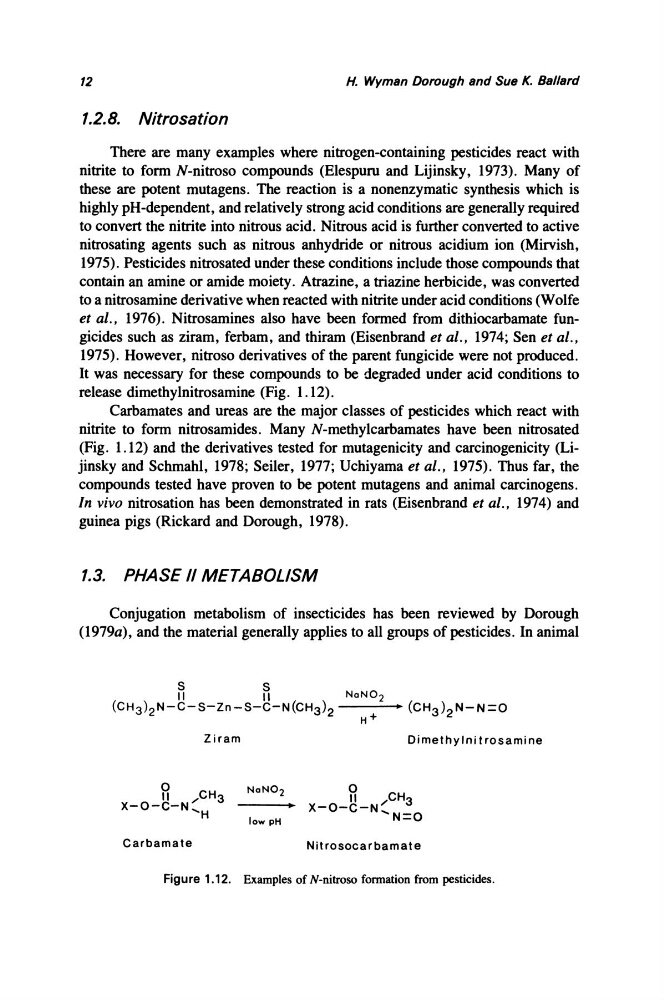
et ai., 1976). Nitrosamines also have been fonned from dithiocarbamate fungicides such as ziram, ferbam, and thiram (Eisenbrand et ai., 1974; Sen et ai.,
1975). However, nitroso derivatives of the parent fungicide were not produced.
It was necessary for these compounds to be degraded under acid conditions to
release dimethylnitrosamine (Fig. 1.12).
Carbamates and ureas are the major classes of pesticides which react with
nitrite to fonn nitrosamides. Many N-methylcarbamates have been nitrosated
(Fig. 1.12) and the derivatives tested for mutagenicity and carcinogenicity (Lijinsky and Schmahl, 1978; Seiler, 1977; Uchiyama et ai., 1975). Thus far, the
compounds tested have proven to be potent mutagens and animal carcinogens.
In vivo nitrosation has been demonstrated in rats (Eisenbrand et ai., 1974) and
guinea pigs (Rickard and Dorough, 1978).
1.3. PHASE /I METABOLISM
Conjugation metabolism of insecticides has been reviewed by Dorough
(1979a), and the material generally applies to all groups of pesticides. In animal
Ziram
Dimethylni t rosami ne
o
II
.... CH 3
X-O-C-N ...... H
low pH
o
1\
/CH 3
X-O-C-N ...... N=O
Carbamate
Nitrosocarbamate
Figure 1.12. Examples of N-nitroso formation from pesticides.
H. Wyman Dorough and Sue K. Ballard
1.2.8. Nitrosation
There are many examples where nitrogen-containing pesticides react with
nitrite to fonn N-nitroso compounds (Elespuru and Lijinsky, 1973). Many of
these are potent mutagens. The reaction is a nonenzymatic synthesis which is
highly pH-dependent, and relatively strong acid conditions are generally required
to convert the nitrite into nitrous acid. Nitrous acid is further converted to active
nitrosating agents such as nitrous anhydride or nitrous acidium ion (Mirvish,
1975). Pesticides nitrosated under these conditions include those compounds that
contain an amine or amide moiety. Atrazine, a triazine herbicide, was converted
to a nitrosamine derivative when reacted with nitrite under acid conditions (Wolfe
et ai., 1976). Nitrosamines also have been fonned from dithiocarbamate fungicides such as ziram, ferbam, and thiram (Eisenbrand et ai., 1974; Sen et ai.,
1975). However, nitroso derivatives of the parent fungicide were not produced.
It was necessary for these compounds to be degraded under acid conditions to
release dimethylnitrosamine (Fig. 1.12).
Carbamates and ureas are the major classes of pesticides which react with
nitrite to fonn nitrosamides. Many N-methylcarbamates have been nitrosated
(Fig. 1.12) and the derivatives tested for mutagenicity and carcinogenicity (Lijinsky and Schmahl, 1978; Seiler, 1977; Uchiyama et ai., 1975). Thus far, the
compounds tested have proven to be potent mutagens and animal carcinogens.
In vivo nitrosation has been demonstrated in rats (Eisenbrand et ai., 1974) and
guinea pigs (Rickard and Dorough, 1978).
1.3. PHASE /I METABOLISM
Conjugation metabolism of insecticides has been reviewed by Dorough
(1979a), and the material generally applies to all groups of pesticides. In animal
Ziram
Dimethylni t rosami ne
o
II
.... CH 3
X-O-C-N ...... H
low pH
o
1\
/CH 3
X-O-C-N ...... N=O
Carbamate
Nitrosocarbamate
Figure 1.12. Examples of N-nitroso formation from pesticides.