

8
1.
2.
H. Wyman Dorough and SUB K. Ballard
S (0)
II
-----+. (RO)2P-OH + HX
S(O)
II
- - - - - . (RO)(HO)P-X + ROH
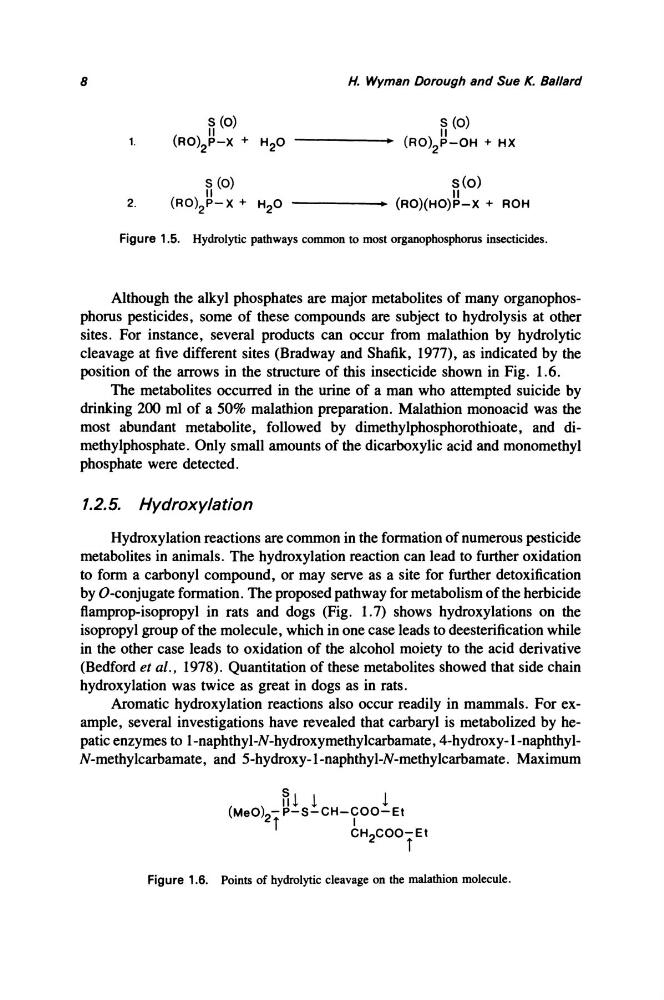
Figure 1.5. Hydrolytic pathways common to most organophosphorus insecticides.
Although the alkyl phosphates are major metabolites of many organophosphorus pesticides, some of these compounds are subject to hydrolysis at other
sites. For instance, several products can occur from malathion by hydrolytic
cleavage at five different sites (Bradway and Shafik, 1977), as indicated by the
position of the arrows in the structure of this insecticide shown in Fig. 1.6.
The metabolites occurred in the urine of a man who attempted suicide by
drinking 200 rn1 of a 50% malathion preparation. Malathion monoacid was the
most abundant metabolite, followed by dimethylphosphorothioate, and dimethylphosphate. Only small amounts of the dicarboxylic acid and monomethyl
phosphate were detected.
1.2.5. Hydroxylation
Hydroxylation reactions are common in the formation of numerous pesticide
metabolites in animals. The hydroxylation reaction can lead to further oxidation
to form a carbonyl compound, or may serve as a site for further detoxification
by O-conjugate formation. The proposed pathway for metabolism of the herbicide
ftamprop-isopropyl in rats and dogs (Fig. 1.7) shows hydroxylations on the
isopropyl group of the molecule, which in one case leads to deesterification while
in the other case leads to oxidation of the alcohol moiety to the acid derivative
(Bedford et al., 1978). Quantitation of these metabolites showed that side chain
hydroxylation was twice as great in dogs as in rats.
Aromatic hydroxylation reactions also occur readily in mammals. For example, several investigations have revealed that carbaryl is metabolized by hepatic enzymes to I-naphthyl-N-hydroxymethylcarbamate, 4-hydroxy-l-naphthylN-methylcarbamate, and 5-hydroxy-l-naphthyl-N-methylcarbamate. Maximum
~l 1
1
(MeO) -P-S-CH-COO-Et
2r
I
CH 2 COO-Et
r
Figure 1.6. Points of hydrolytic cleavage on the malathion molecule.
1.
2.
H. Wyman Dorough and SUB K. Ballard
S (0)
II
-----+. (RO)2P-OH + HX
S(O)
II
- - - - - . (RO)(HO)P-X + ROH
Figure 1.5. Hydrolytic pathways common to most organophosphorus insecticides.
Although the alkyl phosphates are major metabolites of many organophosphorus pesticides, some of these compounds are subject to hydrolysis at other
sites. For instance, several products can occur from malathion by hydrolytic
cleavage at five different sites (Bradway and Shafik, 1977), as indicated by the
position of the arrows in the structure of this insecticide shown in Fig. 1.6.
The metabolites occurred in the urine of a man who attempted suicide by
drinking 200 rn1 of a 50% malathion preparation. Malathion monoacid was the
most abundant metabolite, followed by dimethylphosphorothioate, and dimethylphosphate. Only small amounts of the dicarboxylic acid and monomethyl
phosphate were detected.
1.2.5. Hydroxylation
Hydroxylation reactions are common in the formation of numerous pesticide
metabolites in animals. The hydroxylation reaction can lead to further oxidation
to form a carbonyl compound, or may serve as a site for further detoxification
by O-conjugate formation. The proposed pathway for metabolism of the herbicide
ftamprop-isopropyl in rats and dogs (Fig. 1.7) shows hydroxylations on the
isopropyl group of the molecule, which in one case leads to deesterification while
in the other case leads to oxidation of the alcohol moiety to the acid derivative
(Bedford et al., 1978). Quantitation of these metabolites showed that side chain
hydroxylation was twice as great in dogs as in rats.
Aromatic hydroxylation reactions also occur readily in mammals. For example, several investigations have revealed that carbaryl is metabolized by hepatic enzymes to I-naphthyl-N-hydroxymethylcarbamate, 4-hydroxy-l-naphthylN-methylcarbamate, and 5-hydroxy-l-naphthyl-N-methylcarbamate. Maximum
~l 1
1
(MeO) -P-S-CH-COO-Et
2r
I
CH 2 COO-Et
r
Figure 1.6. Points of hydrolytic cleavage on the malathion molecule.