

Degradation of Pesticides by Animals
7
CI
CI~
C1WV
CI
_ _ _ _ CI~o _ _ _
CI~
CI
CI®::JHOH CCII
CI
I
HOH
CI
CI
CI
CI
CI
CI
heptachlor
epoxide
trans-dihydrodiol
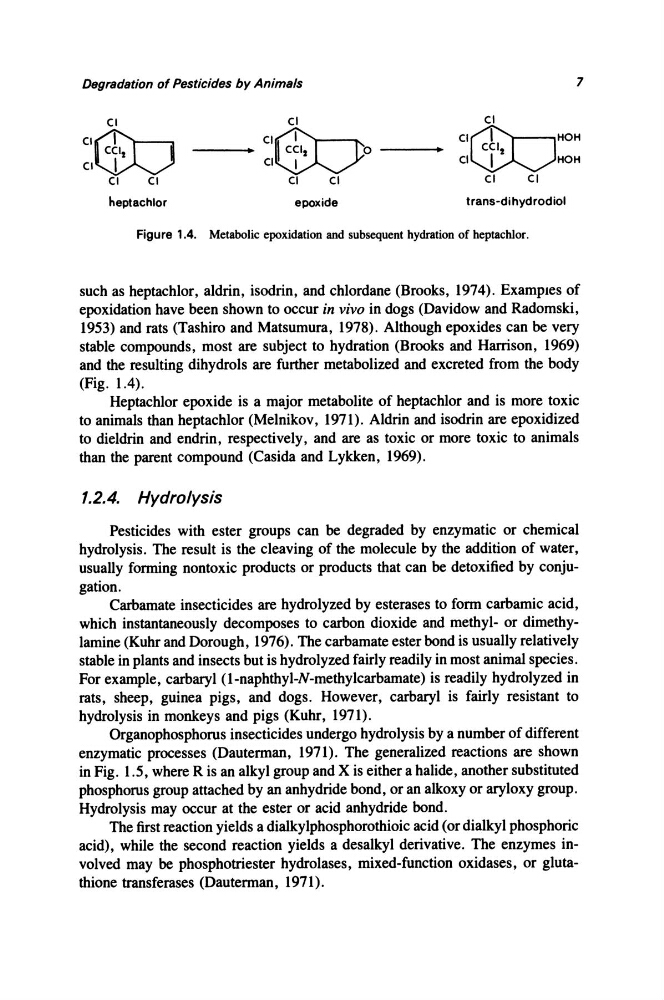
Figure 1.4. Metabolic epoxidation and subsequent hydration of heptachlor.
such as heptachlor, aldrin, isodrin, and chlordane (Brooks, 1974). Examples of
epoxidation have been shown to occur in vivo in dogs (Davidow and Radomski,
1953) and rats (Tashiro and Matsumura, 1978). Although epoxides can be very
stable compounds, most are subject to hydration (Brooks and Harrison, 1969)
and the resulting dihydrols are further metabolized and excreted from the body
(Fig. 1.4).
Heptachlor epoxide is a major metabolite of heptachlor and is more toxic
to animals than heptachlor (Melnikov, 1971). Aldrin and isodrin are epoxidized
to dieldrin and endrin, respectively, and are as toxic or more toxic to animals
than the parent compound (Casida and Lykken, 1969).
1.2.4. Hydrolysis
Pesticides with ester groups can be degraded by enzymatic or chemical
hydrolysis. The result is the cleaving of the molecule by the addition of water,
usually forming nontoxic products or products that can be detoxified by conjugation.
Carbamate insecticides are hydrolyzed by esterases to form carbamic acid,
which instantaneously decomposes to carbon dioxide and methyl- or dimethylamine (Kuhr and Dorough, 1976). The carbamate ester bond is usually relatively
stable in plants and insects but is hydrolyzed fairly readily in most animal species.
For example, carbaryl (l-naphthyl-N-methylcarbamate) is readily hydrolyzed in
rats, sheep, guinea pigs, and dogs. However, carbaryl is fairly resistant to
hydrolysis in monkeys and pigs (Kuhr, 1971).
Organophosphorus insecticides undergo hydrolysis by a number of different
enzymatic processes (Dauterman, 1971). The generalized reactions are shown
in Fig. 1.5, where R is an alkyl group and X is either a halide, another substituted
phosphorus group attached by an anhydride bond, or an alkoxy or aryloxy group.
Hydrolysis may occur at the ester or acid anhydride bond.
The first reaction yields a dialkylphosphorothioic acid (or dialkyl phosphoric
acid), while the second reaction yields a desalkyl derivative. The enzymes involved may be phosphotriester hydrolases, mixed-function oxidases, or glutathione transferases (Dauterman, 1971).
7
CI
CI~
C1WV
CI
_ _ _ _ CI~o _ _ _
CI~
CI
CI®::JHOH CCII
CI
I
HOH
CI
CI
CI
CI
CI
CI
heptachlor
epoxide
trans-dihydrodiol
Figure 1.4. Metabolic epoxidation and subsequent hydration of heptachlor.
such as heptachlor, aldrin, isodrin, and chlordane (Brooks, 1974). Examples of
epoxidation have been shown to occur in vivo in dogs (Davidow and Radomski,
1953) and rats (Tashiro and Matsumura, 1978). Although epoxides can be very
stable compounds, most are subject to hydration (Brooks and Harrison, 1969)
and the resulting dihydrols are further metabolized and excreted from the body
(Fig. 1.4).
Heptachlor epoxide is a major metabolite of heptachlor and is more toxic
to animals than heptachlor (Melnikov, 1971). Aldrin and isodrin are epoxidized
to dieldrin and endrin, respectively, and are as toxic or more toxic to animals
than the parent compound (Casida and Lykken, 1969).
1.2.4. Hydrolysis
Pesticides with ester groups can be degraded by enzymatic or chemical
hydrolysis. The result is the cleaving of the molecule by the addition of water,
usually forming nontoxic products or products that can be detoxified by conjugation.
Carbamate insecticides are hydrolyzed by esterases to form carbamic acid,
which instantaneously decomposes to carbon dioxide and methyl- or dimethylamine (Kuhr and Dorough, 1976). The carbamate ester bond is usually relatively
stable in plants and insects but is hydrolyzed fairly readily in most animal species.
For example, carbaryl (l-naphthyl-N-methylcarbamate) is readily hydrolyzed in
rats, sheep, guinea pigs, and dogs. However, carbaryl is fairly resistant to
hydrolysis in monkeys and pigs (Kuhr, 1971).
Organophosphorus insecticides undergo hydrolysis by a number of different
enzymatic processes (Dauterman, 1971). The generalized reactions are shown
in Fig. 1.5, where R is an alkyl group and X is either a halide, another substituted
phosphorus group attached by an anhydride bond, or an alkoxy or aryloxy group.
Hydrolysis may occur at the ester or acid anhydride bond.
The first reaction yields a dialkylphosphorothioic acid (or dialkyl phosphoric
acid), while the second reaction yields a desalkyl derivative. The enzymes involved may be phosphotriester hydrolases, mixed-function oxidases, or glutathione transferases (Dauterman, 1971).