

122
Floyd M. Ashton
small amount may be lost by spray drift; it may be subject to photodecomposition
in the air as well as on exposed surfaces, including plants and soil surfaces.
Some may be lost by leaching or runoff of surface water. Herbicides with a high
vapor pressure are lost by volatilization unless incorporated into the soil. Under
good agricultural practices, the above losses are minimal. Except for postemergence applications where the applied herbicide is primarily received by
plant foliage, the soil is the major recipient, reservoir, and site of degradation.
Even with postemergence applications, the soil is a major site of degradation
after the plant dies and disintegrates. Therefore, persistence in the soil has been
the major environmental site investigated. The persistence in the soil of the
most commonly used herbicides is presented in Table 5.2 (Klingman and Ashton,
1975).
Table 5.2 shows the persistence from a single application of a herbicide.
A given herbicide is rarely applied more frequently than once a year to the same
site. However, it may be applied to the same site annually over an extended
period of time. The question then arises as to whether it will accumulate with
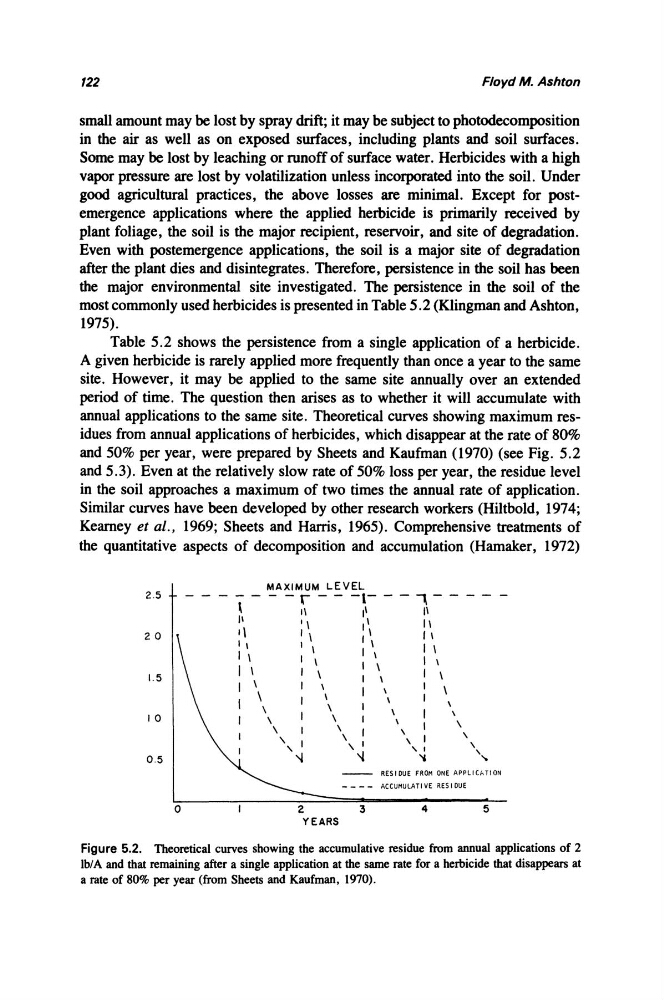
annual applications to the same site. Theoretical curves showing maximum residues from annual applications of herbicides, which disappear at the rate of 80%
and 50% per year, were prepared by Sheets and Kaufman (1970) (see Fig. 5.2
and 5.3). Even at the relatively slow rate of 50% loss per year, the residue level
in the soil approaches a maximum of two times the annual rate of application.
Similar curves have been developed by other research workers (Hiltbold, 1974;
Kearney et al., 1969; Sheets and Harris, 1965). Comprehensive treatments of
the quantitative aspects of decomposition and accumulation (Hamaker, 1972)
25
20
1.5
10
0.5
o
MAXIMUM LEVEL
- - - - - r- - - -1- - - "1 - - - - -
\
1\
1\
1\
II
I \
I \
I \
1\
1\
, \
1\
: \
\
I \
: \
I \
\ ' \
I \
\
\ ' \
\
\
\
I
\
\
\
\
\
,
\
"
I
"
I
" "
\
\
\
\ , I
"
\
,
RESIDUE FROM ONE APPlIChTtON
ACCUHUlATI VE .qES I oue
3
4
5
Figure 5.2. Theoretical curves showing the accumulative residue from annual applications of 2
Ibl A and that remaining after a single application at the same rate for a herbicide that disappears at
a rate of 80% per year (from Sheets and Kaufman, 1970).
Floyd M. Ashton
small amount may be lost by spray drift; it may be subject to photodecomposition
in the air as well as on exposed surfaces, including plants and soil surfaces.
Some may be lost by leaching or runoff of surface water. Herbicides with a high
vapor pressure are lost by volatilization unless incorporated into the soil. Under
good agricultural practices, the above losses are minimal. Except for postemergence applications where the applied herbicide is primarily received by
plant foliage, the soil is the major recipient, reservoir, and site of degradation.
Even with postemergence applications, the soil is a major site of degradation
after the plant dies and disintegrates. Therefore, persistence in the soil has been
the major environmental site investigated. The persistence in the soil of the
most commonly used herbicides is presented in Table 5.2 (Klingman and Ashton,
1975).
Table 5.2 shows the persistence from a single application of a herbicide.
A given herbicide is rarely applied more frequently than once a year to the same
site. However, it may be applied to the same site annually over an extended
period of time. The question then arises as to whether it will accumulate with
annual applications to the same site. Theoretical curves showing maximum residues from annual applications of herbicides, which disappear at the rate of 80%
and 50% per year, were prepared by Sheets and Kaufman (1970) (see Fig. 5.2
and 5.3). Even at the relatively slow rate of 50% loss per year, the residue level
in the soil approaches a maximum of two times the annual rate of application.
Similar curves have been developed by other research workers (Hiltbold, 1974;
Kearney et al., 1969; Sheets and Harris, 1965). Comprehensive treatments of
the quantitative aspects of decomposition and accumulation (Hamaker, 1972)
25
20
1.5
10
0.5
o
MAXIMUM LEVEL
- - - - - r- - - -1- - - "1 - - - - -
\
1\
1\
1\
II
I \
I \
I \
1\
1\
, \
1\
: \
\
I \
: \
I \
\ ' \
I \
\
\ ' \
\
\
\
I
\
\
\
\
\
,
\
"
I
"
I
" "
\
\
\
\ , I
"
\
,
RESIDUE FROM ONE APPlIChTtON
ACCUHUlATI VE .qES I oue
3
4
5
Figure 5.2. Theoretical curves showing the accumulative residue from annual applications of 2
Ibl A and that remaining after a single application at the same rate for a herbicide that disappears at
a rate of 80% per year (from Sheets and Kaufman, 1970).