

Persistence and Biodegradation of Herbicides
4.0
35
-l
o 3.0
(f)
z
;;:; 2.5
a::
u
\
w
D(f)
1.5
a
z
::J
0
1.0
D0.5
0
MAXIMUM LEVEL
1
1\
1\
1
I \
1\
I \
I \
I \
I \
I \
\
1\
1\
I \
I \
I \
I \
\
I
\
\
I
\
I
\
I
'- I
\ I
"
"
\
\
\
\
\
'\
1\
I \
I \
I \
I
I
\ I
~
\
\
\
\
\
\ "
- - RESIDUE FROM ONE APPLICATION
- - - ACCUMULATIVE RESIDUE
2
3
4
5
YEARS
123
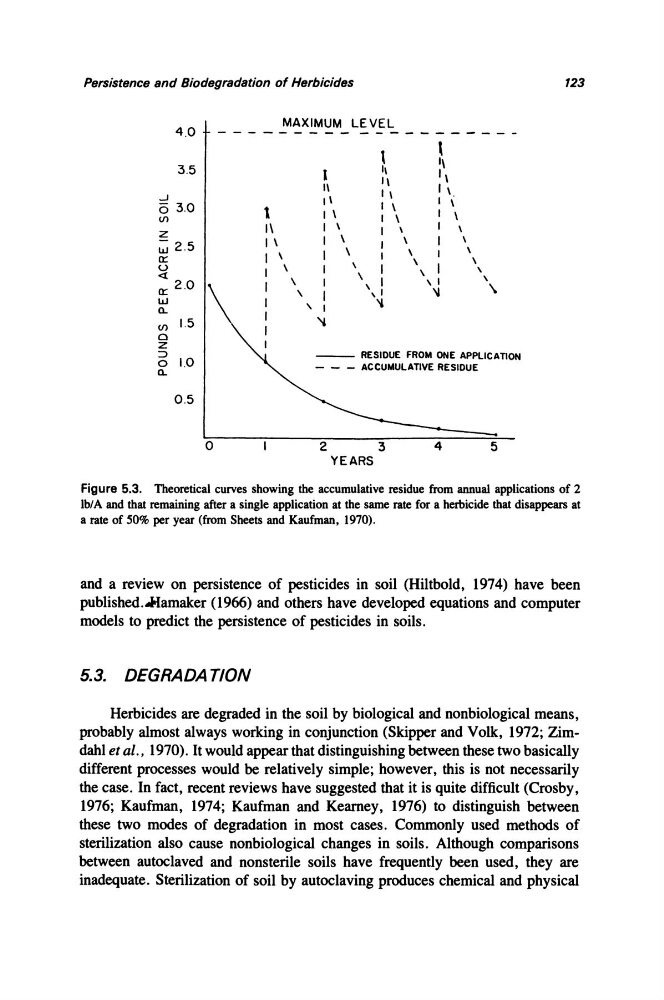
Figure 5.3. Theoretical curves showing the accumulative residue from annual applications of 2
Ibl A and that remaining after a single application at the same rate for a herbicide that disappears at
a rate of 50% per year (from Sheets and Kaufman, 1970).
and a review on persistence of pesticides in soil (Hiltbold, 1974) have been
published . ..Hamaker (1966) and others have developed equations and computer
models to predict the persistence of pesticides in soils.
5.3. DEGRADA TlON
Herbicides are degraded in the soil by biological and nonbiological means,
probably almost always working in conjunction (Skipper and Volk, 1972; Zimdahl et al., 1970). It would appear that distinguishing between these two basically
different processes would be relatively simple; however, this is not necessarily
the case. In fact, recent reviews have suggested that it is quite difficult (Crosby,
1976; Kaufman, 1974; Kaufman and Kearney, 1976) to distinguish between
these two modes of degradation in most cases. Commonly used methods of
sterilization also cause nonbiological changes in soils. Although comparisons
between autoclaved and nonsterile soils have frequently been used, they are
inadequate. Sterilization of soil by autoclaving produces chemical and physical
4.0
35
-l
o 3.0
(f)
z
;;:; 2.5
a::
u
\
w
D(f)
1.5
a
z
::J
0
1.0
D0.5
0
MAXIMUM LEVEL
1
1\
1\
1
I \
1\
I \
I \
I \
I \
I \
\
1\
1\
I \
I \
I \
I \
\
I
\
\
I
\
I
\
I
'- I
\ I
"
"
\
\
\
\
\
'\
1\
I \
I \
I \
I
I
\ I
~
\
\
\
\
\
\ "
- - RESIDUE FROM ONE APPLICATION
- - - ACCUMULATIVE RESIDUE
2
3
4
5
YEARS
123
Figure 5.3. Theoretical curves showing the accumulative residue from annual applications of 2
Ibl A and that remaining after a single application at the same rate for a herbicide that disappears at
a rate of 50% per year (from Sheets and Kaufman, 1970).
and a review on persistence of pesticides in soil (Hiltbold, 1974) have been
published . ..Hamaker (1966) and others have developed equations and computer
models to predict the persistence of pesticides in soils.
5.3. DEGRADA TlON
Herbicides are degraded in the soil by biological and nonbiological means,
probably almost always working in conjunction (Skipper and Volk, 1972; Zimdahl et al., 1970). It would appear that distinguishing between these two basically
different processes would be relatively simple; however, this is not necessarily
the case. In fact, recent reviews have suggested that it is quite difficult (Crosby,
1976; Kaufman, 1974; Kaufman and Kearney, 1976) to distinguish between
these two modes of degradation in most cases. Commonly used methods of
sterilization also cause nonbiological changes in soils. Although comparisons
between autoclaved and nonsterile soils have frequently been used, they are
inadequate. Sterilization of soil by autoclaving produces chemical and physical