

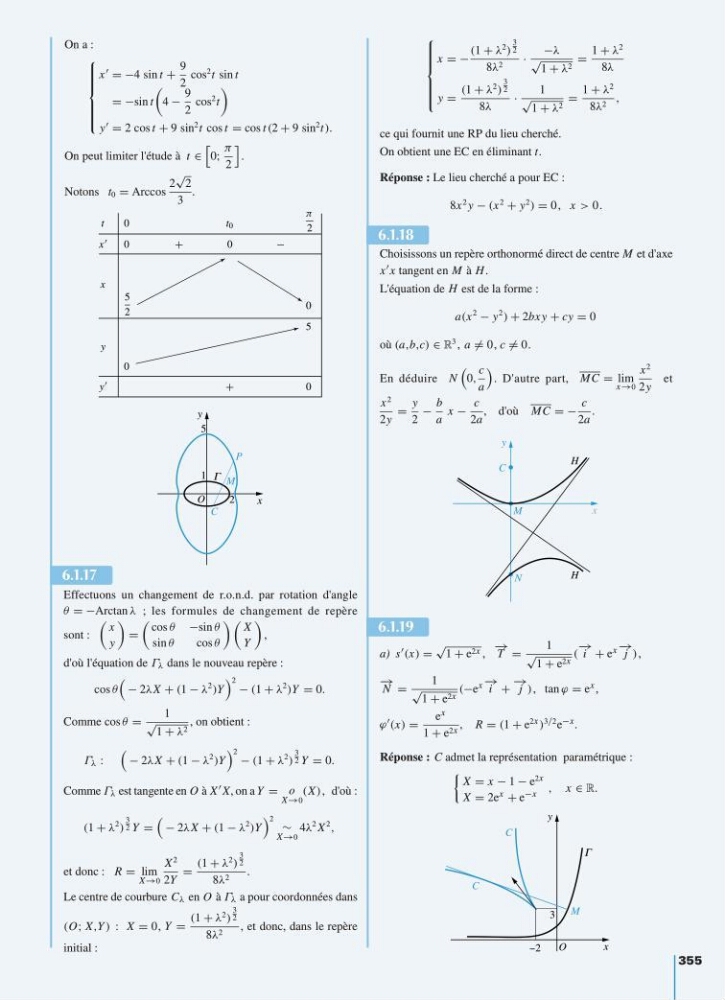
On a :
x = −4 sin t +
9
2
cos
2 t sin t
= −sin t
4 −
9
2
cos
2 t
y = 2 cos t + 9 sin
2 t cos t = cos t (2 + 9 sin
2 t).
On peut limiter l'étude à t ∈
0;
π
2
.
Notons t 0 = Arccos
2
√
2
3
.
355
x = −
(1 + λ
2
)
3
2
8λ 2
·
−λ
√
1 + λ 2
=
1 + λ
2
8λ
y =
(1 + λ
2
)
3
2
8λ
·
1
√
1 + λ 2
=
1 + λ
2
8λ 2 ,
ce qui fournit une RP du lieu cherché.
On obtient une EC en éliminant t.
Réponse : Le lieu cherché a pour EC :
8x
2 y − (x
2
+ y
2
) = 0 , x > 0.
Choisissons un repère orthonormé direct de centre M et d'axe
x x tangent en M à H.
L'équation de H est de la forme :
a(x
2 − y
2 ) + 2bx y + cy = 0
où (a,b,c) ∈ R
3 , a = 0, c = 0.
En déduire N
0,
c
a
. D'autre part, MC = lim
x→0
x
2
2y
et
x
2
2y
=
y
2
−
b
a
x −
c
2a
, d'où MC = −
c
2a
.
6.1.18
6.1.19
t
0
t 0
π
2
x
0
+
0
−
x
5
2
0
5
y
0
y
+
0
y
x
O
Γ
1
5
2
P
M
C
y
x
C
M
H
N
H
y
x
O
Γ
--2
C
C
M
3
Effectuons un changement de r.o.n.d. par rotation d'angle
θ = −Arctan λ ; les formules de changement de repère
sont :
x
y
=
cos θ −sin θ
sin θ
cos θ
X
Y
,
d'où l'équation de Γ λ dans le nouveau repère :
cos θ
− 2λX + (1 − λ
2 )Y
2 − (1 + λ
2 )Y = 0.
Comme cos θ =
1
√
1 + λ 2
, on obtient :
Γ λ :
− 2λX + (1 − λ
2 )Y
2 − (1 + λ
2 )
3
2 Y = 0.
Comme Γ λ est tangente en O à X X, on a Y = o
X→0
(X), d'où :
(1 + λ
2 )
3
2 Y =
− 2λX + (1 − λ
2 )Y
2 ∼
X→0
4λ
2 X
2 ,
et donc : R = lim
X→0
X
2
2Y
=
(1 + λ
2
)
3
2
8λ 2 .
Le centre de courbure C λ en O à Γ λ a pour coordonnées dans
(O; X,Y ) : X = 0, Y =
(1 + λ
2
)
3
2
8λ 2
, et donc, dans le repère
initial :
6.1.17
a) s (x) =
√
1 + e 2x ,
− →
T =
1
√
1 + e 2x
(
− →
i + e x − →
j ),
− →
N =
1
√
1 + e 2x
(−e x − →
i +
− →
j ), tan ϕ = e x ,
ϕ (x) =
e x
1 + e 2x , R = (1 + e
2x
)
3/2 e −x .
Réponse : C admet la représentation paramétrique :
X = x − 1 − e
2x
X = 2e x + e −x , x ∈ R.
x = −4 sin t +
9
2
cos
2 t sin t
= −sin t
4 −
9
2
cos
2 t
y = 2 cos t + 9 sin
2 t cos t = cos t (2 + 9 sin
2 t).
On peut limiter l'étude à t ∈
0;
π
2
.
Notons t 0 = Arccos
2
√
2
3
.
355
x = −
(1 + λ
2
)
3
2
8λ 2
·
−λ
√
1 + λ 2
=
1 + λ
2
8λ
y =
(1 + λ
2
)
3
2
8λ
·
1
√
1 + λ 2
=
1 + λ
2
8λ 2 ,
ce qui fournit une RP du lieu cherché.
On obtient une EC en éliminant t.
Réponse : Le lieu cherché a pour EC :
8x
2 y − (x
2
+ y
2
) = 0 , x > 0.
Choisissons un repère orthonormé direct de centre M et d'axe
x x tangent en M à H.
L'équation de H est de la forme :
a(x
2 − y
2 ) + 2bx y + cy = 0
où (a,b,c) ∈ R
3 , a = 0, c = 0.
En déduire N
0,
c
a
. D'autre part, MC = lim
x→0
x
2
2y
et
x
2
2y
=
y
2
−
b
a
x −
c
2a
, d'où MC = −
c
2a
.
6.1.18
6.1.19
t
0
t 0
π
2
x
0
+
0
−
x
5
2
0
5
y
0
y
+
0
y
x
O
Γ
1
5
2
P
M
C
y
x
C
M
H
N
H
y
x
O
Γ
--2
C
C
M
3
Effectuons un changement de r.o.n.d. par rotation d'angle
θ = −Arctan λ ; les formules de changement de repère
sont :
x
y
=
cos θ −sin θ
sin θ
cos θ
X
Y
,
d'où l'équation de Γ λ dans le nouveau repère :
cos θ
− 2λX + (1 − λ
2 )Y
2 − (1 + λ
2 )Y = 0.
Comme cos θ =
1
√
1 + λ 2
, on obtient :
Γ λ :
− 2λX + (1 − λ
2 )Y
2 − (1 + λ
2 )
3
2 Y = 0.
Comme Γ λ est tangente en O à X X, on a Y = o
X→0
(X), d'où :
(1 + λ
2 )
3
2 Y =
− 2λX + (1 − λ
2 )Y
2 ∼
X→0
4λ
2 X
2 ,
et donc : R = lim
X→0
X
2
2Y
=
(1 + λ
2
)
3
2
8λ 2 .
Le centre de courbure C λ en O à Γ λ a pour coordonnées dans
(O; X,Y ) : X = 0, Y =
(1 + λ
2
)
3
2
8λ 2
, et donc, dans le repère
initial :
6.1.17
a) s (x) =
√
1 + e 2x ,
− →
T =
1
√
1 + e 2x
(
− →
i + e x − →
j ),
− →
N =
1
√
1 + e 2x
(−e x − →
i +
− →
j ), tan ϕ = e x ,
ϕ (x) =
e x
1 + e 2x , R = (1 + e
2x
)
3/2 e −x .
Réponse : C admet la représentation paramétrique :
X = x − 1 − e
2x
X = 2e x + e −x , x ∈ R.