

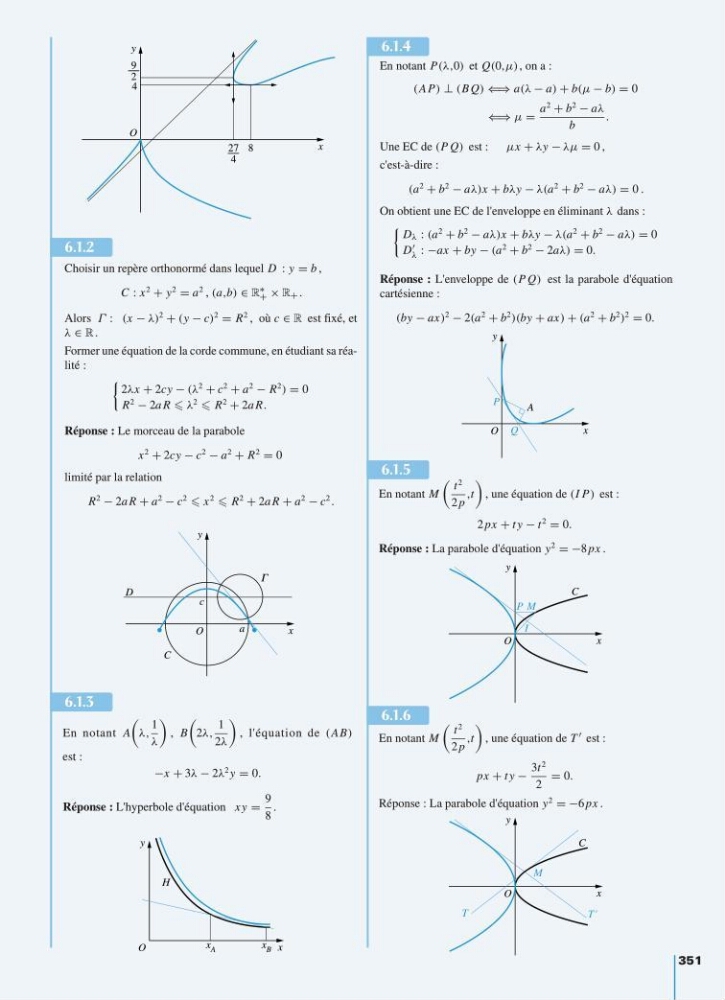
Choisir un repère orthonormé dans lequel D : y = b ,
C : x
2
+ y
2
= a
2 , (a,b) ∈ R ∗
+ × R + .
Alors Γ : (x − λ)
2
+ (y − c)
2
= R
2 , où c ∈ R est fixé, et
λ ∈ R .
Former une équation de la corde commune, en étudiant sa réalité :
2λx + 2cy − (λ
2
+ c
2
+ a
2
− R
2
) = 0
R
2
− 2a R λ
2
R
2
+ 2a R.
Réponse : Le morceau de la parabole
x
2
+ 2cy − c
2
− a
2
+ R
2
= 0
limité par la relation
R
2
− 2a R + a
2
− c
2
x
2
R
2
+ 2a R + a
2
− c
2 .
351
En notant P(λ,0) et Q(0,µ) , on a :
(AP) ⊥ (B Q) ⇐⇒ a(λ − a) + b(µ − b) = 0
⇐⇒ µ =
a
2
+ b
2
− aλ
b
.
Une EC de (P Q) est : µx + λy − λµ = 0 ,
c'est-à-dire :
(a
2
+ b
2
− aλ)x + bλy − λ(a
2
+ b
2
− aλ) = 0 .
On obtient une EC de l'enveloppe en éliminant λ dans :
D λ : (a
2
+ b
2
− aλ)x + bλy − λ(a
2
+ b
2
− aλ) = 0
D
λ : −ax + by − (a
2
+ b
2
− 2aλ) = 0.
Réponse : L'enveloppe de (P Q) est la parabole d'équation
cartésienne :
(by − ax)
2
− 2(a
2
+ b
2
)(by + ax) + (a
2
+ b
2
)
2
= 0.
y
x
O
8
4
27
4
9
2
y
x
O
Γ
D
C
c
a
y
x
O
P
A
Q
y
x
O
H
x A
x B
6.1.2
6.1.3
En notant A
λ,
1
λ
, B
2λ,
1
2λ
, l'équation de (AB)
est :
−x + 3λ − 2λ
2 y = 0.
Réponse : L'hyperbole d'équation xy =
9
8
.
6.1.4
En notant M
t
2
2 p
,t
, une équation de (I P) est :
2 px + t y − t
2
= 0.
Réponse : La parabole d'équation y
2
= −8 px .
6.1.5
y
x
O
M
P
C
I
y
x
O
T
T'
M
C
En notant M
t
2
2 p
,t
, une équation de T est :
px + t y −
3t
2
2
= 0.
Réponse : La parabole d'équation y
2
= −6 px .
6.1.6
C : x
2
+ y
2
= a
2 , (a,b) ∈ R ∗
+ × R + .
Alors Γ : (x − λ)
2
+ (y − c)
2
= R
2 , où c ∈ R est fixé, et
λ ∈ R .
Former une équation de la corde commune, en étudiant sa réalité :
2λx + 2cy − (λ
2
+ c
2
+ a
2
− R
2
) = 0
R
2
− 2a R λ
2
R
2
+ 2a R.
Réponse : Le morceau de la parabole
x
2
+ 2cy − c
2
− a
2
+ R
2
= 0
limité par la relation
R
2
− 2a R + a
2
− c
2
x
2
R
2
+ 2a R + a
2
− c
2 .
351
En notant P(λ,0) et Q(0,µ) , on a :
(AP) ⊥ (B Q) ⇐⇒ a(λ − a) + b(µ − b) = 0
⇐⇒ µ =
a
2
+ b
2
− aλ
b
.
Une EC de (P Q) est : µx + λy − λµ = 0 ,
c'est-à-dire :
(a
2
+ b
2
− aλ)x + bλy − λ(a
2
+ b
2
− aλ) = 0 .
On obtient une EC de l'enveloppe en éliminant λ dans :
D λ : (a
2
+ b
2
− aλ)x + bλy − λ(a
2
+ b
2
− aλ) = 0
D
λ : −ax + by − (a
2
+ b
2
− 2aλ) = 0.
Réponse : L'enveloppe de (P Q) est la parabole d'équation
cartésienne :
(by − ax)
2
− 2(a
2
+ b
2
)(by + ax) + (a
2
+ b
2
)
2
= 0.
y
x
O
8
4
27
4
9
2
y
x
O
Γ
D
C
c
a
y
x
O
P
A
Q
y
x
O
H
x A
x B
6.1.2
6.1.3
En notant A
λ,
1
λ
, B
2λ,
1
2λ
, l'équation de (AB)
est :
−x + 3λ − 2λ
2 y = 0.
Réponse : L'hyperbole d'équation xy =
9
8
.
6.1.4
En notant M
t
2
2 p
,t
, une équation de (I P) est :
2 px + t y − t
2
= 0.
Réponse : La parabole d'équation y
2
= −8 px .
6.1.5
y
x
O
M
P
C
I
y
x
O
T
T'
M
C
En notant M
t
2
2 p
,t
, une équation de T est :
px + t y −
3t
2
2
= 0.
Réponse : La parabole d'équation y
2
= −6 px .
6.1.6