

6.1 • Courbes du plan
225
On a :
s
= (x
2 + y
2 )
1
2 =
1 + sh
2 x
a
1
2 = ch
x
a
,
puis :
− →
T =
− →
dC
ds
=
dx
ds
− →
dC
dx
=
1
ch
x
a
− →
i + sh
x
a
− →
j
.
En choisissant pour origine des abscisses curvilignes sur C le point A(0,a), correspondant
à x = 0, on a : s = a sh
x
a
.
Les développantes de C sont les courbes γ λ (λ ∈ R) définies par les représentations paramétriques :
X = x + (λ − s)
1
ch
x
a
= x +
λ − a sh
x
a
1
ch
x
a
Y = y + (λ − s)th
x
a
= a ch
x
a
+
λ − a sh
x
a
th
x
a
.
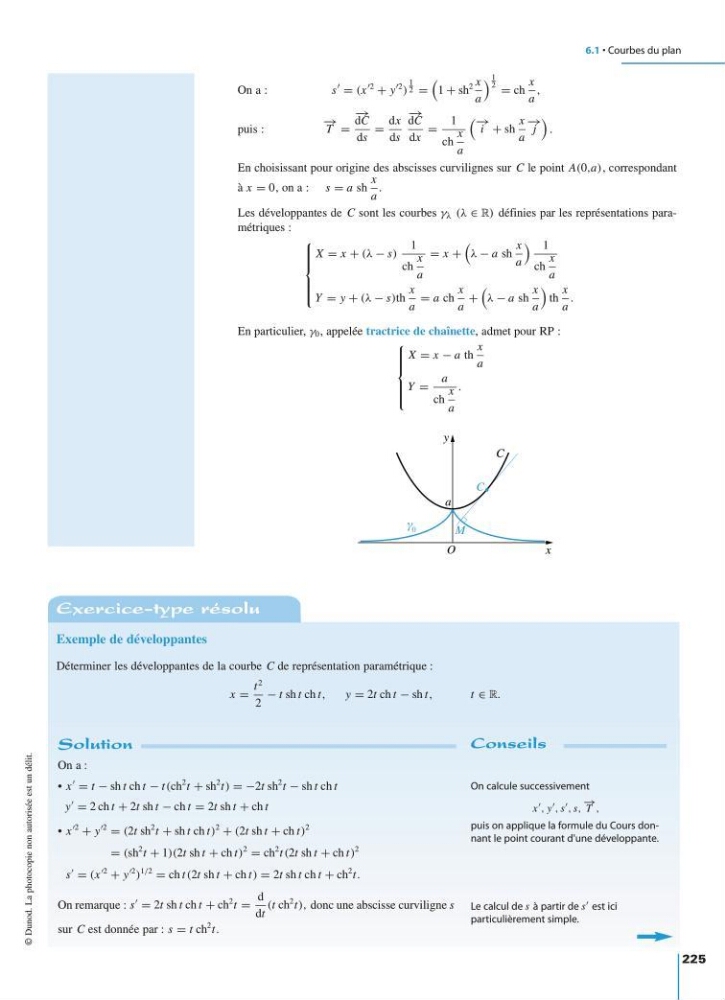
En particulier, γ 0 , appelée tractrice de chaînette, admet pour RP :
X = x − a th
x
a
Y =
a
ch
x
a
.
© Dunod. La photocopie non autorisée est un délit.
y
x
O
M
C
C
γ 0
a
Exercice-type résolu
Exemple de développantes
Déterminer les développantes de la courbe C de représentation paramétrique :
x =
t
2
2
− t sh t ch t,
y = 2t ch t − sh t,
t ∈ R.
Conseils
On calcule successivement
x
, y
, s
, s,
− →
T ,
puis on applique la formule du Cours donnant le point courant d'une développante.
Le calcul de s à partir de s est ici
particulièrement simple.
Solution
On a :
• x
= t − sh t ch t − t (ch
2 t + sh
2 t) = −2t sh
2 t − sh t ch t
y
= 2 ch t + 2t sh t − ch t = 2t sh t + ch t
• x
2 + y
2 = (2t sh
2 t + sh t ch t)
2 + (2t sh t + ch t)
2
= (sh
2 t + 1)(2t sh t + ch t)
2 = ch
2 t (2t sh t + ch t)
2
s
= (x
2 + y
2 )
1/2 = ch t (2t sh t + ch t) = 2t sh t ch t + ch
2 t.
On remarque : s
= 2t sh t ch t + ch
2 t =
d
dt
(t ch
2 t), donc une abscisse curviligne s
sur C est donnée par : s = t ch
2 t.
225
On a :
s
= (x
2 + y
2 )
1
2 =
1 + sh
2 x
a
1
2 = ch
x
a
,
puis :
− →
T =
− →
dC
ds
=
dx
ds
− →
dC
dx
=
1
ch
x
a
− →
i + sh
x
a
− →
j
.
En choisissant pour origine des abscisses curvilignes sur C le point A(0,a), correspondant
à x = 0, on a : s = a sh
x
a
.
Les développantes de C sont les courbes γ λ (λ ∈ R) définies par les représentations paramétriques :
X = x + (λ − s)
1
ch
x
a
= x +
λ − a sh
x
a
1
ch
x
a
Y = y + (λ − s)th
x
a
= a ch
x
a
+
λ − a sh
x
a
th
x
a
.
En particulier, γ 0 , appelée tractrice de chaînette, admet pour RP :
X = x − a th
x
a
Y =
a
ch
x
a
.
© Dunod. La photocopie non autorisée est un délit.
y
x
O
M
C
C
γ 0
a
Exercice-type résolu
Exemple de développantes
Déterminer les développantes de la courbe C de représentation paramétrique :
x =
t
2
2
− t sh t ch t,
y = 2t ch t − sh t,
t ∈ R.
Conseils
On calcule successivement
x
, y
, s
, s,
− →
T ,
puis on applique la formule du Cours donnant le point courant d'une développante.
Le calcul de s à partir de s est ici
particulièrement simple.
Solution
On a :
• x
= t − sh t ch t − t (ch
2 t + sh
2 t) = −2t sh
2 t − sh t ch t
y
= 2 ch t + 2t sh t − ch t = 2t sh t + ch t
• x
2 + y
2 = (2t sh
2 t + sh t ch t)
2 + (2t sh t + ch t)
2
= (sh
2 t + 1)(2t sh t + ch t)
2 = ch
2 t (2t sh t + ch t)
2
s
= (x
2 + y
2 )
1/2 = ch t (2t sh t + ch t) = 2t sh t ch t + ch
2 t.
On remarque : s
= 2t sh t ch t + ch
2 t =
d
dt
(t ch
2 t), donc une abscisse curviligne s
sur C est donnée par : s = t ch
2 t.