

4.1 • Formes bilinéaires symétriques, formes quadratiques
133
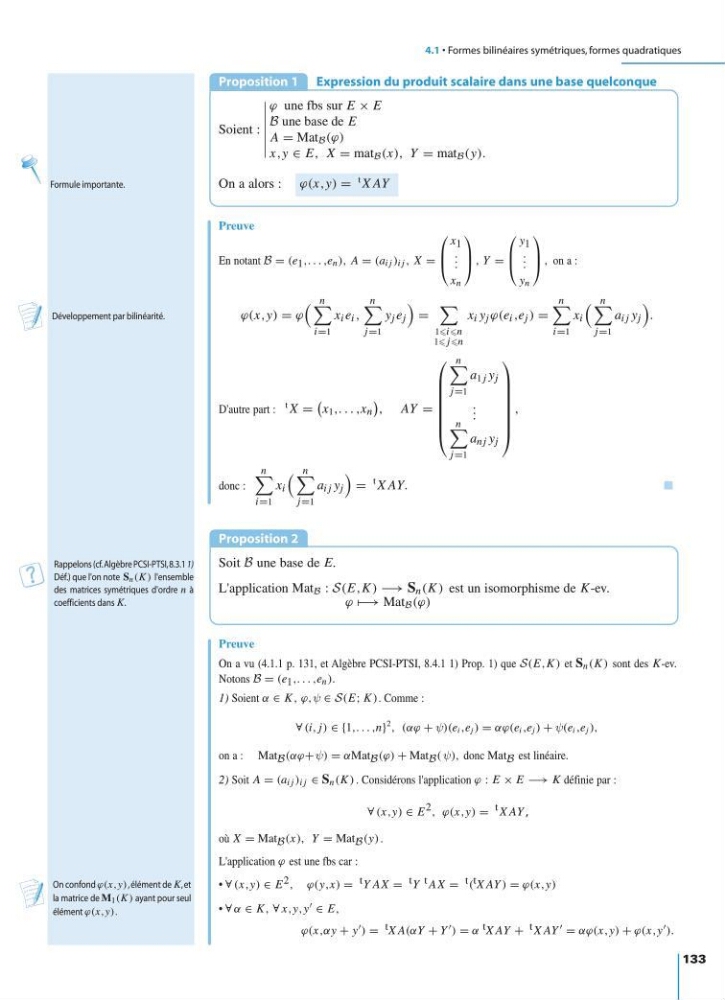
Proposition 1 Expression du produit scalaire dans une base quelconque
Soient :
ϕ une fbs sur E × E
B une base de E
A = Mat B (ϕ)
x,y ∈ E, X = mat B (x), Y = mat B (y).
On a alors : ϕ(x,y) =
t X AY
Preuve
En notant B = (e 1 ,. . . ,e n ), A = (a i j ) i j , X =
x 1
. . .
x n
, Y =
y 1
. . .
y n
, on a :
ϕ(x,y) = ϕ
n
i=1
x i e i ,
n
j=1
y j e j
=
1i n
1 jn
x i y j ϕ(e i ,e j ) =
n
i=1
x i
n
j=1
a i j y j
.
D'autre part :
t X =
x 1 ,. . . ,x n
, AY =
n
j=1
a 1 j y j
. . .
n
j=1
a nj y j
,
donc :
n
i=1
x i
n
j=1
a i j y j
=
t X AY.
Proposition 2
Soit B une base de E.
L'application Mat B : S(E,K ) −→ S n (K )
ϕ −→ Mat B (ϕ)
est un isomorphisme de K-ev.
Preuve
On a vu (4.1.1 p. 131, et Algèbre PCSI-PTSI, 8.4.1 1) Prop. 1) que S(E,K ) et S n (K ) sont des K-ev.
Notons B = (e 1 ,. . . ,e n ).
1) Soient α ∈ K , ϕ,ψ ∈ S(E; K ). Comme :
∀ (i, j) ∈ {1,. . . ,n}
2 , (αϕ + ψ)(e i ,e j ) = αϕ(e i ,e j ) + ψ(e i ,e j ),
on a : Mat B (αϕ+ ψ) = αMat B (ϕ) + Mat B ( ψ), donc Mat B est linéaire.
2) Soit A = (a i j ) i j ∈ S n (K ) . Considérons l'application ϕ : E × E −→ K définie par :
∀ (x,y) ∈ E 2 , ϕ(x,y) = t X AY ,
où X = Mat B (x), Y = Mat B (y) .
L'application ϕ est une fbs car :
• ∀ (x,y) ∈ E 2 , ϕ(y,x) = t Y AX = t Y t AX = t ( t X AY ) = ϕ(x,y)
• ∀ α ∈ K , ∀ x,y,y ∈ E ,
ϕ(x,αy + y ) = t X A(αY + Y ) = α t X AY + t X AY = αϕ(x,y) + ϕ(x,y ).
Formule importante.
Développement par bilinéarité.
Monie r Algèbre Monier
Géométrie
Moni er Algèbre Monier
Mon ier Algèbre Géomé
Gé
ométrie Monier
Rappelons (cf.Algèbre PCSI-PTSI,8.3.1 1)
Déf.) que l'on note S n (K ) l'ensemble
des matrices symétriques d'ordre n à
coefficients dans K.
On confond ϕ(x,y),élément de K,et
la matrice de M 1 (K ) ayant pour seul
élément ϕ(x,y).
Monie r Algèbre Monier
Géométrie
Moni er Algèbre Monier
Mon ier Algèbre Géomé
Gé
ométrie Monier
133
Proposition 1 Expression du produit scalaire dans une base quelconque
Soient :
ϕ une fbs sur E × E
B une base de E
A = Mat B (ϕ)
x,y ∈ E, X = mat B (x), Y = mat B (y).
On a alors : ϕ(x,y) =
t X AY
Preuve
En notant B = (e 1 ,. . . ,e n ), A = (a i j ) i j , X =
x 1
. . .
x n
, Y =
y 1
. . .
y n
, on a :
ϕ(x,y) = ϕ
n
i=1
x i e i ,
n
j=1
y j e j
=
1i n
1 jn
x i y j ϕ(e i ,e j ) =
n
i=1
x i
n
j=1
a i j y j
.
D'autre part :
t X =
x 1 ,. . . ,x n
, AY =
n
j=1
a 1 j y j
. . .
n
j=1
a nj y j
,
donc :
n
i=1
x i
n
j=1
a i j y j
=
t X AY.
Proposition 2
Soit B une base de E.
L'application Mat B : S(E,K ) −→ S n (K )
ϕ −→ Mat B (ϕ)
est un isomorphisme de K-ev.
Preuve
On a vu (4.1.1 p. 131, et Algèbre PCSI-PTSI, 8.4.1 1) Prop. 1) que S(E,K ) et S n (K ) sont des K-ev.
Notons B = (e 1 ,. . . ,e n ).
1) Soient α ∈ K , ϕ,ψ ∈ S(E; K ). Comme :
∀ (i, j) ∈ {1,. . . ,n}
2 , (αϕ + ψ)(e i ,e j ) = αϕ(e i ,e j ) + ψ(e i ,e j ),
on a : Mat B (αϕ+ ψ) = αMat B (ϕ) + Mat B ( ψ), donc Mat B est linéaire.
2) Soit A = (a i j ) i j ∈ S n (K ) . Considérons l'application ϕ : E × E −→ K définie par :
∀ (x,y) ∈ E 2 , ϕ(x,y) = t X AY ,
où X = Mat B (x), Y = Mat B (y) .
L'application ϕ est une fbs car :
• ∀ (x,y) ∈ E 2 , ϕ(y,x) = t Y AX = t Y t AX = t ( t X AY ) = ϕ(x,y)
• ∀ α ∈ K , ∀ x,y,y ∈ E ,
ϕ(x,αy + y ) = t X A(αY + Y ) = α t X AY + t X AY = αϕ(x,y) + ϕ(x,y ).
Formule importante.
Développement par bilinéarité.
Monie r Algèbre Monier
Géométrie
Moni er Algèbre Monier
Mon ier Algèbre Géomé
Gé
ométrie Monier
Rappelons (cf.Algèbre PCSI-PTSI,8.3.1 1)
Déf.) que l'on note S n (K ) l'ensemble
des matrices symétriques d'ordre n à
coefficients dans K.
On confond ϕ(x,y),élément de K,et
la matrice de M 1 (K ) ayant pour seul
élément ϕ(x,y).
Monie r Algèbre Monier
Géométrie
Moni er Algèbre Monier
Mon ier Algèbre Géomé
Gé
ométrie Monier