

Chapitre 3 • Réduction des endomorphismes et des matrices carrées
94
Conseils
On peut contrôler P P −1 = I 2 .
Solution
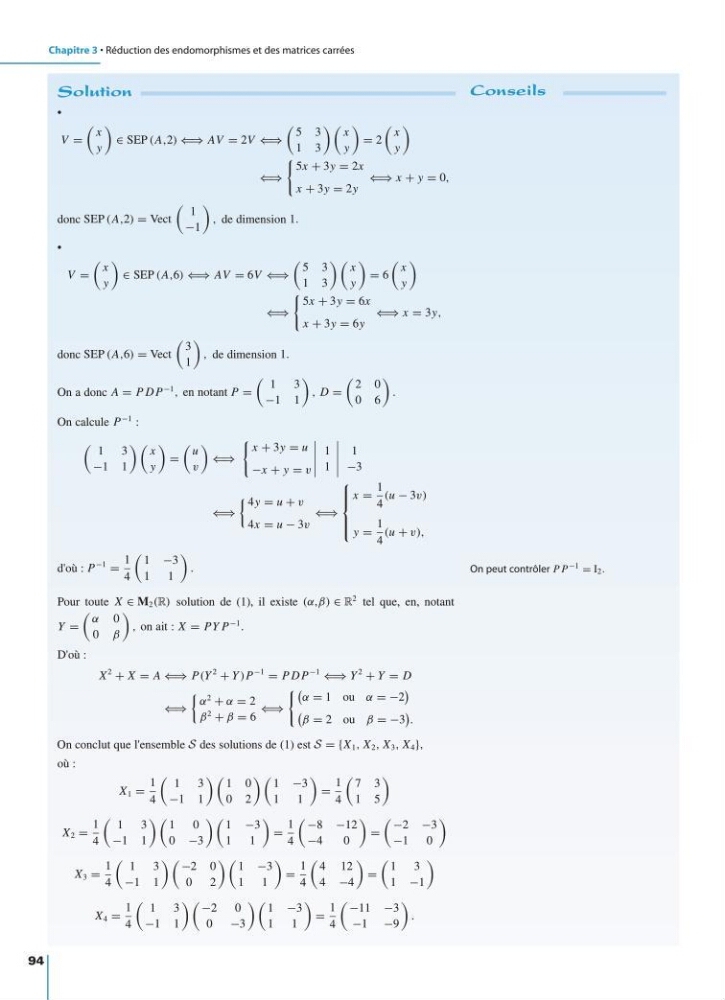
•
V =
x
y
∈ SEP (A,2) ⇐⇒ AV = 2V ⇐⇒
5 3
1 3
x
y
= 2
x
y
⇐⇒
5x + 3y = 2x
x + 3y = 2y
⇐⇒ x + y = 0,
donc SEP (A,2) = Vect
1
−1
, de dimension 1.
•
V =
x
y
∈ SEP (A,6) ⇐⇒ AV = 6V ⇐⇒
5 3
1 3
x
y
= 6
x
y
⇐⇒
5x + 3y = 6x
x + 3y = 6y
⇐⇒ x = 3y,
donc SEP (A,6) = Vect
3
1
, de dimension 1.
On a donc A = P D P
−1
, en notant P =
1 3
−1 1
, D =
2 0
0 6
.
On calcule P
−1 :
1 3
−1 1
x
y
=
u
v
⇐⇒
x + 3y = u
−x + y = v
1
1
1
−3
⇐⇒
4y = u + v
4x = u − 3v
⇐⇒
x =
1
4
(u − 3v)
y =
1
4
(u + v),
d'où : P
−1 =
1
4
1 −3
1 1
.
Pour toute X ∈ M 2 (R) solution de (1), il existe (α,β) ∈ R
2 tel que, en, notant
Y =
α 0
0 β
, on ait : X = PY P
−1
.
D'où :
X
2 + X = A ⇐⇒ P(Y
2 + Y )P
−1 = P D P
−1 ⇐⇒ Y
2 + Y = D
⇐⇒
α
2
+ α = 2
β
2
+ β = 6
⇐⇒
α = 1 ou α = −2
β = 2 ou β = −3
.
On conclut que l'ensemble S des solutions de (1) est S = {X 1 , X 2 , X 3 , X 4 },
où :
X 1 =
1
4
1 3
−1 1
1 0
0 2
1 −3
1 1
=
1
4
7 3
1 5
X 2 =
1
4
1 3
−1 1
1 0
0 −3
1 −3
1 1
=
1
4
−8 −12
−4
0
=
−2 −3
−1 0
X 3 =
1
4
1 3
−1 1
−2 0
0 2
1 −3
1 1
=
1
4
4 12
4 −4
=
1 3
1 −1
X 4 =
1
4
1 3
−1 1
−2 0
0 −3
1 −3
1 1
=
1
4
−11 −3
−1 −9
.
94
Conseils
On peut contrôler P P −1 = I 2 .
Solution
•
V =
x
y
∈ SEP (A,2) ⇐⇒ AV = 2V ⇐⇒
5 3
1 3
x
y
= 2
x
y
⇐⇒
5x + 3y = 2x
x + 3y = 2y
⇐⇒ x + y = 0,
donc SEP (A,2) = Vect
1
−1
, de dimension 1.
•
V =
x
y
∈ SEP (A,6) ⇐⇒ AV = 6V ⇐⇒
5 3
1 3
x
y
= 6
x
y
⇐⇒
5x + 3y = 6x
x + 3y = 6y
⇐⇒ x = 3y,
donc SEP (A,6) = Vect
3
1
, de dimension 1.
On a donc A = P D P
−1
, en notant P =
1 3
−1 1
, D =
2 0
0 6
.
On calcule P
−1 :
1 3
−1 1
x
y
=
u
v
⇐⇒
x + 3y = u
−x + y = v
1
1
1
−3
⇐⇒
4y = u + v
4x = u − 3v
⇐⇒
x =
1
4
(u − 3v)
y =
1
4
(u + v),
d'où : P
−1 =
1
4
1 −3
1 1
.
Pour toute X ∈ M 2 (R) solution de (1), il existe (α,β) ∈ R
2 tel que, en, notant
Y =
α 0
0 β
, on ait : X = PY P
−1
.
D'où :
X
2 + X = A ⇐⇒ P(Y
2 + Y )P
−1 = P D P
−1 ⇐⇒ Y
2 + Y = D
⇐⇒
α
2
+ α = 2
β
2
+ β = 6
⇐⇒
α = 1 ou α = −2
β = 2 ou β = −3
.
On conclut que l'ensemble S des solutions de (1) est S = {X 1 , X 2 , X 3 , X 4 },
où :
X 1 =
1
4
1 3
−1 1
1 0
0 2
1 −3
1 1
=
1
4
7 3
1 5
X 2 =
1
4
1 3
−1 1
1 0
0 −3
1 −3
1 1
=
1
4
−8 −12
−4
0
=
−2 −3
−1 0
X 3 =
1
4
1 3
−1 1
−2 0
0 2
1 −3
1 1
=
1
4
4 12
4 −4
=
1 3
1 −1
X 4 =
1
4
1 3
−1 1
−2 0
0 −3
1 −3
1 1
=
1
4
−11 −3
−1 −9
.