

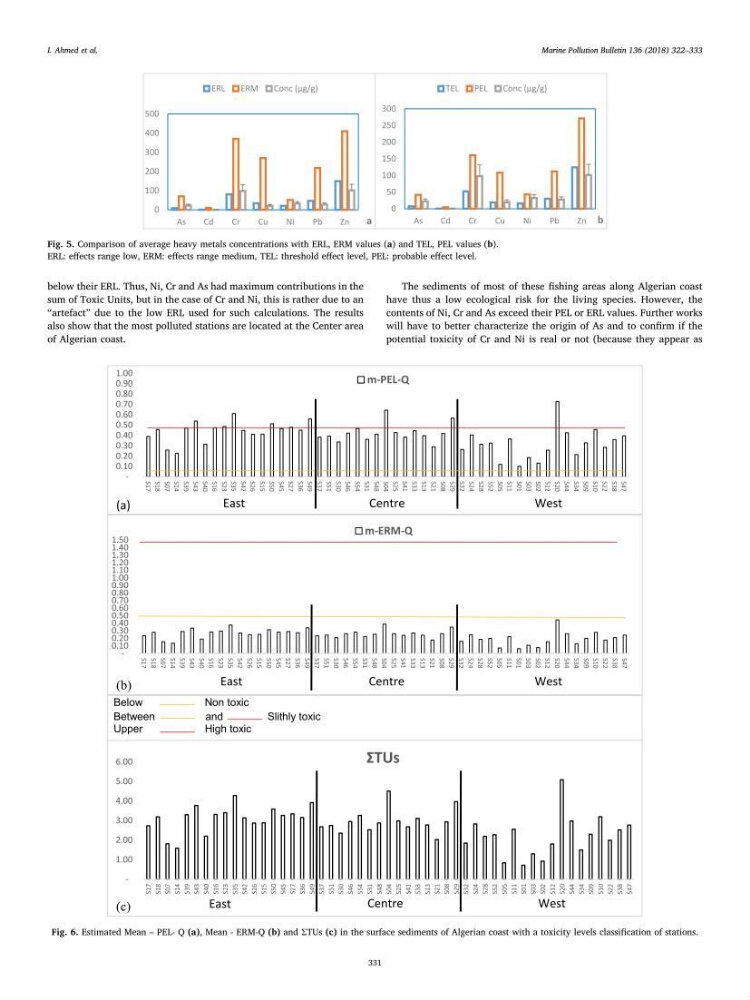
below their ERL. Thus, Ni, Cr and As had maximum contributions in the
sum of Toxic Units, but in the case of Cr and Ni, this is rather due to an
“artefact” due to the low ERL used for such calculations. The results
also show that the most polluted stations are located at the Center area
of Algerian coast.
The sediments of most of these fishing areas along Algerian coast
have thus a low ecological risk for the living species. However, the
contents of Ni, Cr and As exceed their PEL or ERL values. Further works
will have to better characterize the origin of As and to confirm if the
potential toxicity of Cr and Ni is real or not (because they appear as
Fig. 5. Comparison of average heavy metals concentrations with ERL, ERM values (a) and TEL, PEL values (b).
ERL: effects range low, ERM: effects range medium, TEL: threshold effect level, PEL: probable effect level.
Fig. 6. Estimated Mean – PEL- Q (a), Mean - ERM-Q (b) and ΣTUs (c) in the surface sediments of Algerian coast with a toxicity levels classification of stations.
I. Ahmed et al.
Marine Pollution Bulletin 136 (2018) 322–333
331
sum of Toxic Units, but in the case of Cr and Ni, this is rather due to an
“artefact” due to the low ERL used for such calculations. The results
also show that the most polluted stations are located at the Center area
of Algerian coast.
The sediments of most of these fishing areas along Algerian coast
have thus a low ecological risk for the living species. However, the
contents of Ni, Cr and As exceed their PEL or ERL values. Further works
will have to better characterize the origin of As and to confirm if the
potential toxicity of Cr and Ni is real or not (because they appear as
Fig. 5. Comparison of average heavy metals concentrations with ERL, ERM values (a) and TEL, PEL values (b).
ERL: effects range low, ERM: effects range medium, TEL: threshold effect level, PEL: probable effect level.
Fig. 6. Estimated Mean – PEL- Q (a), Mean - ERM-Q (b) and ΣTUs (c) in the surface sediments of Algerian coast with a toxicity levels classification of stations.
I. Ahmed et al.
Marine Pollution Bulletin 136 (2018) 322–333
331