

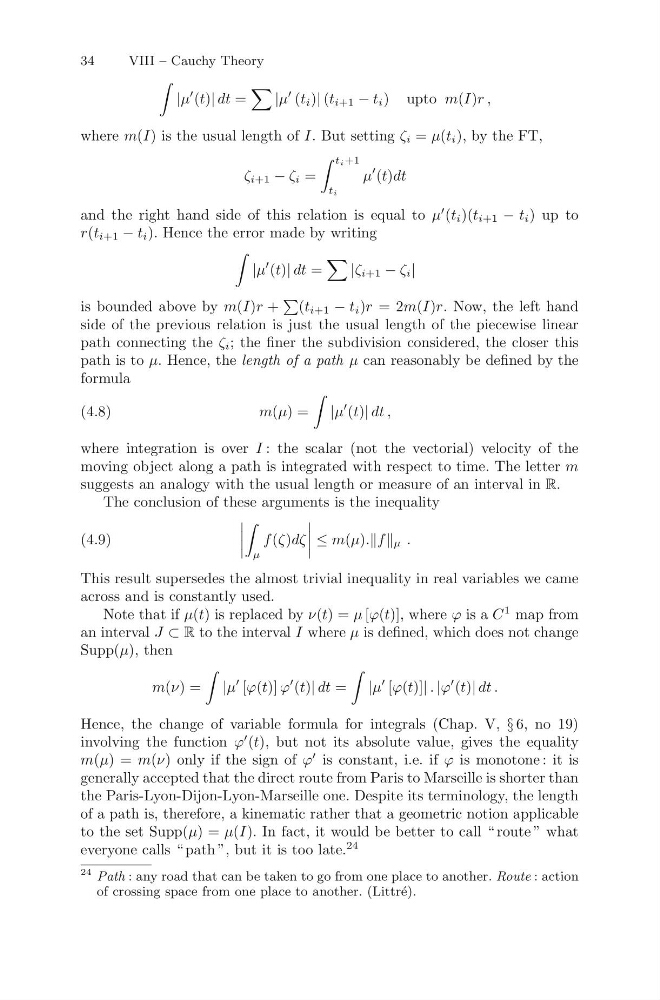
34
VIII – Cauchy Theory
|μ
(t)| dt =
|μ
(t i )| (t i+1 − t i ) upto m(I)r ,
where m(I) is the usual length of I. But setting ζ i = μ(t i ), by the FT,
ζ i+1 − ζ i =
ti+1
ti
μ
(t)dt
and the right hand side of this relation is equal to μ
(t i )(t i+1 − t i ) up to
r(t i+1 − t i ). Hence the error made by writing
|μ
(t)| dt =
|ζ i+1 − ζ i |
is bounded above by m(I)r +
(t i+1 − t i )r = 2m(I)r. Now, the left hand
side of the previous relation is just the usual length of the piecewise linear
path connecting the ζ i ; the finer the subdivision considered, the closer this
path is to μ. Hence, the length of a path μ can reasonably be defined by the
formula
m(μ) =
|μ
(t)| dt ,
(4.8)
where integration is over I : the scalar (not the vectorial) velocity of the
moving object along a path is integrated with respect to time. The letter m
suggests an analogy with the usual length or measure of an interval in R.
The conclusion of these arguments is the inequality
μ
f (ζ)dζ
≤ m(μ).f μ .
(4.9)
This result supersedes the almost trivial inequality in real variables we came
across and is constantly used.
Note that if μ(t) is replaced by ν(t) = μ [ϕ(t)], where ϕ is a C
1 map from
an interval J ⊂ R to the interval I where μ is defined, which does not change
Supp(μ), then
m(ν) =
|μ
[ϕ(t)] ϕ
(t)| dt =
|μ
[ϕ(t)]| . |ϕ
(t)| dt .
Hence, the change of variable formula for integrals (Chap. V, § 6, no 19)
involving the function ϕ
(t), but not its absolute value, gives the equality
m(μ) = m(ν) only if the sign of ϕ
is constant, i.e. if ϕ is monotone : it is
generally accepted that the direct route from Paris to Marseille is shorter than
the Paris-Lyon-Dijon-Lyon-Marseille one. Despite its terminology, the length
of a path is, therefore, a kinematic rather that a geometric notion applicable
to the set Supp(μ) = μ(I). In fact, it would be better to call “ route ” what
everyone calls “ path ”, but it is too late.
24
24 Path : any road that can be taken to go from one place to another. Route : action
of crossing space from one place to another. (Littr´ e).
VIII – Cauchy Theory
|μ
(t)| dt =
|μ
(t i )| (t i+1 − t i ) upto m(I)r ,
where m(I) is the usual length of I. But setting ζ i = μ(t i ), by the FT,
ζ i+1 − ζ i =
ti+1
ti
μ
(t)dt
and the right hand side of this relation is equal to μ
(t i )(t i+1 − t i ) up to
r(t i+1 − t i ). Hence the error made by writing
|μ
(t)| dt =
|ζ i+1 − ζ i |
is bounded above by m(I)r +
(t i+1 − t i )r = 2m(I)r. Now, the left hand
side of the previous relation is just the usual length of the piecewise linear
path connecting the ζ i ; the finer the subdivision considered, the closer this
path is to μ. Hence, the length of a path μ can reasonably be defined by the
formula
m(μ) =
|μ
(t)| dt ,
(4.8)
where integration is over I : the scalar (not the vectorial) velocity of the
moving object along a path is integrated with respect to time. The letter m
suggests an analogy with the usual length or measure of an interval in R.
The conclusion of these arguments is the inequality
μ
f (ζ)dζ
≤ m(μ).f μ .
(4.9)
This result supersedes the almost trivial inequality in real variables we came
across and is constantly used.
Note that if μ(t) is replaced by ν(t) = μ [ϕ(t)], where ϕ is a C
1 map from
an interval J ⊂ R to the interval I where μ is defined, which does not change
Supp(μ), then
m(ν) =
|μ
[ϕ(t)] ϕ
(t)| dt =
|μ
[ϕ(t)]| . |ϕ
(t)| dt .
Hence, the change of variable formula for integrals (Chap. V, § 6, no 19)
involving the function ϕ
(t), but not its absolute value, gives the equality
m(μ) = m(ν) only if the sign of ϕ
is constant, i.e. if ϕ is monotone : it is
generally accepted that the direct route from Paris to Marseille is shorter than
the Paris-Lyon-Dijon-Lyon-Marseille one. Despite its terminology, the length
of a path is, therefore, a kinematic rather that a geometric notion applicable
to the set Supp(μ) = μ(I). In fact, it would be better to call “ route ” what
everyone calls “ path ”, but it is too late.
24
24 Path : any road that can be taken to go from one place to another. Route : action
of crossing space from one place to another. (Littr´ e).