

§ 2. Cauchy’s Integral Formulas
35
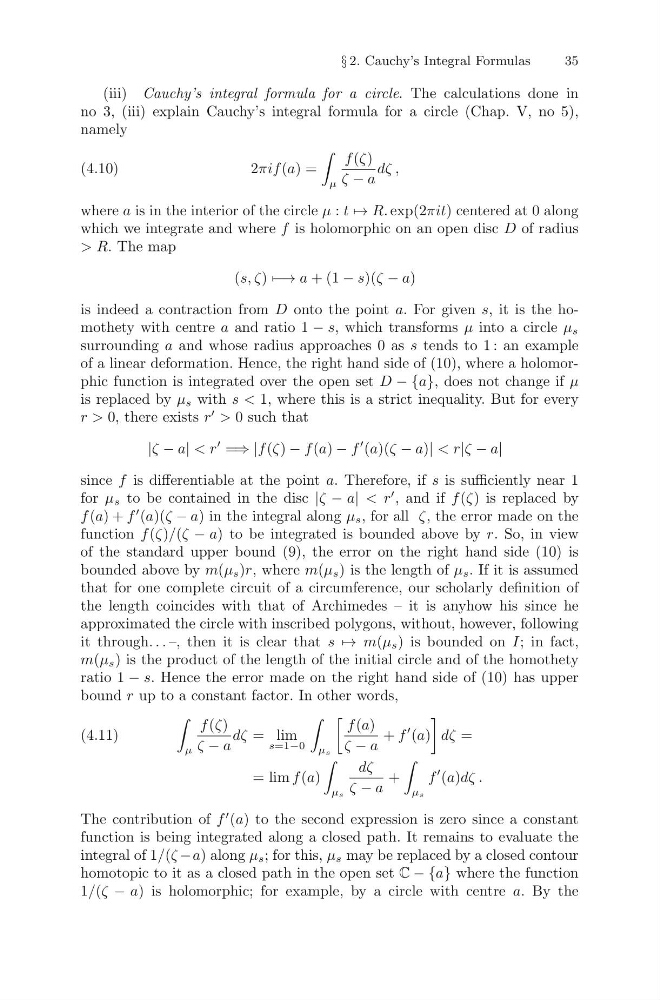
(iii) Cauchy’s integral formula for a circle. The calculations done in
no 3, (iii) explain Cauchy’s integral formula for a circle (Chap. V, no 5),
namely
2πif (a) =
μ
f (ζ)
ζ − a
dζ ,
(4.10)
where a is in the interior of the circle μ : t → R. exp(2πit) centered at 0 along
which we integrate and where f is holomorphic on an open disc D of radius
> R. The map
(s, ζ) −→ a + (1 − s)(ζ − a)
is indeed a contraction from D onto the point a. For given s, it is the homothety with centre a and ratio 1 − s, which transforms μ into a circle μ s
surrounding a and whose radius approaches 0 as s tends to 1 : an example
of a linear deformation. Hence, the right hand side of (10), where a holomorphic function is integrated over the open set D − {a}, does not change if μ
is replaced by μ s with s < 1, where this is a strict inequality. But for every
r > 0, there exists r
> 0 such that
|ζ − a| < r
=⇒ |f (ζ) − f (a) − f
(a)(ζ − a)| < r|ζ − a|
since f is differentiable at the point a. Therefore, if s is sufficiently near 1
for μ s to be contained in the disc |ζ − a| < r
, and if f (ζ) is replaced by
f (a) + f
(a)(ζ − a) in the integral along μ s , for all ζ, the error made on the
function f (ζ)/(ζ − a) to be integrated is bounded above by r. So, in view
of the standard upper bound (9), the error on the right hand side (10) is
bounded above by m(μ s )r, where m(μ s ) is the length of μ s . If it is assumed
that for one complete circuit of a circumference, our scholarly definition of
the length coincides with that of Archimedes – it is anyhow his since he
approximated the circle with inscribed polygons, without, however, following
it through. . . –, then it is clear that s → m(μ s ) is bounded on I; in fact,
m(μ s ) is the product of the length of the initial circle and of the homothety
ratio 1 − s. Hence the error made on the right hand side of (10) has upper
bound r up to a constant factor. In other words,
μ
f (ζ)
ζ − a
dζ = lim
s=1−0
μs
f (a)
ζ − a
+ f
(a)
dζ =
(4.11)
= lim f (a)
μs
dζ
ζ − a
+
μs
f
(a)dζ .
The contribution of f
(a) to the second expression is zero since a constant
function is being integrated along a closed path. It remains to evaluate the
integral of 1/(ζ −a) along μ s ; for this, μ s may be replaced by a closed contour
homotopic to it as a closed path in the open set C − {a} where the function
1/(ζ − a) is holomorphic; for example, by a circle with centre a. By the
35
(iii) Cauchy’s integral formula for a circle. The calculations done in
no 3, (iii) explain Cauchy’s integral formula for a circle (Chap. V, no 5),
namely
2πif (a) =
μ
f (ζ)
ζ − a
dζ ,
(4.10)
where a is in the interior of the circle μ : t → R. exp(2πit) centered at 0 along
which we integrate and where f is holomorphic on an open disc D of radius
> R. The map
(s, ζ) −→ a + (1 − s)(ζ − a)
is indeed a contraction from D onto the point a. For given s, it is the homothety with centre a and ratio 1 − s, which transforms μ into a circle μ s
surrounding a and whose radius approaches 0 as s tends to 1 : an example
of a linear deformation. Hence, the right hand side of (10), where a holomorphic function is integrated over the open set D − {a}, does not change if μ
is replaced by μ s with s < 1, where this is a strict inequality. But for every
r > 0, there exists r
> 0 such that
|ζ − a| < r
=⇒ |f (ζ) − f (a) − f
(a)(ζ − a)| < r|ζ − a|
since f is differentiable at the point a. Therefore, if s is sufficiently near 1
for μ s to be contained in the disc |ζ − a| < r
, and if f (ζ) is replaced by
f (a) + f
(a)(ζ − a) in the integral along μ s , for all ζ, the error made on the
function f (ζ)/(ζ − a) to be integrated is bounded above by r. So, in view
of the standard upper bound (9), the error on the right hand side (10) is
bounded above by m(μ s )r, where m(μ s ) is the length of μ s . If it is assumed
that for one complete circuit of a circumference, our scholarly definition of
the length coincides with that of Archimedes – it is anyhow his since he
approximated the circle with inscribed polygons, without, however, following
it through. . . –, then it is clear that s → m(μ s ) is bounded on I; in fact,
m(μ s ) is the product of the length of the initial circle and of the homothety
ratio 1 − s. Hence the error made on the right hand side of (10) has upper
bound r up to a constant factor. In other words,
μ
f (ζ)
ζ − a
dζ = lim
s=1−0
μs
f (a)
ζ − a
+ f
(a)
dζ =
(4.11)
= lim f (a)
μs
dζ
ζ − a
+
μs
f
(a)dζ .
The contribution of f
(a) to the second expression is zero since a constant
function is being integrated along a closed path. It remains to evaluate the
integral of 1/(ζ −a) along μ s ; for this, μ s may be replaced by a closed contour
homotopic to it as a closed path in the open set C − {a} where the function
1/(ζ − a) is holomorphic; for example, by a circle with centre a. By the