

§ 2. Cauchy’s Integral Formulas
33
Int( )
μ
Ext( )
μ
Ext( )
μ
Ext( )
μ
Int( )
μ
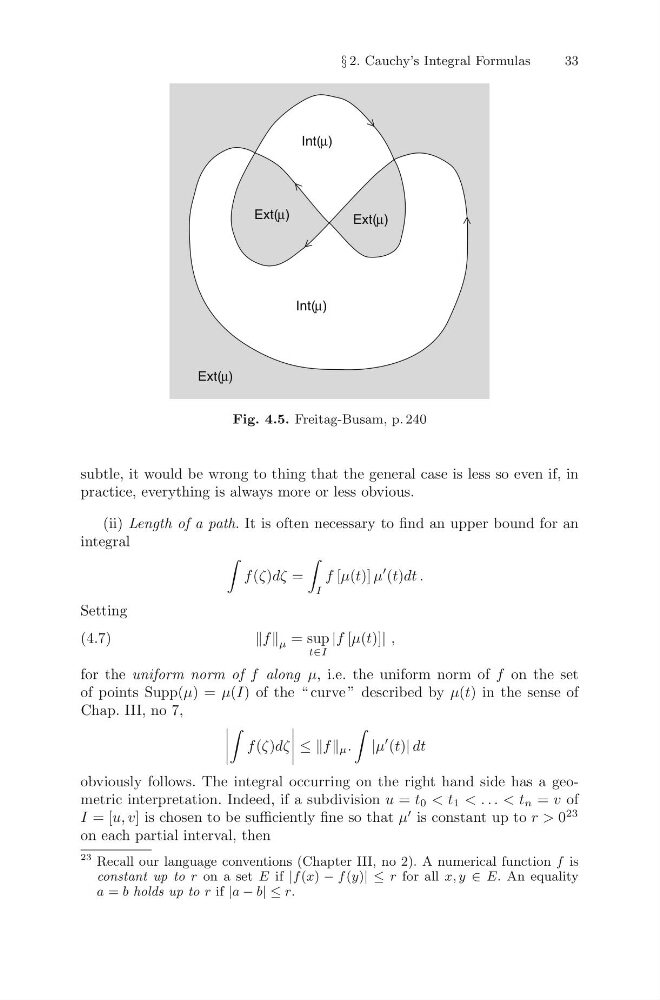
Fig. 4.5. Freitag-Busam, p. 240
subtle, it would be wrong to thing that the general case is less so even if, in
practice, everything is always more or less obvious.
(ii) Length of a path. It is often necessary to find an upper bound for an
integral
f (ζ)dζ =
I
f [μ(t)] μ
(t)dt .
Setting
f μ = sup
t∈I
|f [μ(t)]| ,
(4.7)
for the uniform norm of f along μ, i.e. the uniform norm of f on the set
of points Supp(μ) = μ(I) of the “ curve ” described by μ(t) in the sense of
Chap. III, no 7,
f (ζ)dζ
≤ ≤f μ .
|μ
(t)| dt
obviously follows. The integral occurring on the right hand side has a geometric interpretation. Indeed, if a subdivision u = t 0 < t 1 < . . . < t n = v of
I = [u, v] is chosen to be sufficiently fine so that μ
is constant up to r > 0
23
on each partial interval, then
23 Recall our language conventions (Chapter III, no 2). A numerical function f is
constant up to r on a set E if |f (x) − f (y)| ≤ r for all x, y ∈ E. An equality
a = b holds up to r if |a − b| ≤ r.
33
Int( )
μ
Ext( )
μ
Ext( )
μ
Ext( )
μ
Int( )
μ
Fig. 4.5. Freitag-Busam, p. 240
subtle, it would be wrong to thing that the general case is less so even if, in
practice, everything is always more or less obvious.
(ii) Length of a path. It is often necessary to find an upper bound for an
integral
f (ζ)dζ =
I
f [μ(t)] μ
(t)dt .
Setting
f μ = sup
t∈I
|f [μ(t)]| ,
(4.7)
for the uniform norm of f along μ, i.e. the uniform norm of f on the set
of points Supp(μ) = μ(I) of the “ curve ” described by μ(t) in the sense of
Chap. III, no 7,
f (ζ)dζ
≤ ≤f μ .
|μ
(t)| dt
obviously follows. The integral occurring on the right hand side has a geometric interpretation. Indeed, if a subdivision u = t 0 < t 1 < . . . < t n = v of
I = [u, v] is chosen to be sufficiently fine so that μ
is constant up to r > 0
23
on each partial interval, then
23 Recall our language conventions (Chapter III, no 2). A numerical function f is
constant up to r on a set E if |f (x) − f (y)| ≤ r for all x, y ∈ E. An equality
a = b holds up to r if |a − b| ≤ r.