

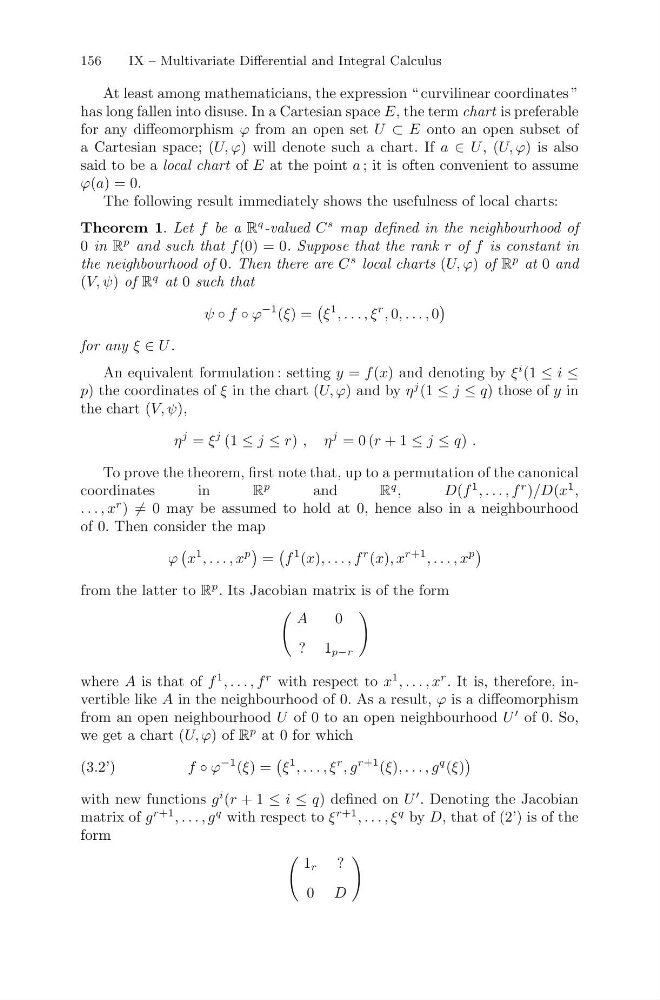
156
IX – Multivariate Differential and Integral Calculus
At least among mathematicians, the expression “ curvilinear coordinates ”
has long fallen into disuse. In a Cartesian space E, the term chart is preferable
for any diffeomorphism ϕ from an open set U ⊂ E onto an open subset of
a Cartesian space; (U, ϕ) will denote such a chart. If a ∈ U , (U, ϕ) is also
said to be a local chart of E at the point a ; it is often convenient to assume
ϕ(a) = 0.
The following result immediately shows the usefulness of local charts:
Theorem 1. Let f be a R
q -valued C
s map defined in the neighbourhood of
0 in R
p and such that f (0) = 0. Suppose that the rank r of f is constant in
the neighbourhood of 0. Then there are C
s local charts (U, ϕ) of R
p at 0 and
(V, ψ) of R
q at 0 such that
ψ ◦ f ◦ ϕ
−1 (ξ) =
ξ
1 , . . . , ξ
r , 0, . . . , 0
for any ξ ∈ U .
An equivalent formulation : setting y = f (x) and denoting by ξ
i (1 ≤ i ≤
p) the coordinates of ξ in the chart (U, ϕ) and by η
j (1 ≤ j ≤ q) those of y in
the chart (V, ψ),
η
j = ξ
j (1 ≤ j ≤ r) , η
j = 0 (r + 1 ≤ j ≤ q) .
To prove the theorem, first note that, up to a permutation of the canonical
coordinates
in
R
p
and
R
q ,
D(f
1 , . . . , f
r )/D(x
1 ,
. . . , x
r ) = 0 may be assumed to hold at 0, hence also in a neighbourhood
of 0. Then consider the map
ϕ
x
1 , . . . , x
p
=
f
1 (x), . . . , f
r (x), x
r+1 , . . . , x
p
from the latter to R
p . Its Jacobian matrix is of the form
A
0
? 1 p−r
where A is that of f
1 , . . . , f
r with respect to x
1 , . . . , x
r . It is, therefore, invertible like A in the neighbourhood of 0. As a result, ϕ is a diffeomorphism
from an open neighbourhood U of 0 to an open neighbourhood U
of 0. So,
we get a chart (U, ϕ) of R
p at 0 for which
f ◦ ϕ
−1 (ξ) =
ξ
1 , . . . , ξ
r , g
r+1 (ξ), . . . , g
q (ξ)
(3.2’)
with new functions g
i (r + 1 ≤ i ≤ q) defined on U
. Denoting the Jacobian
matrix of g
r+1 , . . . , g
q with respect to ξ
r+1 , . . . , ξ
q by D, that of (2’) is of the
form
1 r ?
0 D
IX – Multivariate Differential and Integral Calculus
At least among mathematicians, the expression “ curvilinear coordinates ”
has long fallen into disuse. In a Cartesian space E, the term chart is preferable
for any diffeomorphism ϕ from an open set U ⊂ E onto an open subset of
a Cartesian space; (U, ϕ) will denote such a chart. If a ∈ U , (U, ϕ) is also
said to be a local chart of E at the point a ; it is often convenient to assume
ϕ(a) = 0.
The following result immediately shows the usefulness of local charts:
Theorem 1. Let f be a R
q -valued C
s map defined in the neighbourhood of
0 in R
p and such that f (0) = 0. Suppose that the rank r of f is constant in
the neighbourhood of 0. Then there are C
s local charts (U, ϕ) of R
p at 0 and
(V, ψ) of R
q at 0 such that
ψ ◦ f ◦ ϕ
−1 (ξ) =
ξ
1 , . . . , ξ
r , 0, . . . , 0
for any ξ ∈ U .
An equivalent formulation : setting y = f (x) and denoting by ξ
i (1 ≤ i ≤
p) the coordinates of ξ in the chart (U, ϕ) and by η
j (1 ≤ j ≤ q) those of y in
the chart (V, ψ),
η
j = ξ
j (1 ≤ j ≤ r) , η
j = 0 (r + 1 ≤ j ≤ q) .
To prove the theorem, first note that, up to a permutation of the canonical
coordinates
in
R
p
and
R
q ,
D(f
1 , . . . , f
r )/D(x
1 ,
. . . , x
r ) = 0 may be assumed to hold at 0, hence also in a neighbourhood
of 0. Then consider the map
ϕ
x
1 , . . . , x
p
=
f
1 (x), . . . , f
r (x), x
r+1 , . . . , x
p
from the latter to R
p . Its Jacobian matrix is of the form
A
0
? 1 p−r
where A is that of f
1 , . . . , f
r with respect to x
1 , . . . , x
r . It is, therefore, invertible like A in the neighbourhood of 0. As a result, ϕ is a diffeomorphism
from an open neighbourhood U of 0 to an open neighbourhood U
of 0. So,
we get a chart (U, ϕ) of R
p at 0 for which
f ◦ ϕ
−1 (ξ) =
ξ
1 , . . . , ξ
r , g
r+1 (ξ), . . . , g
q (ξ)
(3.2’)
with new functions g
i (r + 1 ≤ i ≤ q) defined on U
. Denoting the Jacobian
matrix of g
r+1 , . . . , g
q with respect to ξ
r+1 , . . . , ξ
q by D, that of (2’) is of the
form
1 r ?
0 D