

§ 1. Classical Differential Calculus
155
minors of M f (x) by J f (x) (Cramer formulas), and so extend by continuity
to B when (29) holds.
The situation described above is encountered when f is the restriction
to A of a diffeomorphism defined on an open set containing A, but the converse is most dubious: for a function defined on a compact set A to have a
C
1 extension on an open set containing A, it must satisfy more restrictive
conditions than those imposed above.
18
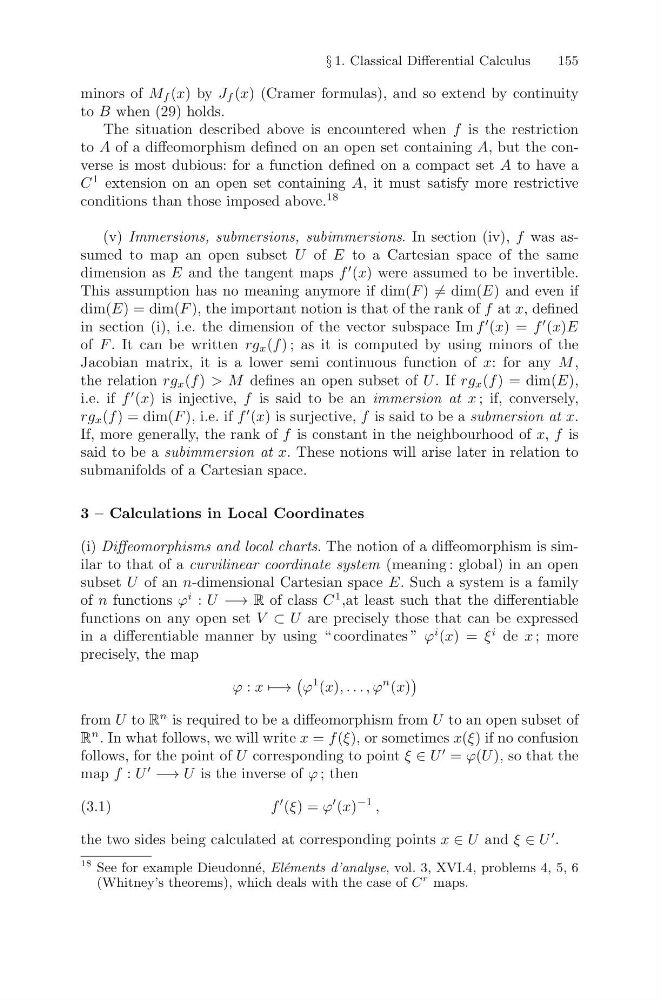
(v) Immersions, submersions, subimmersions. In section (iv), f was assumed to map an open subset U of E to a Cartesian space of the same
dimension as E and the tangent maps f
(x) were assumed to be invertible.
This assumption has no meaning anymore if dim(F ) = dim(E) and even if
dim(E) = dim(F ), the important notion is that of the rank of f at x, defined
in section (i), i.e. the dimension of the vector subspace Im f
(x) = f
(x)E
of F . It can be written rg x (f ) ; as it is computed by using minors of the
Jacobian matrix, it is a lower semi continuous function of x: for any M ,
the relation rg x (f ) > M defines an open subset of U . If rg x (f ) = dim(E),
i.e. if f
(x) is injective, f is said to be an immersion at x ; if, conversely,
rg x (f ) = dim(F ), i.e. if f
(x) is surjective, f is said to be a submersion at x.
If, more generally, the rank of f is constant in the neighbourhood of x, f is
said to be a subimmersion at x. These notions will arise later in relation to
submanifolds of a Cartesian space.
3 – Calculations in Local Coordinates
(i) Diffeomorphisms and local charts. The notion of a diffeomorphism is similar to that of a curvilinear coordinate system (meaning : global) in an open
subset U of an n-dimensional Cartesian space E. Such a system is a family
of n functions ϕ
i : U −→ R of class C
1 ,at least such that the differentiable
functions on any open set V ⊂ U are precisely those that can be expressed
in a differentiable manner by using “ coordinates ” ϕ
i (x) = ξ
i de x ; more
precisely, the map
ϕ : x −→
ϕ
1 (x), . . . , ϕ
n (x)
from U to R
n is required to be a diffeomorphism from U to an open subset of
R
n . In what follows, we will write x = f (ξ), or sometimes x(ξ) if no confusion
follows, for the point of U corresponding to point ξ ∈ U
= ϕ(U ), so that the
map f : U
−→ U is the inverse of ϕ ; then
f
(ξ) = ϕ
(x)
−1 ,
(3.1)
the two sides being calculated at corresponding points x ∈ U and ξ ∈ U
.
18 See for example Dieudonn´ e, El´ ements d’analyse, vol. 3, XVI.4, problems 4, 5, 6
(Whitney’s theorems), which deals with the case of C
r maps.
155
minors of M f (x) by J f (x) (Cramer formulas), and so extend by continuity
to B when (29) holds.
The situation described above is encountered when f is the restriction
to A of a diffeomorphism defined on an open set containing A, but the converse is most dubious: for a function defined on a compact set A to have a
C
1 extension on an open set containing A, it must satisfy more restrictive
conditions than those imposed above.
18
(v) Immersions, submersions, subimmersions. In section (iv), f was assumed to map an open subset U of E to a Cartesian space of the same
dimension as E and the tangent maps f
(x) were assumed to be invertible.
This assumption has no meaning anymore if dim(F ) = dim(E) and even if
dim(E) = dim(F ), the important notion is that of the rank of f at x, defined
in section (i), i.e. the dimension of the vector subspace Im f
(x) = f
(x)E
of F . It can be written rg x (f ) ; as it is computed by using minors of the
Jacobian matrix, it is a lower semi continuous function of x: for any M ,
the relation rg x (f ) > M defines an open subset of U . If rg x (f ) = dim(E),
i.e. if f
(x) is injective, f is said to be an immersion at x ; if, conversely,
rg x (f ) = dim(F ), i.e. if f
(x) is surjective, f is said to be a submersion at x.
If, more generally, the rank of f is constant in the neighbourhood of x, f is
said to be a subimmersion at x. These notions will arise later in relation to
submanifolds of a Cartesian space.
3 – Calculations in Local Coordinates
(i) Diffeomorphisms and local charts. The notion of a diffeomorphism is similar to that of a curvilinear coordinate system (meaning : global) in an open
subset U of an n-dimensional Cartesian space E. Such a system is a family
of n functions ϕ
i : U −→ R of class C
1 ,at least such that the differentiable
functions on any open set V ⊂ U are precisely those that can be expressed
in a differentiable manner by using “ coordinates ” ϕ
i (x) = ξ
i de x ; more
precisely, the map
ϕ : x −→
ϕ
1 (x), . . . , ϕ
n (x)
from U to R
n is required to be a diffeomorphism from U to an open subset of
R
n . In what follows, we will write x = f (ξ), or sometimes x(ξ) if no confusion
follows, for the point of U corresponding to point ξ ∈ U
= ϕ(U ), so that the
map f : U
−→ U is the inverse of ϕ ; then
f
(ξ) = ϕ
(x)
−1 ,
(3.1)
the two sides being calculated at corresponding points x ∈ U and ξ ∈ U
.
18 See for example Dieudonn´ e, El´ ements d’analyse, vol. 3, XVI.4, problems 4, 5, 6
(Whitney’s theorems), which deals with the case of C
r maps.