

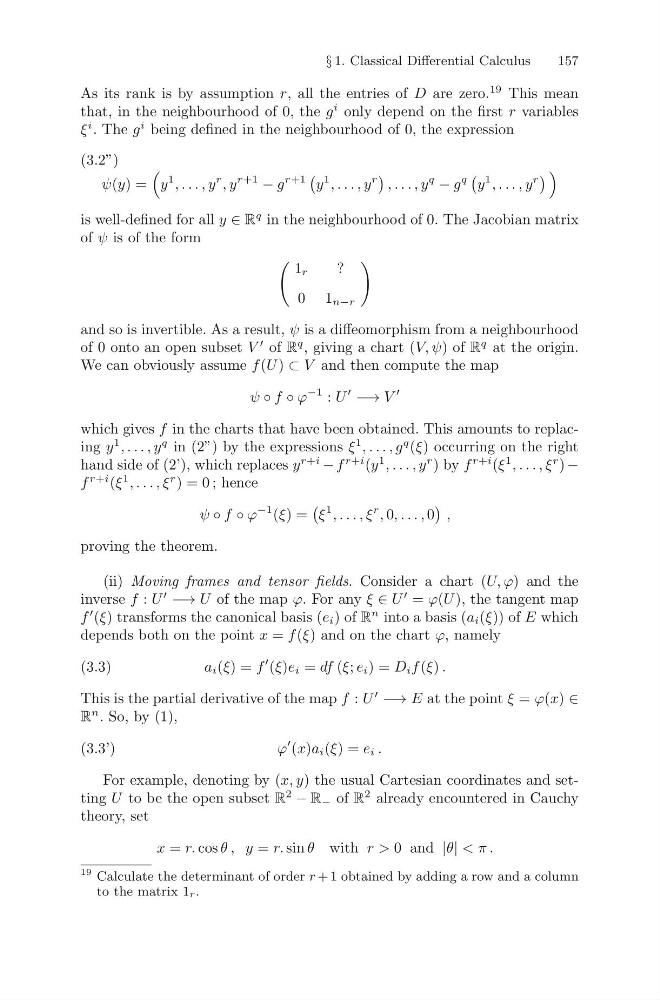
§ 1. Classical Differential Calculus
157
As its rank is by assumption r, all the entries of D are zero.
19 This mean
that, in the neighbourhood of 0, the g
i only depend on the first r variables
ξ
i . The g
i being defined in the neighbourhood of 0, the expression
ψ(y) =
y
1 , . . . , y
r , y
r+1
− g
r+1
y
1 , . . . , y
r
, . . . , y
q
− g
q
y
1 , . . . , y
r
(3.2”)
is well-defined for all y ∈ R
q in the neighbourhood of 0. The Jacobian matrix
of ψ is of the form
1 r
?
0 1 n−r
and so is invertible. As a result, ψ is a diffeomorphism from a neighbourhood
of 0 onto an open subset V
of R
q , giving a chart (V, ψ) of R
q at the origin.
We can obviously assume f (U ) ⊂ V and then compute the map
ψ ◦ f ◦ ϕ
−1 : U
−→ V
which gives f in the charts that have been obtained. This amounts to replacing y
1 , . . . , y
q in (2”) by the expressions ξ
1 , . . . , g
q (ξ) occurring on the right
hand side of (2’), which replaces y
r+i
− f
r+i (y
1 , . . . , y
r ) by f
r+i (ξ
1 , . . . , ξ
r ) −
f
r+i (ξ
1 , . . . , ξ
r ) = 0 ; hence
ψ ◦ f ◦ ϕ
−1 (ξ) =
ξ
1 , . . . , ξ
r , 0, . . . , 0
,
proving the theorem.
(ii) Moving frames and tensor fields. Consider a chart (U, ϕ) and the
inverse f : U
−→ U of the map ϕ. For any ξ ∈ U
= ϕ(U ), the tangent map
f
(ξ) transforms the canonical basis (e i ) of R
n into a basis (a i (ξ)) of E which
depends both on the point x = f (ξ) and on the chart ϕ, namely
a i (ξ) = f
(ξ)e i = df (ξ; e i ) = D i f (ξ) .
(3.3)
This is the partial derivative of the map f : U
−→ E at the point ξ = ϕ(x) ∈
R
n . So, by (1),
ϕ
(x)a i (ξ) = e i .
(3.3’)
For example, denoting by (x, y) the usual Cartesian coordinates and setting U to be the open subset R
2
− R − of R
2 already encountered in Cauchy
theory, set
x = r. cos θ , y = r. sin θ with r > 0 and |θ| < π .
19 Calculate the determinant of order r + 1 obtained by adding a row and a column
to the matrix 1r.
157
As its rank is by assumption r, all the entries of D are zero.
19 This mean
that, in the neighbourhood of 0, the g
i only depend on the first r variables
ξ
i . The g
i being defined in the neighbourhood of 0, the expression
ψ(y) =
y
1 , . . . , y
r , y
r+1
− g
r+1
y
1 , . . . , y
r
, . . . , y
q
− g
q
y
1 , . . . , y
r
(3.2”)
is well-defined for all y ∈ R
q in the neighbourhood of 0. The Jacobian matrix
of ψ is of the form
1 r
?
0 1 n−r
and so is invertible. As a result, ψ is a diffeomorphism from a neighbourhood
of 0 onto an open subset V
of R
q , giving a chart (V, ψ) of R
q at the origin.
We can obviously assume f (U ) ⊂ V and then compute the map
ψ ◦ f ◦ ϕ
−1 : U
−→ V
which gives f in the charts that have been obtained. This amounts to replacing y
1 , . . . , y
q in (2”) by the expressions ξ
1 , . . . , g
q (ξ) occurring on the right
hand side of (2’), which replaces y
r+i
− f
r+i (y
1 , . . . , y
r ) by f
r+i (ξ
1 , . . . , ξ
r ) −
f
r+i (ξ
1 , . . . , ξ
r ) = 0 ; hence
ψ ◦ f ◦ ϕ
−1 (ξ) =
ξ
1 , . . . , ξ
r , 0, . . . , 0
,
proving the theorem.
(ii) Moving frames and tensor fields. Consider a chart (U, ϕ) and the
inverse f : U
−→ U of the map ϕ. For any ξ ∈ U
= ϕ(U ), the tangent map
f
(ξ) transforms the canonical basis (e i ) of R
n into a basis (a i (ξ)) of E which
depends both on the point x = f (ξ) and on the chart ϕ, namely
a i (ξ) = f
(ξ)e i = df (ξ; e i ) = D i f (ξ) .
(3.3)
This is the partial derivative of the map f : U
−→ E at the point ξ = ϕ(x) ∈
R
n . So, by (1),
ϕ
(x)a i (ξ) = e i .
(3.3’)
For example, denoting by (x, y) the usual Cartesian coordinates and setting U to be the open subset R
2
− R − of R
2 already encountered in Cauchy
theory, set
x = r. cos θ , y = r. sin θ with r > 0 and |θ| < π .
19 Calculate the determinant of order r + 1 obtained by adding a row and a column
to the matrix 1r.