

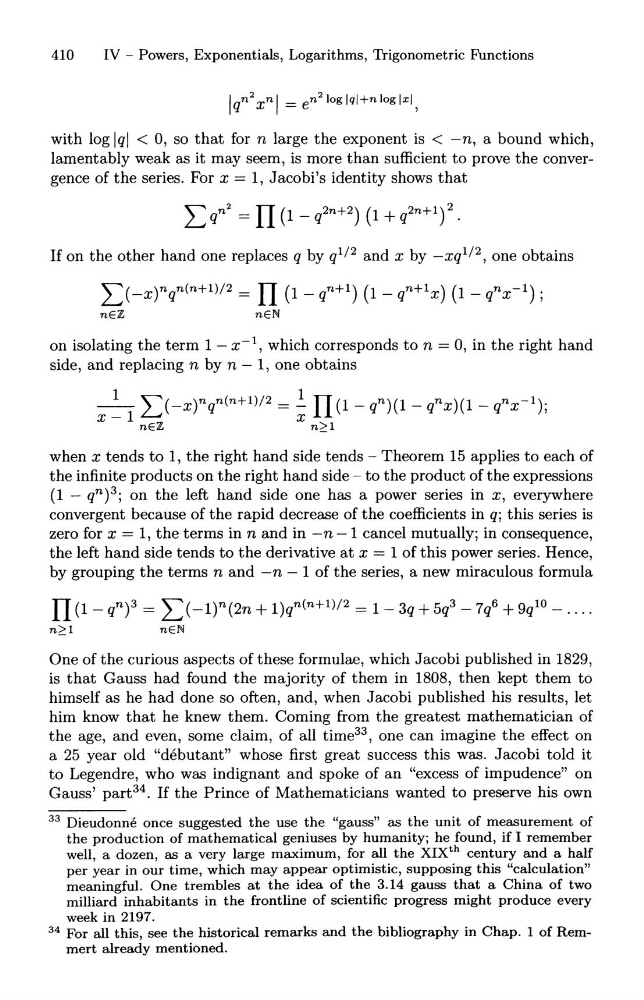
410
IV - Powers, Exponentials, Logarithms, Trigonometric Functions
with log Iql < 0, so that for n large the exponent is < -n, a bound which,
lamentably weak as it may seem, is more than sufficient to prove the convergence of the series. For x = 1, Jacobi's identity shows that
If on the other hand one replaces q by ql/2 and x by _ xq l/2, one obtains
nEZ
nEN
on isolating the term 1 - X-I, which corresponds to n = 0, in the right hand
side, and replacing n by n - 1, one obtains
when x tends to 1, the right hand side tends - Theorem 15 applies to each of
the infinite products on the right hand side - to the product of the expressions
(1 - qn)3 j on the left hand side one has a power series in x, everywhere
convergent because of the rapid decrease of the coefficients in qj this series is
zero for x = 1, the terms in n and in -n - 1 cancel mutuallyj in consequence,
the left hand side tends to the derivative at x = 1 of this power series. Hence,
by grouping the terms nand -n - 1 of the series, a new miraculous formula
One of the curious aspects of these formulae, which Jacobi published in 1829,
is that Gauss had found the majority of them in 1808, then kept them to
himself as he had done so often, and, when Jacobi published his results, let
him know that he knew them. Coming from the greatest mathematician of
the age, and even, some claim, of all time 33 , one can imagine the effect on
a 25 year old "debut ant" whose first great success this was. Jacobi told it
to Legendre, who was indignant and spoke of an "excess of impudence" on
Gauss' part34. If the Prince of Mathematicians wanted to preserve his own
33 Dieudonne once suggested the use the "gauss" as the unit of measurement of
the production of mathematical geniuses by humanity; he found, if I remember
well, a dozen, as a very large maximum, for all the XIX th century and a half
per year in our time, which may appear optimistic, supposing this "calculation"
meaningful. One trembles at the idea of the 3.14 gauss that a China of two
milliard inhabitants in the frontline of scientific progress might produce every
week in 2197.
34 For all this, see the historical remarks and the bibliography in Chap. 1 of Remmert already mentioned.
IV - Powers, Exponentials, Logarithms, Trigonometric Functions
with log Iql < 0, so that for n large the exponent is < -n, a bound which,
lamentably weak as it may seem, is more than sufficient to prove the convergence of the series. For x = 1, Jacobi's identity shows that
If on the other hand one replaces q by ql/2 and x by _ xq l/2, one obtains
nEZ
nEN
on isolating the term 1 - X-I, which corresponds to n = 0, in the right hand
side, and replacing n by n - 1, one obtains
when x tends to 1, the right hand side tends - Theorem 15 applies to each of
the infinite products on the right hand side - to the product of the expressions
(1 - qn)3 j on the left hand side one has a power series in x, everywhere
convergent because of the rapid decrease of the coefficients in qj this series is
zero for x = 1, the terms in n and in -n - 1 cancel mutuallyj in consequence,
the left hand side tends to the derivative at x = 1 of this power series. Hence,
by grouping the terms nand -n - 1 of the series, a new miraculous formula
One of the curious aspects of these formulae, which Jacobi published in 1829,
is that Gauss had found the majority of them in 1808, then kept them to
himself as he had done so often, and, when Jacobi published his results, let
him know that he knew them. Coming from the greatest mathematician of
the age, and even, some claim, of all time 33 , one can imagine the effect on
a 25 year old "debut ant" whose first great success this was. Jacobi told it
to Legendre, who was indignant and spoke of an "excess of impudence" on
Gauss' part34. If the Prince of Mathematicians wanted to preserve his own
33 Dieudonne once suggested the use the "gauss" as the unit of measurement of
the production of mathematical geniuses by humanity; he found, if I remember
well, a dozen, as a very large maximum, for all the XIX th century and a half
per year in our time, which may appear optimistic, supposing this "calculation"
meaningful. One trembles at the idea of the 3.14 gauss that a China of two
milliard inhabitants in the frontline of scientific progress might produce every
week in 2197.
34 For all this, see the historical remarks and the bibliography in Chap. 1 of Remmert already mentioned.