

§3. Infinite products
409
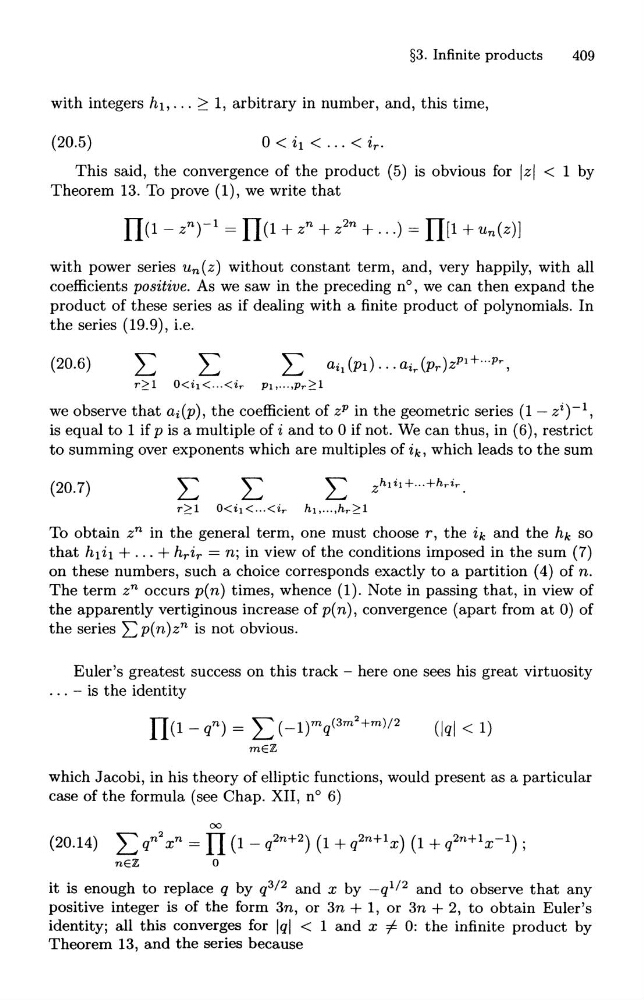
with integers hI, . .. 2: 1, arbitrary in number, and, this time,
(20.5)
0< i l < ... < ir.
This said, the convergence of the product (5) is obvious for Izl < 1 by
Theorem 13. To prove (1), we write that
with power series Un (z) without constant term, and, very happily, with all
coefficients positive. As we saw in the preceding nO, we can then expand the
product of these series as if dealing with a finite product of polynomials. In
the series (19.9), i.e.
(20.6)
we observe that ai(p), the coefficient of zP in the geometric series (1 - Zi)-l,
is equal to 1 if p is a multiple of i and to 0 if not. We can thus, in (6), restrict
to summing over exponents which are multiples of ik, which leads to the sum
(20.7)
To obtain zn in the general term, one must choose r, the ik and the hk so
that hlil + ... + hrir = n; in view of the conditions imposed in the sum (7)
on these numbers, such a choice corresponds exactly to a partition (4) of n.
The term zn occurs p(n) times, whence (1). Note in passing that, in view of
the apparently vertiginous increase of p(n), convergence (apart from at 0) of
the series l:p(n)zn is not obvious.
Euler's greatest success on this track - here one sees his great virtuosity
... - is the identity
IT (1 - qn) = L (_I)m q(3m
2 +m)/2
mEZ
(Iql < 1)
which Jacobi, in his theory of elliptic functions, would present as a particular
case of the formula (see Chap. XII, nO 6)
00
(20.14) L qn
2 xn = IT (1 - q2n+2) (1 + q2n+1x) (1 + q2n+l x -l) ;
nEZ
0
it is enough to replace q by q3/2 and x by _ql/2 and to observe that any
positive integer is of the form 3n, or 3n + 1, or 3n + 2, to obtain Euler's
identity; all this converges for Iql < 1 and x =I- 0: the infinite product by
Theorem 13, and the series because
409
with integers hI, . .. 2: 1, arbitrary in number, and, this time,
(20.5)
0< i l < ... < ir.
This said, the convergence of the product (5) is obvious for Izl < 1 by
Theorem 13. To prove (1), we write that
with power series Un (z) without constant term, and, very happily, with all
coefficients positive. As we saw in the preceding nO, we can then expand the
product of these series as if dealing with a finite product of polynomials. In
the series (19.9), i.e.
(20.6)
we observe that ai(p), the coefficient of zP in the geometric series (1 - Zi)-l,
is equal to 1 if p is a multiple of i and to 0 if not. We can thus, in (6), restrict
to summing over exponents which are multiples of ik, which leads to the sum
(20.7)
To obtain zn in the general term, one must choose r, the ik and the hk so
that hlil + ... + hrir = n; in view of the conditions imposed in the sum (7)
on these numbers, such a choice corresponds exactly to a partition (4) of n.
The term zn occurs p(n) times, whence (1). Note in passing that, in view of
the apparently vertiginous increase of p(n), convergence (apart from at 0) of
the series l:p(n)zn is not obvious.
Euler's greatest success on this track - here one sees his great virtuosity
... - is the identity
IT (1 - qn) = L (_I)m q(3m
2 +m)/2
mEZ
(Iql < 1)
which Jacobi, in his theory of elliptic functions, would present as a particular
case of the formula (see Chap. XII, nO 6)
00
(20.14) L qn
2 xn = IT (1 - q2n+2) (1 + q2n+1x) (1 + q2n+l x -l) ;
nEZ
0
it is enough to replace q by q3/2 and x by _ql/2 and to observe that any
positive integer is of the form 3n, or 3n + 1, or 3n + 2, to obtain Euler's
identity; all this converges for Iql < 1 and x =I- 0: the infinite product by
Theorem 13, and the series because