

408
IV - Powers, Exponentials, Logarithms, Trigonometric Functions
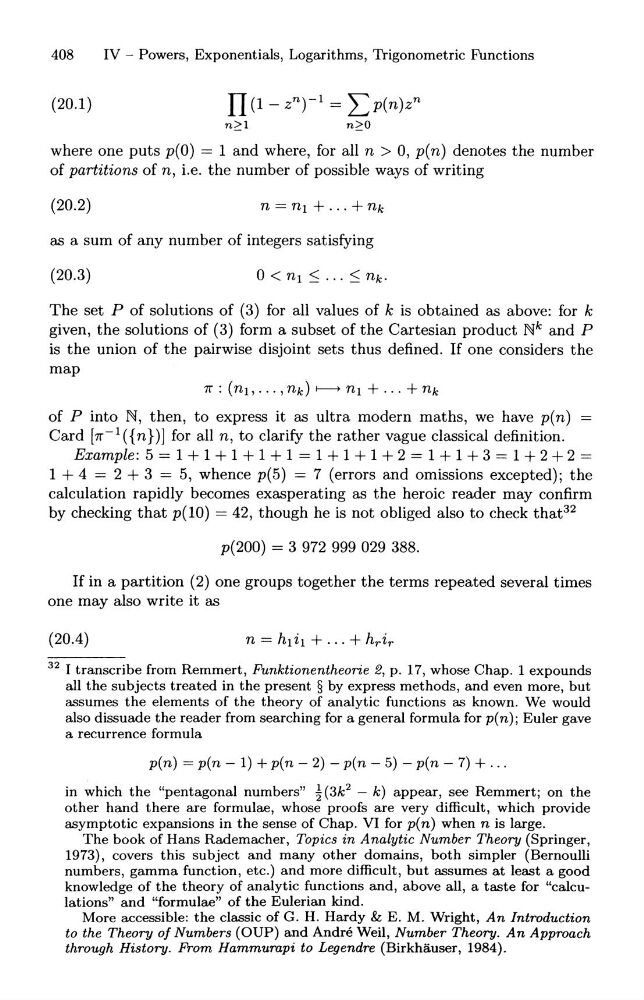
where one puts p(O) = 1 and where, for all n > 0, p(n) denotes the number
of partitions of n, i.e. the number of possible ways of writing
(20.2)
as a sum of any number of integers satisfying
(20.3)
The set P of solutions of (3) for all values of k is obtained as above: for k
given, the solutions of (3) form a subset of the Cartesian product N k and P
is the union of the pairwise disjoint sets thus defined. If one considers the
map
7r: (nl, ... , nk) I----> nl + ... + nk
of Pinto N, then, to express it as ultra modern maths, we have p( n) =
Card [7r- I ({n})] for all n, to clarify the rather vague classical definition.
Example: 5 = 1 + 1 + 1 + 1 + 1 = 1 + 1 + 1 + 2 = 1 + 1 + 3 = 1 + 2 + 2 =
1 + 4 = 2 + 3 = 5, whence p(5) = 7 (errors and omissions excepted); the
calculation rapidly becomes exasperating as the heroic reader may confirm
by checking that p(lO) = 42, though he is not obliged also to check that 32
p(200) = 3 972 999 029 388.
If in a partition (2) one groups together the terms repeated several times
one may also write it as
(20.4)
32 I transcribe from Remmert, F'unktionentheorie 2, p. 17, whose Chap. 1 expounds
all the subjects treated in the present § by express methods, and even more, but
assumes the elements of the theory of analytic functions as known. We would
also dissuade the reader from searching for a general formula for p( n); Euler gave
a recurrence formula
p(n) = p(n - 1) + p(n - 2) - p(n - 5) - p(n - 7) + ...
in which the "pentagonal numbers" H3k 2 - k) appear, see Remmert; on the
other hand there are formulae, whose proofs are very difficult, which provide
asymptotic expansions in the sense of Chap. VI for p(n) when n is large.
The book of Hans Rademacher, Topics in Analytic Number Theory (Springer,
1973), covers this subject and many other domains, both simpler (Bernoulli
numbers, gamma function, etc.) and more difficult, but assumes at least a good
knowledge of the theory of analytic functions and, above all, a taste for "calculations" and "formulae" of the Eulerian kind.
More accessible: the classic of G. H. Hardy & E. M. Wright, An Introduction
to the Theory of Numbers (OUP) and Andre Weil, Number Theory. An Approach
through History. Prom Hammumpi to Legendre (Birkhauser, 1984).
IV - Powers, Exponentials, Logarithms, Trigonometric Functions
where one puts p(O) = 1 and where, for all n > 0, p(n) denotes the number
of partitions of n, i.e. the number of possible ways of writing
(20.2)
as a sum of any number of integers satisfying
(20.3)
The set P of solutions of (3) for all values of k is obtained as above: for k
given, the solutions of (3) form a subset of the Cartesian product N k and P
is the union of the pairwise disjoint sets thus defined. If one considers the
map
7r: (nl, ... , nk) I----> nl + ... + nk
of Pinto N, then, to express it as ultra modern maths, we have p( n) =
Card [7r- I ({n})] for all n, to clarify the rather vague classical definition.
Example: 5 = 1 + 1 + 1 + 1 + 1 = 1 + 1 + 1 + 2 = 1 + 1 + 3 = 1 + 2 + 2 =
1 + 4 = 2 + 3 = 5, whence p(5) = 7 (errors and omissions excepted); the
calculation rapidly becomes exasperating as the heroic reader may confirm
by checking that p(lO) = 42, though he is not obliged also to check that 32
p(200) = 3 972 999 029 388.
If in a partition (2) one groups together the terms repeated several times
one may also write it as
(20.4)
32 I transcribe from Remmert, F'unktionentheorie 2, p. 17, whose Chap. 1 expounds
all the subjects treated in the present § by express methods, and even more, but
assumes the elements of the theory of analytic functions as known. We would
also dissuade the reader from searching for a general formula for p( n); Euler gave
a recurrence formula
p(n) = p(n - 1) + p(n - 2) - p(n - 5) - p(n - 7) + ...
in which the "pentagonal numbers" H3k 2 - k) appear, see Remmert; on the
other hand there are formulae, whose proofs are very difficult, which provide
asymptotic expansions in the sense of Chap. VI for p(n) when n is large.
The book of Hans Rademacher, Topics in Analytic Number Theory (Springer,
1973), covers this subject and many other domains, both simpler (Bernoulli
numbers, gamma function, etc.) and more difficult, but assumes at least a good
knowledge of the theory of analytic functions and, above all, a taste for "calculations" and "formulae" of the Eulerian kind.
More accessible: the classic of G. H. Hardy & E. M. Wright, An Introduction
to the Theory of Numbers (OUP) and Andre Weil, Number Theory. An Approach
through History. Prom Hammumpi to Legendre (Birkhauser, 1984).