

§3. Infinite products
411
reputation, sufficiently established by then, even forgetting the first operational telegraph (it connected his office to that of the astronomer Wilhelm
Weber, at G6ttingen), he failed, since everyone has always attributed these
results to Jacobi: whoever publishes first has the proper title, is the winner.
Present-day Americans, who, in all subjects, are under the influence of the
savage Darwinism of the XIX th century, have found the "apt" formulation:
Publish or perish.
The reader will maybe think that this is all the mode of 1750 or 1830 and
is no longer of interest; but no. This kind of formula continued to impassion
respectable mathematicians like Dirichlet, Hermite, Dedekind, Leopold Kronecker, Felix Klein, Henri Poincare, Erich Hecke, Carl Ludwig Siegel, etc.,
up to about 1940. They have since been generalised formidably over about
twenty years in the ultra modern framework of the theory of semi-simple Lie
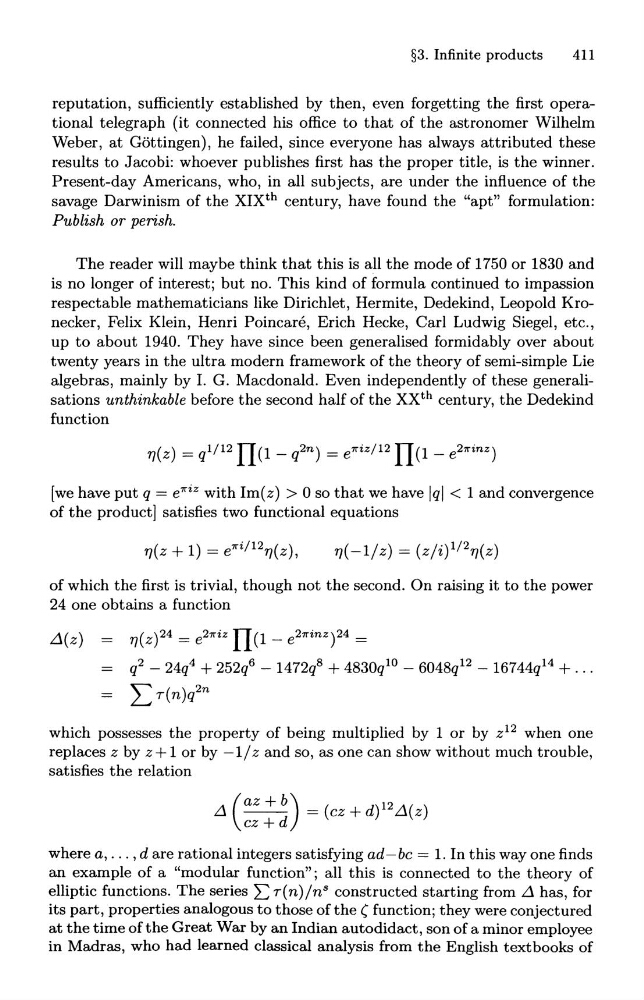
algebras, mainly by I. G. Macdonald. Even independently of these generalisations unthinkable before the second half of the XXth century, the Dedekind
function
17(Z) = ql/12 II (1 - q2n) = ewiz/12 II (1 _ e2winz)
[we have put q = e wiz with Im(z) > 0 so that we have /q/ < 1 and convergence
of the product] satisfies two functional equations
17(Z + 1) = e wi / 12 17(Z),
of which the first is trivial, though not the second. On raising it to the power
24 one obtains a function
L1(z)
17(z)24 = e 2wiz II(1- e2winZ)24 =
q2 _ 24q4 + 252q6 _ 1472q8 + 4830ql0 - 6048q12 - 16744q14 + ...
LT(n)q2n
which possesses the property of being multiplied by 1 or by Z12 when one
replaces z by z + 1 or by -1/ z and so, as one can show without much trouble,
satisfies the relation
where a, . .. ,d are rational integers satisfying ad-be = 1. In this way one finds
an example of a "modular function"; all this is connected to the theory of
elliptic functions. The series L: T(n)/n 8 constructed starting from L1 has, for
its part, properties analogous to those of the ( function; they were conjectured
at the time of the Great War by an Indian autodidact, son of a minor employee
in Madras, who had learned classical analysis from the English textbooks of
411
reputation, sufficiently established by then, even forgetting the first operational telegraph (it connected his office to that of the astronomer Wilhelm
Weber, at G6ttingen), he failed, since everyone has always attributed these
results to Jacobi: whoever publishes first has the proper title, is the winner.
Present-day Americans, who, in all subjects, are under the influence of the
savage Darwinism of the XIX th century, have found the "apt" formulation:
Publish or perish.
The reader will maybe think that this is all the mode of 1750 or 1830 and
is no longer of interest; but no. This kind of formula continued to impassion
respectable mathematicians like Dirichlet, Hermite, Dedekind, Leopold Kronecker, Felix Klein, Henri Poincare, Erich Hecke, Carl Ludwig Siegel, etc.,
up to about 1940. They have since been generalised formidably over about
twenty years in the ultra modern framework of the theory of semi-simple Lie
algebras, mainly by I. G. Macdonald. Even independently of these generalisations unthinkable before the second half of the XXth century, the Dedekind
function
17(Z) = ql/12 II (1 - q2n) = ewiz/12 II (1 _ e2winz)
[we have put q = e wiz with Im(z) > 0 so that we have /q/ < 1 and convergence
of the product] satisfies two functional equations
17(Z + 1) = e wi / 12 17(Z),
of which the first is trivial, though not the second. On raising it to the power
24 one obtains a function
L1(z)
17(z)24 = e 2wiz II(1- e2winZ)24 =
q2 _ 24q4 + 252q6 _ 1472q8 + 4830ql0 - 6048q12 - 16744q14 + ...
LT(n)q2n
which possesses the property of being multiplied by 1 or by Z12 when one
replaces z by z + 1 or by -1/ z and so, as one can show without much trouble,
satisfies the relation
where a, . .. ,d are rational integers satisfying ad-be = 1. In this way one finds
an example of a "modular function"; all this is connected to the theory of
elliptic functions. The series L: T(n)/n 8 constructed starting from L1 has, for
its part, properties analogous to those of the ( function; they were conjectured
at the time of the Great War by an Indian autodidact, son of a minor employee
in Madras, who had learned classical analysis from the English textbooks of