

§3. Infinite products
403
etc. In the first series, one sums over the p > 0, in the second over all pairs
p,q such that 0 < P < q, in third over the triplets such that 0 < p < q < r,
etc., as one does in ordinary algebra. Now this also tells you for example that
whence the immortal formulae
etc.
19 - Expansion of an infinite product in series
In Chapter 10 of his Introductio Euler dealt with a much more general formula
that he wrote as
(19.1)
1 + Ax + Bx 2 + Cx 3 + ... = (1 + aX)(l + bX)(l + ex) ... ;
and sought to calculate A, B, ... as functions of a, b, .... For him, "it is necessary, as we know in Algebra" , that
A be equal to the sum of all the magnitudes a, b, ... , so equal to a+b+ ... ,
B be equal to the sum of the pairwise products of these magnitudes, so to
ab + ac + ad + bc + bd + ed + ... ,
C be equal to the sum of their products in threes, so to abc + abd + bed +
aed+ ... ,
etc. Euler then shows how to deduce from this the sum of the squares, or of
the cubes, etc .... of the coefficients a, b, ... This is a rather difficult exercise
in the manipulation of multiple series; the reader can ignore it without worry,
as also the following n O •
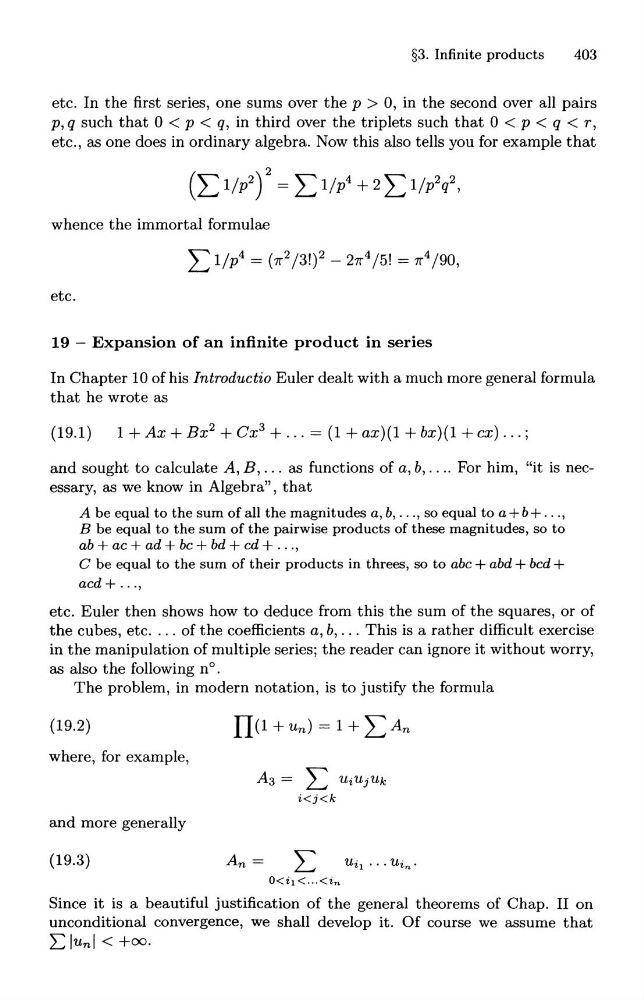
The problem, in modern notation, is to justify the formula
(19.2)
where, for example,
and more generally
(19.3)
A3 = L UiUjUk
i
L Uil·· .Uin •
O
unconditional convergence, we shall develop it. Of course we assume that
Elunl < +00.
403
etc. In the first series, one sums over the p > 0, in the second over all pairs
p,q such that 0 < P < q, in third over the triplets such that 0 < p < q < r,
etc., as one does in ordinary algebra. Now this also tells you for example that
whence the immortal formulae
etc.
19 - Expansion of an infinite product in series
In Chapter 10 of his Introductio Euler dealt with a much more general formula
that he wrote as
(19.1)
1 + Ax + Bx 2 + Cx 3 + ... = (1 + aX)(l + bX)(l + ex) ... ;
and sought to calculate A, B, ... as functions of a, b, .... For him, "it is necessary, as we know in Algebra" , that
A be equal to the sum of all the magnitudes a, b, ... , so equal to a+b+ ... ,
B be equal to the sum of the pairwise products of these magnitudes, so to
ab + ac + ad + bc + bd + ed + ... ,
C be equal to the sum of their products in threes, so to abc + abd + bed +
aed+ ... ,
etc. Euler then shows how to deduce from this the sum of the squares, or of
the cubes, etc .... of the coefficients a, b, ... This is a rather difficult exercise
in the manipulation of multiple series; the reader can ignore it without worry,
as also the following n O •
The problem, in modern notation, is to justify the formula
(19.2)
where, for example,
and more generally
(19.3)
A3 = L UiUjUk
i
L Uil·· .Uin •
O
unconditional convergence, we shall develop it. Of course we assume that
Elunl < +00.