

402
IV - Powers, Exponentials, Logarithms, Trigonometric Functions
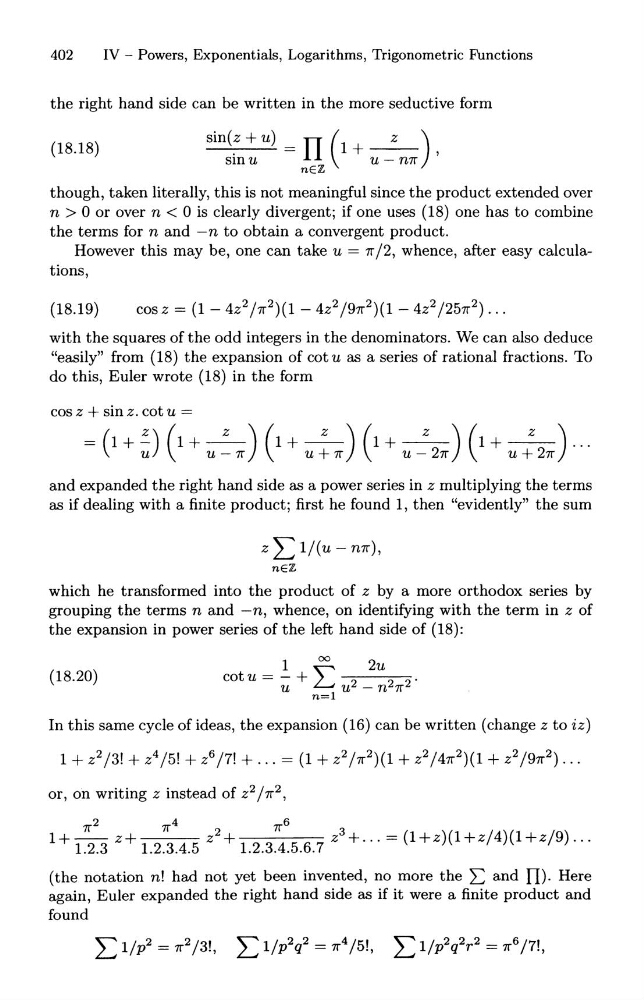
the right hand side can be written in the more seductive form
sin(~ + u) = II (1 + _z_) ,
smu
u - n7f
nEZ
(18.18)
though, taken literally, this is not meaningful since the product extended over
n > 0 or over n < 0 is clearly divergent; if one uses (18) one has to combine
the terms for nand -n to obtain a convergent product.
However this may be, one can take u = 7f /2, whence, after easy calculations,
(18.19)
with the squares of the odd integers in the denominators. We can also deduce
"easily" from (18) the expansion of cot u as a series of rational fractions. To
do this, Euler wrote (18) in the form
cos z + sin z. cot u =
= (1 + ~) (1 + _ z ) (1 + _ z ) (1 + _ z ) (1 + _ z ) ...
u
u - 7f
U + 7f
U - 27f
U + 27f
and expanded the right hand side as a power series in z multiplying the terms
as if dealing with a finite product; first he found 1, then "evidently" the sum
z L 1/(u - n7f),
nEZ
which he transformed into the product of z by a more orthodox series by
grouping the terms nand -n, whence, on identifying with the term in z of
the expansion in power series of the left hand side of (18):
(18.20)
1
00
2u
cot u = - + L 2 2 2·
U
U - n 7f
n=l
In this same cycle of ideas, the expansion (16) can be written (change z to iz)
or, on writing z instead of Z2 / 7f2 ,
7f2
7f4
7f6
1+-- z+
z2+
z3+ ... = (l+z)(I+z/4)(I+z/9) ...
1.2.3
1.2.3.4.5
1.2.3.4.5.6.7
(the notation n! had not yet been invented, no more the ~ and I1). Here
again, Euler expanded the right hand side as if it were a finite product and
found
IV - Powers, Exponentials, Logarithms, Trigonometric Functions
the right hand side can be written in the more seductive form
sin(~ + u) = II (1 + _z_) ,
smu
u - n7f
nEZ
(18.18)
though, taken literally, this is not meaningful since the product extended over
n > 0 or over n < 0 is clearly divergent; if one uses (18) one has to combine
the terms for nand -n to obtain a convergent product.
However this may be, one can take u = 7f /2, whence, after easy calculations,
(18.19)
with the squares of the odd integers in the denominators. We can also deduce
"easily" from (18) the expansion of cot u as a series of rational fractions. To
do this, Euler wrote (18) in the form
cos z + sin z. cot u =
= (1 + ~) (1 + _ z ) (1 + _ z ) (1 + _ z ) (1 + _ z ) ...
u
u - 7f
U + 7f
U - 27f
U + 27f
and expanded the right hand side as a power series in z multiplying the terms
as if dealing with a finite product; first he found 1, then "evidently" the sum
z L 1/(u - n7f),
nEZ
which he transformed into the product of z by a more orthodox series by
grouping the terms nand -n, whence, on identifying with the term in z of
the expansion in power series of the left hand side of (18):
(18.20)
1
00
2u
cot u = - + L 2 2 2·
U
U - n 7f
n=l
In this same cycle of ideas, the expansion (16) can be written (change z to iz)
or, on writing z instead of Z2 / 7f2 ,
7f2
7f4
7f6
1+-- z+
z2+
z3+ ... = (l+z)(I+z/4)(I+z/9) ...
1.2.3
1.2.3.4.5
1.2.3.4.5.6.7
(the notation n! had not yet been invented, no more the ~ and I1). Here
again, Euler expanded the right hand side as if it were a finite product and
found