

404
IV - Powers, Exponentials, Logarithms, Trigonometric Functions
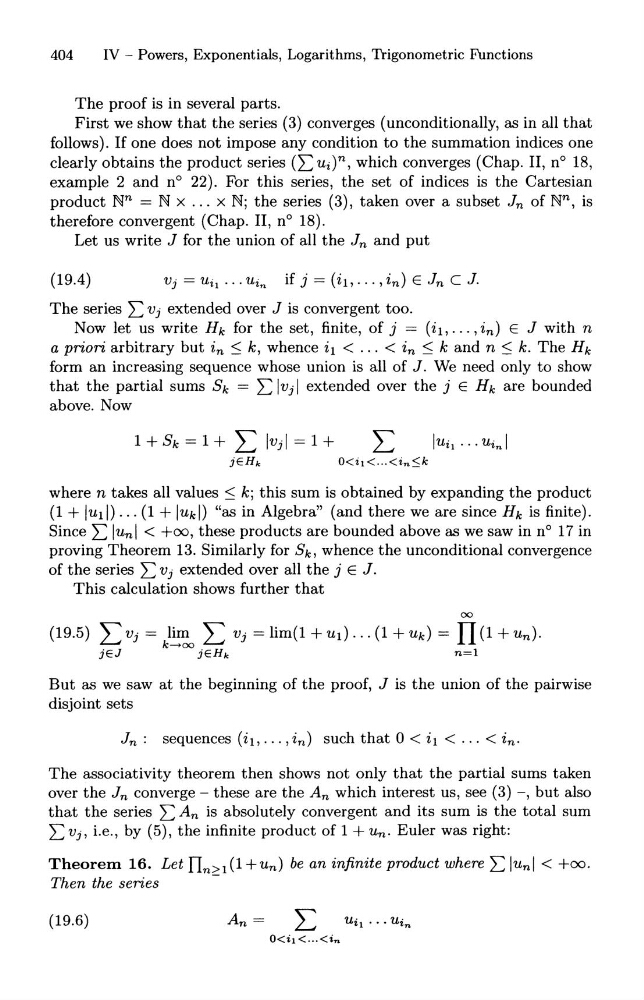
The proof is in several parts.
First we show that the series (3) converges (unconditionally, as in all that
follows). If one does not impose any condition to the summation indices one
clearly obtains the product series (E Ui)n, which converges (Chap. II, nO 18,
example 2 and nO 22). For this series, the set of indices is the Cartesian
product N n = N x ... x N; the series (3), taken over a subset I n of N n , is
therefore convergent (Chap. II, nO 18).
Let us write J for the union of all the I n and put
(19.4)
The series E Vj extended over J is convergent too.
Now let us write Hk for the set, finite, of j = (i l , ... , in) E J with n
a priori arbitrary but in ::; k, whence i l < ... < in ::; k and n ::; k. The Hk
form an increasing sequence whose union is all of J. We need only to show
that the partial sums Sk = E IVjl extended over the j E Hk are bounded
above. Now
where n takes all values::; k; this sum is obtained by expanding the product
(1 + IUII) ... (1 + IUkl) "as in Algebra" (and there we are since Hk is finite).
Since E Iunl < +00, these products are bounded above as we saw in nO 17 in
proving Theorem 13. Similarly for Sk, whence the unconditional convergence
of the series E Vj extended over all the j E J.
This calculation shows further that
00
(19.5) L Vj = kl~ L Vj = lim(1 + UI) ... (1 + Uk) = IT (1 + un).
jEJ
JERk
n=l
But as we saw at the beginning of the proof, J is the union of the pairwise
disjoint sets
I n : sequences (i l , ... ,in) such that 0 < i l < ... < in.
The associativity theorem then shows not only that the partial sums taken
over the I n converge - these are the An which interest us, see (3) -, but also
that the series E An is absolutely convergent and its sum is the total sum
EVj, i.e., by (5), the infinite product of 1 + Un. Euler was right:
Theorem 16. Let I1n>l(l+un ) be an infinite product where E Iunl < +00.
Then the series
-
(19.6)
An =
L Uil" .Uin
O
IV - Powers, Exponentials, Logarithms, Trigonometric Functions
The proof is in several parts.
First we show that the series (3) converges (unconditionally, as in all that
follows). If one does not impose any condition to the summation indices one
clearly obtains the product series (E Ui)n, which converges (Chap. II, nO 18,
example 2 and nO 22). For this series, the set of indices is the Cartesian
product N n = N x ... x N; the series (3), taken over a subset I n of N n , is
therefore convergent (Chap. II, nO 18).
Let us write J for the union of all the I n and put
(19.4)
The series E Vj extended over J is convergent too.
Now let us write Hk for the set, finite, of j = (i l , ... , in) E J with n
a priori arbitrary but in ::; k, whence i l < ... < in ::; k and n ::; k. The Hk
form an increasing sequence whose union is all of J. We need only to show
that the partial sums Sk = E IVjl extended over the j E Hk are bounded
above. Now
where n takes all values::; k; this sum is obtained by expanding the product
(1 + IUII) ... (1 + IUkl) "as in Algebra" (and there we are since Hk is finite).
Since E Iunl < +00, these products are bounded above as we saw in nO 17 in
proving Theorem 13. Similarly for Sk, whence the unconditional convergence
of the series E Vj extended over all the j E J.
This calculation shows further that
00
(19.5) L Vj = kl~ L Vj = lim(1 + UI) ... (1 + Uk) = IT (1 + un).
jEJ
JERk
n=l
But as we saw at the beginning of the proof, J is the union of the pairwise
disjoint sets
I n : sequences (i l , ... ,in) such that 0 < i l < ... < in.
The associativity theorem then shows not only that the partial sums taken
over the I n converge - these are the An which interest us, see (3) -, but also
that the series E An is absolutely convergent and its sum is the total sum
EVj, i.e., by (5), the infinite product of 1 + Un. Euler was right:
Theorem 16. Let I1n>l(l+un ) be an infinite product where E Iunl < +00.
Then the series
-
(19.6)
An =
L Uil" .Uin
O