

164
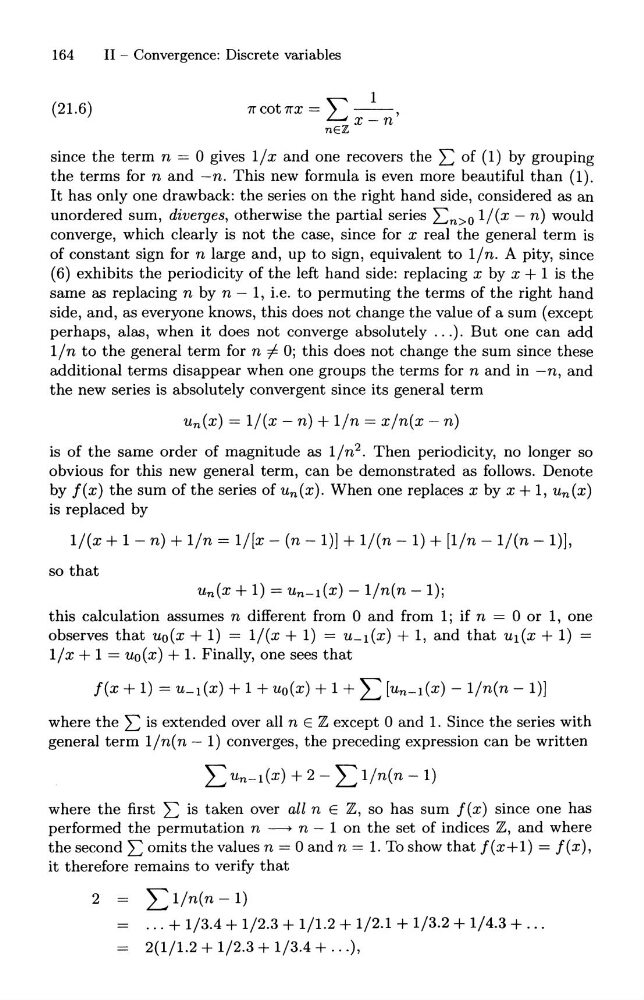
(21.6)
II - Convergence: Discrete variables
1
7r cot 7rX = """' - - ,
~x-n
nEZ
since the term n = 0 gives I/x and one recovers the L of (1) by grouping
the terms for nand -no This new formula is even more beautiful than (1).
It has only one drawback: the series on the right hand side, considered as an
unordered sum, diverges, otherwise the partial series Ln>o I/(x - n) would
converge, which clearly is not the case, since for x real the general term is
of constant sign for n large and, up to sign, equivalent to I/n. A pity, since
(6) exhibits the periodicity of the left hand side: replacing x by x + 1 is the
same as replacing n by n - 1, i.e. to permuting the terms of the right hand
side, and, as everyone knows, this does not change the value of a sum (except
perhaps, alas, when it does not converge absolutely ... ). But one can add
I/n to the general term for n :I 0; this does not change the sum since these
additional terms disappear when one groups the terms for n and in -n, and
the new series is absolutely convergent since its general term
Un(x) = I/(x - n) + I/n = x/n(x - n)
is of the same order of magnitude as I/n2. Then periodicity, no longer so
obvious for this new general term, can be demonstrated as follows. Denote
by f(x) the sum of the series of un(x). When one replaces x by x + 1, un(x)
is replaced by
I/(x + 1 - n) + I/n = I/[x - (n - 1)] + I/(n - 1) + [I/n - I/(n - 1)],
so that
Un(x + 1) = Un-l(X) - I/n(n -1);
this calculation assumes n different from 0 and from 1; if n = 0 or 1, one
observes that uo(x + 1) = I/(x + 1) = U_l(X) + 1, and that Ul(X + 1) =
I/x + 1 = uo(x) + 1. Finally, one sees that
f(x + 1) = U_l(X) + 1 + uo(x) + 1 + L [Un-l(X) - l/n(n - 1)]
where the L is extended over all n E IE except 0 and 1. Since the series with
general term I/n(n - 1) converges, the preceding expression can be written
L Un-l(X) + 2 - L l/n(n - 1)
where the first L is taken over all n E IE, so has sum f(x) since one has
performed the permutation n ---> n - 1 on the set of indices IE, and where
the second L omits the values n = 0 and n = 1. To show that f(x+I) = f(x),
it therefore remains to verify that
2
L1/n(n -1)
... + 1/3.4 + 1/2.3 + 1/1.2 + 1/2.1 + 1/3.2 + 1/4.3 + ...
2(1/1.2 + 1/2.3 + 1/3.4 + ... ),
(21.6)
II - Convergence: Discrete variables
1
7r cot 7rX = """' - - ,
~x-n
nEZ
since the term n = 0 gives I/x and one recovers the L of (1) by grouping
the terms for nand -no This new formula is even more beautiful than (1).
It has only one drawback: the series on the right hand side, considered as an
unordered sum, diverges, otherwise the partial series Ln>o I/(x - n) would
converge, which clearly is not the case, since for x real the general term is
of constant sign for n large and, up to sign, equivalent to I/n. A pity, since
(6) exhibits the periodicity of the left hand side: replacing x by x + 1 is the
same as replacing n by n - 1, i.e. to permuting the terms of the right hand
side, and, as everyone knows, this does not change the value of a sum (except
perhaps, alas, when it does not converge absolutely ... ). But one can add
I/n to the general term for n :I 0; this does not change the sum since these
additional terms disappear when one groups the terms for n and in -n, and
the new series is absolutely convergent since its general term
Un(x) = I/(x - n) + I/n = x/n(x - n)
is of the same order of magnitude as I/n2. Then periodicity, no longer so
obvious for this new general term, can be demonstrated as follows. Denote
by f(x) the sum of the series of un(x). When one replaces x by x + 1, un(x)
is replaced by
I/(x + 1 - n) + I/n = I/[x - (n - 1)] + I/(n - 1) + [I/n - I/(n - 1)],
so that
Un(x + 1) = Un-l(X) - I/n(n -1);
this calculation assumes n different from 0 and from 1; if n = 0 or 1, one
observes that uo(x + 1) = I/(x + 1) = U_l(X) + 1, and that Ul(X + 1) =
I/x + 1 = uo(x) + 1. Finally, one sees that
f(x + 1) = U_l(X) + 1 + uo(x) + 1 + L [Un-l(X) - l/n(n - 1)]
where the L is extended over all n E IE except 0 and 1. Since the series with
general term I/n(n - 1) converges, the preceding expression can be written
L Un-l(X) + 2 - L l/n(n - 1)
where the first L is taken over all n E IE, so has sum f(x) since one has
performed the permutation n ---> n - 1 on the set of indices IE, and where
the second L omits the values n = 0 and n = 1. To show that f(x+I) = f(x),
it therefore remains to verify that
2
L1/n(n -1)
... + 1/3.4 + 1/2.3 + 1/1.2 + 1/2.1 + 1/3.2 + 1/4.3 + ...
2(1/1.2 + 1/2.3 + 1/3.4 + ... ),