

§3. First concepts of analytic functions
163
00
(s) = L l/ns.
1
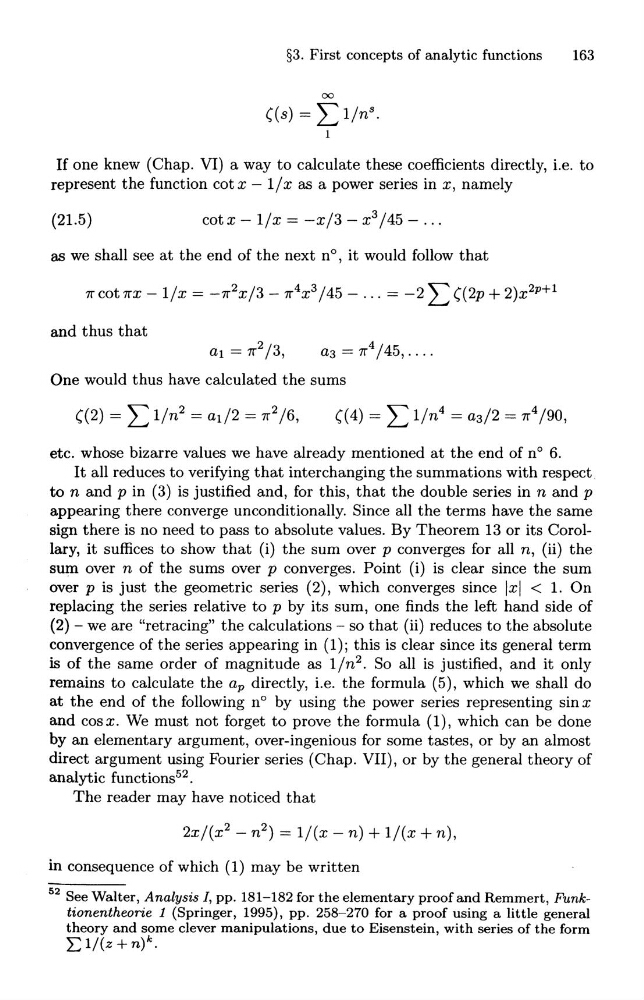
If one knew (Chap. VI) a way to calculate these coefficients directly, i.e. to
represent the function cot x-I / x as a power series in x, namely
(21.5)
cot x - l/x = -x/3 - x 3 /45 - ...
as we shall see at the end of the next n°, it would follow that
7r cot 7rX - l/x = -7r 2 x/3 - 7r 4 x 3 /45 - ... = -2 L (2p + 2)x 2P +1
and thus that
One would thus have calculated the sums
(2) = L 1/n 2 = al/2 = 7r 2 /6, ( 4) = L 1/n 4 = a3/2 = 7r 4 /90,
etc. whose bizarre values we have already mentioned at the end of nO 6.
It all reduces to verifying that interchanging the summations with respect
to n and p in (3) is justified and, for this, that the double series in nand p
appearing there converge unconditionally. Since all the terms have the same
sign there is no need to pass to absolute values. By Theorem 13 or its Corollary, it suffices to show that (i) the sum over p converges for all n, (ii) the
sum over n of the sums over p converges. Point (i) is clear since the sum
over p is just the geometric series (2), which converges since Ixl < 1. On
replacing the series relative to p by its sum, one finds the left hand side of
(2) - we are "retracing" the calculations - so that (ii) reduces to the absolute
convergence of the series appearing in (1); this is clear since its general term
is of the same order of magnitude as 1/n2. So all is justified, and it only
remains to calculate the ap directly, i.e. the formula (5), which we shall do
at the end of the following n° by using the power series representing sin x
and cosx. We must not forget to prove the formula (1), which can be done
by an elementary argument, over-ingenious for some tastes, or by an almost
direct argument using Fourier series (Chap. VII), or by the general theory of
analytic functions 52.
The reader may have noticed that
2x/(x 2 - n 2 ) = l/(x - n) + l/(x + n),
in consequence of which (1) may be written
52 See Walter, Analysis I, pp. 181-182 for the elementary proof and Remmert, Funktionentheorie 1 (Springer, 1995), pp. 258-270 for a proof using a little general
theory and some clever manipulations, due to Eisenstein, with series of the form
E 1/(z + n)k.
163
00
(s) = L l/ns.
1
If one knew (Chap. VI) a way to calculate these coefficients directly, i.e. to
represent the function cot x-I / x as a power series in x, namely
(21.5)
cot x - l/x = -x/3 - x 3 /45 - ...
as we shall see at the end of the next n°, it would follow that
7r cot 7rX - l/x = -7r 2 x/3 - 7r 4 x 3 /45 - ... = -2 L (2p + 2)x 2P +1
and thus that
One would thus have calculated the sums
(2) = L 1/n 2 = al/2 = 7r 2 /6, ( 4) = L 1/n 4 = a3/2 = 7r 4 /90,
etc. whose bizarre values we have already mentioned at the end of nO 6.
It all reduces to verifying that interchanging the summations with respect
to n and p in (3) is justified and, for this, that the double series in nand p
appearing there converge unconditionally. Since all the terms have the same
sign there is no need to pass to absolute values. By Theorem 13 or its Corollary, it suffices to show that (i) the sum over p converges for all n, (ii) the
sum over n of the sums over p converges. Point (i) is clear since the sum
over p is just the geometric series (2), which converges since Ixl < 1. On
replacing the series relative to p by its sum, one finds the left hand side of
(2) - we are "retracing" the calculations - so that (ii) reduces to the absolute
convergence of the series appearing in (1); this is clear since its general term
is of the same order of magnitude as 1/n2. So all is justified, and it only
remains to calculate the ap directly, i.e. the formula (5), which we shall do
at the end of the following n° by using the power series representing sin x
and cosx. We must not forget to prove the formula (1), which can be done
by an elementary argument, over-ingenious for some tastes, or by an almost
direct argument using Fourier series (Chap. VII), or by the general theory of
analytic functions 52.
The reader may have noticed that
2x/(x 2 - n 2 ) = l/(x - n) + l/(x + n),
in consequence of which (1) may be written
52 See Walter, Analysis I, pp. 181-182 for the elementary proof and Remmert, Funktionentheorie 1 (Springer, 1995), pp. 258-270 for a proof using a little general
theory and some clever manipulations, due to Eisenstein, with series of the form
E 1/(z + n)k.