

§3. First concepts of analytic functions
165
which brings us back to Johann Bernoulli and the marvels of the harmonic
series. So we have, changing the notation,
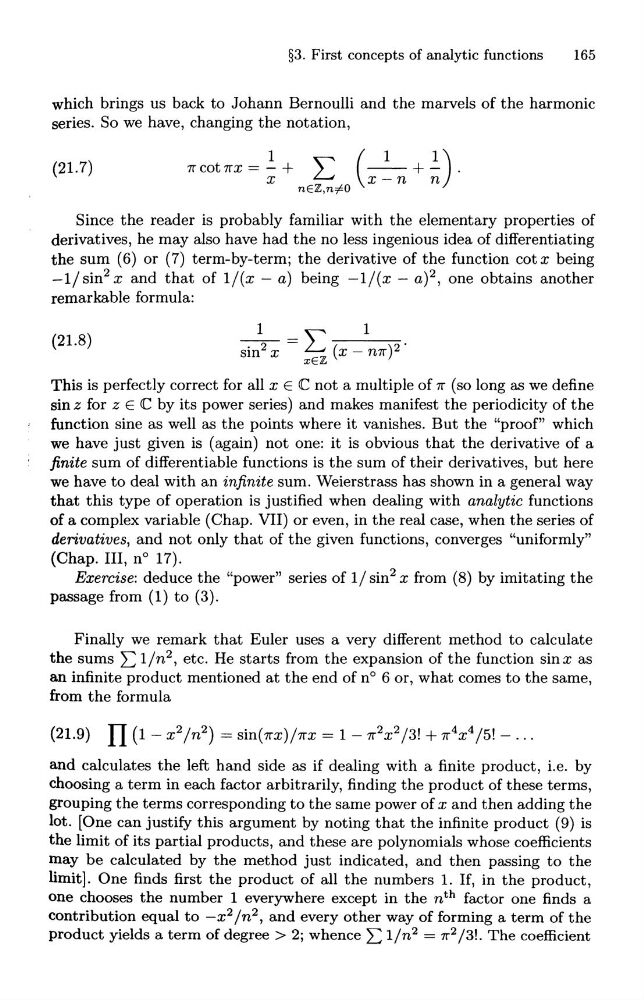
(21. 7)
1
(1 1)
7r cot 7rX = - + L -- + - .
x
x-n n
nEZ,n;60
Since the reader is probably familiar with the elementary properties of
derivatives, he may also have had the no less ingenious idea of differentiating
the sum (6) or (7) term-by-term; the derivative of the function cot x being
-I/sin 2 x and that of I/(x - a) being -I/(x - a)2, one obtains another
remarkable formula:
(21.8)
1
1
sin 2 x = L (x - nrr)2·
xEZ
This is perfectly correct for all x E C not a multiple of rr (so long as we define
sin z for z E C by its power series) and makes manifest the periodicity of the
function sine as well as the points where it vanishes. But the "proof" which
we have just given is (again) not one: it is obvious that the derivative of a
finite sum of differentiable functions is the sum of their derivatives, but here
we have to deal with an infinite sum. Weierstrass has shown in a general way
that this type of operation is justified when dealing with analytic functions
of a complex variable (Chap. VII) or even, in the real case, when the series of
derivatives, and not only that of the given functions, converges "uniformly"
(Chap. III, nO 17).
Exercise: deduce the "power" series of 1/ sin 2 x from (8) by imitating the
passage from (1) to (3).
Finally we remark that Euler uses a very different method to calculate
the sums L: I/n 2 , etc. He starts from the expansion of the function sinx as
an infinite product mentioned at the end of nO 6 or, what comes to the same,
from the formula
(21.9) II (1 - x 2 /n 2 ) = sin(7rx)/7rX = 1 - rr 2 x 2 /3! + rr 4 x 4 /5! - ...
and calculates the left hand side as if dealing with a finite product, i.e. by
choosing a term in each factor arbitrarily, finding the product of these terms,
grouping the terms corresponding to the same power of x and then adding the
lot. [One can justify this argument by noting that the infinite product (9) is
the limit of its partial products, and these are polynomials whose coefficients
may be calculated by the method just indicated, and then passing to the
limit]. One finds first the product of all the numbers 1. If, in the product,
one chooses the number 1 everywhere except in the nth factor one finds a
contribution equal to -x 2 /n 2 , and every other way of forming a term of the
product yields a term of degree> 2; whence L: 1/n 2 = rr2/3!. The coefficient
165
which brings us back to Johann Bernoulli and the marvels of the harmonic
series. So we have, changing the notation,
(21. 7)
1
(1 1)
7r cot 7rX = - + L -- + - .
x
x-n n
nEZ,n;60
Since the reader is probably familiar with the elementary properties of
derivatives, he may also have had the no less ingenious idea of differentiating
the sum (6) or (7) term-by-term; the derivative of the function cot x being
-I/sin 2 x and that of I/(x - a) being -I/(x - a)2, one obtains another
remarkable formula:
(21.8)
1
1
sin 2 x = L (x - nrr)2·
xEZ
This is perfectly correct for all x E C not a multiple of rr (so long as we define
sin z for z E C by its power series) and makes manifest the periodicity of the
function sine as well as the points where it vanishes. But the "proof" which
we have just given is (again) not one: it is obvious that the derivative of a
finite sum of differentiable functions is the sum of their derivatives, but here
we have to deal with an infinite sum. Weierstrass has shown in a general way
that this type of operation is justified when dealing with analytic functions
of a complex variable (Chap. VII) or even, in the real case, when the series of
derivatives, and not only that of the given functions, converges "uniformly"
(Chap. III, nO 17).
Exercise: deduce the "power" series of 1/ sin 2 x from (8) by imitating the
passage from (1) to (3).
Finally we remark that Euler uses a very different method to calculate
the sums L: I/n 2 , etc. He starts from the expansion of the function sinx as
an infinite product mentioned at the end of nO 6 or, what comes to the same,
from the formula
(21.9) II (1 - x 2 /n 2 ) = sin(7rx)/7rX = 1 - rr 2 x 2 /3! + rr 4 x 4 /5! - ...
and calculates the left hand side as if dealing with a finite product, i.e. by
choosing a term in each factor arbitrarily, finding the product of these terms,
grouping the terms corresponding to the same power of x and then adding the
lot. [One can justify this argument by noting that the infinite product (9) is
the limit of its partial products, and these are polynomials whose coefficients
may be calculated by the method just indicated, and then passing to the
limit]. One finds first the product of all the numbers 1. If, in the product,
one chooses the number 1 everywhere except in the nth factor one finds a
contribution equal to -x 2 /n 2 , and every other way of forming a term of the
product yields a term of degree> 2; whence L: 1/n 2 = rr2/3!. The coefficient