

154
II - Convergence: Discrete variables
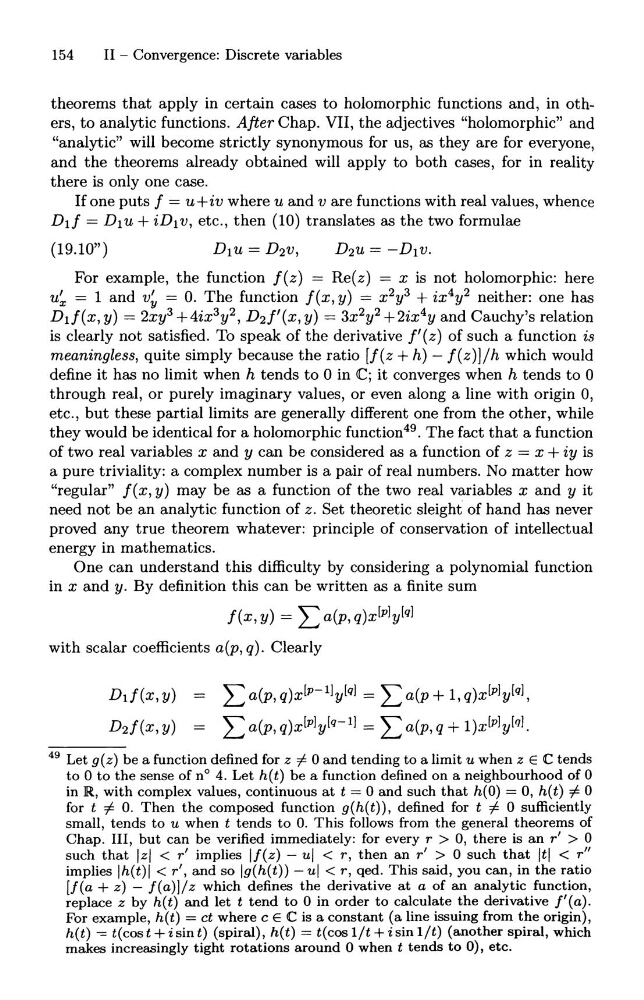
theorems that apply in certain cases to holomorphic functions and, in others, to analytic functions. After Chap. VII, the adjectives "holomorphic" and
"analytic" will become strictly synonymous for us, as they are for everyone,
and the theorems already obtained will apply to both cases, for in reality
there is only one case.
If one puts J = u+iv where u and v are functions with real values, whence
Dd = DIU + iDIv, etc., then (10) translates as the two formulae
(19.10")
For example, the function J(z) = Re(z) = x is not holomorphic: here
u~ = 1 and v~ = O. The function J(x, y) = x 2 y3 + ix 4 y2 neither: one has
Dd(x,y) = 2xy3+4ix 3 y2, D2/'(x,y) = 3x 2 y2+2ix 4 y and Cauchy's relation
is clearly not satisfied. To speak of the derivative J'(z) of such a function is
meaningless, quite simply because the ratio [J(z + h) - J(z)l/h which would
define it has no limit when h tends to 0 in C; it converges when h tends to 0
through real, or purely imaginary values, or even along a line with origin 0,
etc., but these partial limits are generally different one from the other, while
they would be identical for a holomorphic function 49 . The fact that a function
of two real variables x and y can be considered as a function of z = x + iy is
a pure triviality: a complex number is a pair of real numbers. No matter how
"regular" J(x, y) may be as a function of the two real variables x and y it
need not be an analytic function of z. Set theoretic sleight of hand has never
proved any true theorem whatever: principle of conservation of intellectual
energy in mathematics.
One can understand this difficulty by considering a polynomial function
in x and y. By definition this can be written as a finite sum
J(x, y) = L a(p, q)x[p]y[q]
with scalar coefficients a(p, q). Clearly
Dd(x,y)
D2/(x,y)
La(p,q)x[P-I]y[q] = La(p+ l,q)x[P]y[q],
L a(p, q)x[p]y[q-I] = L a(p, q + l)x[p]y[q].
49 Let g(z) be a function defined for z =I 0 and tending to a limit u when z E C tends
to 0 to the sense of nO 4. Let h(t) be a function defined on a neighbourhood of 0
in R, with complex values, continuous at t = 0 and such that h(O) = 0, h(t) =I 0
for t =I O. Then the composed function g(h(t», defined for t =I 0 sufficiently
small, tends to u when t tends to O. This follows from the general theorems of
Chap. III, but can be verified immediately: for every r > 0, there is an r' > 0
such that Izl < r' implies If(z) - ul < r, then an r' > 0 such that It I < r"
implies Ih(t)1 < r', and so Ig(h(t» -ul < r, qed. This said, you can, in the ratio
[J(a + z) - J(a)Jlz which defines the derivative at a of an analytic function,
replace z by h(t) and let t tend to 0 in order to calculate the derivative j'(a).
For example, h(t) = ct where c E C is a constant (a line issuing from the origin),
h(t) -= t(cos t + i sin t) (spiral), h(t) = t(cos 1ft + i sin 1ft) (another spiral, which
makes increasingly tight rotations around 0 when t tends to 0), etc.
II - Convergence: Discrete variables
theorems that apply in certain cases to holomorphic functions and, in others, to analytic functions. After Chap. VII, the adjectives "holomorphic" and
"analytic" will become strictly synonymous for us, as they are for everyone,
and the theorems already obtained will apply to both cases, for in reality
there is only one case.
If one puts J = u+iv where u and v are functions with real values, whence
Dd = DIU + iDIv, etc., then (10) translates as the two formulae
(19.10")
For example, the function J(z) = Re(z) = x is not holomorphic: here
u~ = 1 and v~ = O. The function J(x, y) = x 2 y3 + ix 4 y2 neither: one has
Dd(x,y) = 2xy3+4ix 3 y2, D2/'(x,y) = 3x 2 y2+2ix 4 y and Cauchy's relation
is clearly not satisfied. To speak of the derivative J'(z) of such a function is
meaningless, quite simply because the ratio [J(z + h) - J(z)l/h which would
define it has no limit when h tends to 0 in C; it converges when h tends to 0
through real, or purely imaginary values, or even along a line with origin 0,
etc., but these partial limits are generally different one from the other, while
they would be identical for a holomorphic function 49 . The fact that a function
of two real variables x and y can be considered as a function of z = x + iy is
a pure triviality: a complex number is a pair of real numbers. No matter how
"regular" J(x, y) may be as a function of the two real variables x and y it
need not be an analytic function of z. Set theoretic sleight of hand has never
proved any true theorem whatever: principle of conservation of intellectual
energy in mathematics.
One can understand this difficulty by considering a polynomial function
in x and y. By definition this can be written as a finite sum
J(x, y) = L a(p, q)x[p]y[q]
with scalar coefficients a(p, q). Clearly
Dd(x,y)
D2/(x,y)
La(p,q)x[P-I]y[q] = La(p+ l,q)x[P]y[q],
L a(p, q)x[p]y[q-I] = L a(p, q + l)x[p]y[q].
49 Let g(z) be a function defined for z =I 0 and tending to a limit u when z E C tends
to 0 to the sense of nO 4. Let h(t) be a function defined on a neighbourhood of 0
in R, with complex values, continuous at t = 0 and such that h(O) = 0, h(t) =I 0
for t =I O. Then the composed function g(h(t», defined for t =I 0 sufficiently
small, tends to u when t tends to O. This follows from the general theorems of
Chap. III, but can be verified immediately: for every r > 0, there is an r' > 0
such that Izl < r' implies If(z) - ul < r, then an r' > 0 such that It I < r"
implies Ih(t)1 < r', and so Ig(h(t» -ul < r, qed. This said, you can, in the ratio
[J(a + z) - J(a)Jlz which defines the derivative at a of an analytic function,
replace z by h(t) and let t tend to 0 in order to calculate the derivative j'(a).
For example, h(t) = ct where c E C is a constant (a line issuing from the origin),
h(t) -= t(cos t + i sin t) (spiral), h(t) = t(cos 1ft + i sin 1ft) (another spiral, which
makes increasingly tight rotations around 0 when t tends to 0), etc.