

§3. First concepts of analytic functions
153
was the first to see. Just for the moment let us note that it implies a simple
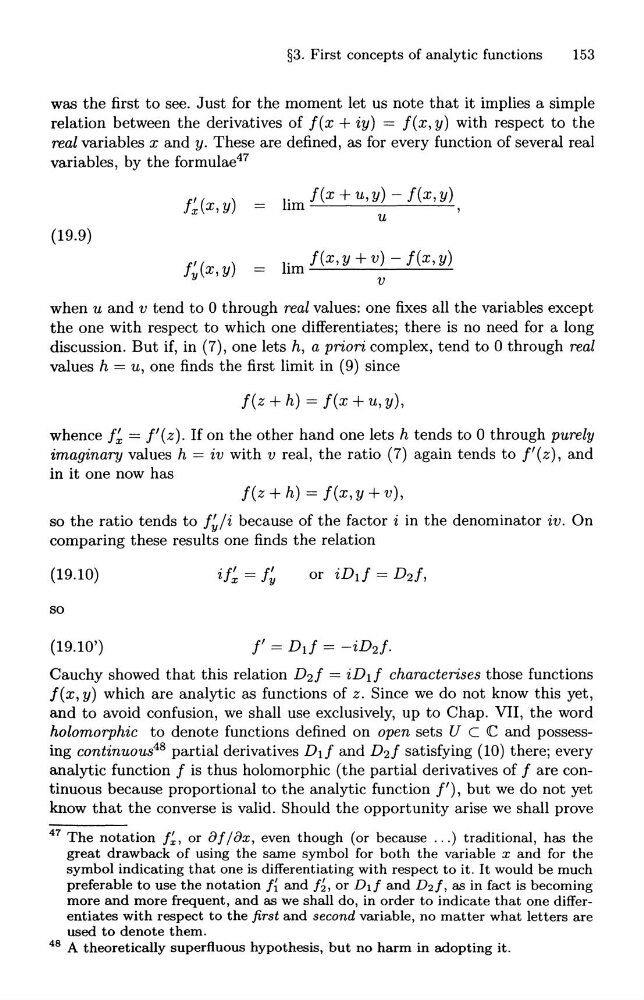
relation between the derivatives of f(x + iy) = f(x,y) with respect to the
real variables x and y. These are defined, as for every function of several real
variables, by the formulae 47
f~(x, y)
1 . f(x + u, y) - f(x, y)
1m
,
u
(19.9)
f~(x, y)
1 . f(x, y + v) - f(x, y)
1m .o......:.--,,--_,---,---,--....::c...:...
v
when u and v tend to 0 through real values: one fixes all the variables except
the one with respect to which one differentiates; there is no need for a long
discussion. But if, in (7), one lets h, a priori complex, tend to 0 through real
values h = u, one finds the first limit in (9) since
f(z + h) = f(x + u, y),
whence f~ = f'(z). If on the other hand one lets h tends to 0 through purely
imaginary values h = iv with v real, the ratio (7) again tends to I'(z), and
in it one now has
f(z + h) = f(x,y + v),
so the ratio tends to f~/i because of the factor i in the denominator iv. On
comparing these results one finds the relation
(19.10)
or iDd = D2I,
so
(19.10')
I' = Dd = -iD2I.
Cauchy showed that this relation D2I = iDd characterises those functions
f(x, y) which are analytic as functions of z. Since we do not know this yet,
and to avoid confusion, we shall use exclusively, up to Chap. VII, the word
holomorphic to denote functions defined on open sets U C C and possessing continuous 48 partial derivatives Dd and D2I satisfying (10) there; every
analytic function f is thus holomorphic (the partial derivatives of f are continuous because proportional to the analytic function 1'), but we do not yet
know that the converse is valid. Should the opportunity arise we shall prove
47 The notation f~, or af lax, even though (or because ... ) traditional, has the
great drawback of using the same symbol for both the variable x and for the
symbol indicating that one is differentiating with respect to it. It would be much
preferable to use the notation f{ and f~, or Dl/ and D2f, as in fact is becoming
more and more frequent, and as we shall do, in order to indicate that one differentiates with respect to the first and second variable, no matter what letters are
used to denote them.
48 A theoretically superfluous hypothesis, but no harm in adopting it.
153
was the first to see. Just for the moment let us note that it implies a simple
relation between the derivatives of f(x + iy) = f(x,y) with respect to the
real variables x and y. These are defined, as for every function of several real
variables, by the formulae 47
f~(x, y)
1 . f(x + u, y) - f(x, y)
1m
,
u
(19.9)
f~(x, y)
1 . f(x, y + v) - f(x, y)
1m .o......:.--,,--_,---,---,--....::c...:...
v
when u and v tend to 0 through real values: one fixes all the variables except
the one with respect to which one differentiates; there is no need for a long
discussion. But if, in (7), one lets h, a priori complex, tend to 0 through real
values h = u, one finds the first limit in (9) since
f(z + h) = f(x + u, y),
whence f~ = f'(z). If on the other hand one lets h tends to 0 through purely
imaginary values h = iv with v real, the ratio (7) again tends to I'(z), and
in it one now has
f(z + h) = f(x,y + v),
so the ratio tends to f~/i because of the factor i in the denominator iv. On
comparing these results one finds the relation
(19.10)
or iDd = D2I,
so
(19.10')
I' = Dd = -iD2I.
Cauchy showed that this relation D2I = iDd characterises those functions
f(x, y) which are analytic as functions of z. Since we do not know this yet,
and to avoid confusion, we shall use exclusively, up to Chap. VII, the word
holomorphic to denote functions defined on open sets U C C and possessing continuous 48 partial derivatives Dd and D2I satisfying (10) there; every
analytic function f is thus holomorphic (the partial derivatives of f are continuous because proportional to the analytic function 1'), but we do not yet
know that the converse is valid. Should the opportunity arise we shall prove
47 The notation f~, or af lax, even though (or because ... ) traditional, has the
great drawback of using the same symbol for both the variable x and for the
symbol indicating that one is differentiating with respect to it. It would be much
preferable to use the notation f{ and f~, or Dl/ and D2f, as in fact is becoming
more and more frequent, and as we shall do, in order to indicate that one differentiates with respect to the first and second variable, no matter what letters are
used to denote them.
48 A theoretically superfluous hypothesis, but no harm in adopting it.