

§3. First concepts of analytic functions
155
Cauchy's relation then forces
ia(p+ 1,q) = a(p,q + 1)
since the coefficients of xPyq must be the same in if~ and f~. But this relation
implies
a(p, q) = ia(p + 1, q - t) = i 2 a(p + 2, q - 2) = ... = iqa(p + q, 0).
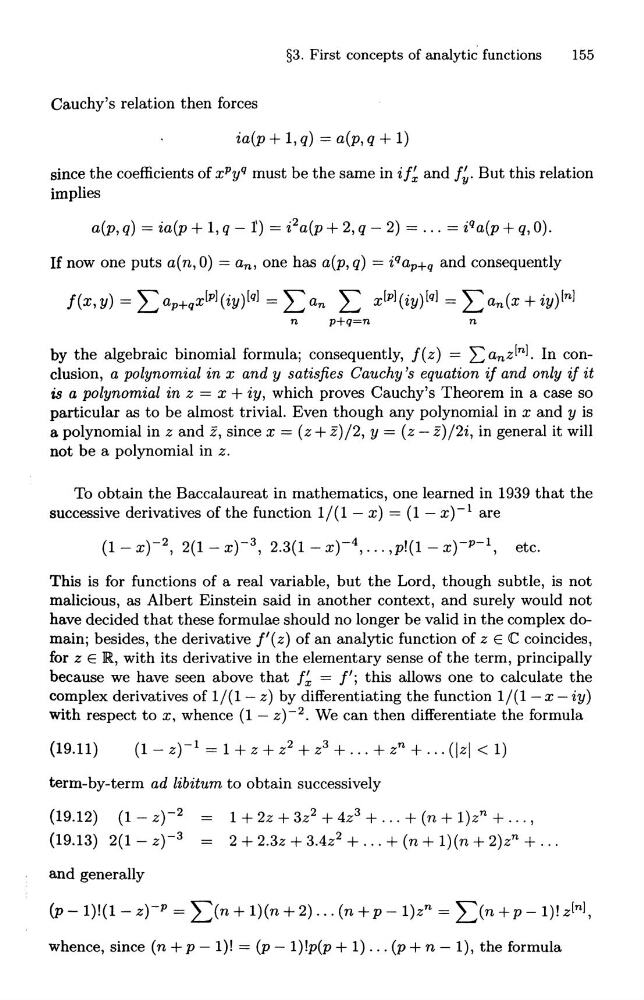
If now one puts a(n,O) = an, one has a(p, q) = iqap+q and consequently
by the algebraic binomial formula; consequently, f(z) = I:anz[n1• In conclusion, a polynomial in x and y satisfies Cauchy's equation if and only if it
is a polynomial in z = x + iy, which proves Cauchy's Theorem in a case so
particular as to be almost trivial. Even though any polynomial in x and y is
a polynomial in z and z, since x = (z + z)/2, y = (z - z)/2i, in general it will
not be a polynomial in z.
To obtain the Baccalaureat in mathematics, one learned in 1939 that the
successive derivatives of the function 1/(1 - x) = (1 - X)-l are
(1 - X)-2, 2(1 - x)-3, 2.3(1 - x)-4, ... ,p!(l - x)-p-l, etc.
This is for functions of a real variable, but the Lord, though subtle, is not
malicious, as Albert Einstein said in another context, and surely would not
have decided that these formulae should no longer be valid in the complex domain; besides, the derivative f'(z) of an analytic function of z E C coincides,
for z E JR, with its derivative in the elementary sense of the term, principally
because we have seen above that f~ = f'; this allows one to calculate the
complex derivatives of 1/(1- z) by differentiating the function 1/(1- x - iy)
with respect to x, whence (1- Z)-2. We can then differentiate the formula
(19.11)
(1 - Z)-l = 1 + z + z2 + z3 + ... + zn + ... (Izl < 1)
term-by-term ad libitum to obtain successively
(19.12) (1 - z)-2
(19.13) 2(1 - z)-3
and generally
1 + 2z + 3z 2 + 4z 3 + ... + (n + l)zn + ... ,
2 + 2.3z + 3.4z 2 + ... + (n + l)(n + 2)zn + ...
(p -1)!(1- z)-P = ~)n + l)(n + 2) ... (n + p -l)zn = 'L)n + p - I)! z[n1,
whence, since (n + p - I)! = (p - l)!p(p + 1) ... (p + n - 1), the formula
155
Cauchy's relation then forces
ia(p+ 1,q) = a(p,q + 1)
since the coefficients of xPyq must be the same in if~ and f~. But this relation
implies
a(p, q) = ia(p + 1, q - t) = i 2 a(p + 2, q - 2) = ... = iqa(p + q, 0).
If now one puts a(n,O) = an, one has a(p, q) = iqap+q and consequently
by the algebraic binomial formula; consequently, f(z) = I:anz[n1• In conclusion, a polynomial in x and y satisfies Cauchy's equation if and only if it
is a polynomial in z = x + iy, which proves Cauchy's Theorem in a case so
particular as to be almost trivial. Even though any polynomial in x and y is
a polynomial in z and z, since x = (z + z)/2, y = (z - z)/2i, in general it will
not be a polynomial in z.
To obtain the Baccalaureat in mathematics, one learned in 1939 that the
successive derivatives of the function 1/(1 - x) = (1 - X)-l are
(1 - X)-2, 2(1 - x)-3, 2.3(1 - x)-4, ... ,p!(l - x)-p-l, etc.
This is for functions of a real variable, but the Lord, though subtle, is not
malicious, as Albert Einstein said in another context, and surely would not
have decided that these formulae should no longer be valid in the complex domain; besides, the derivative f'(z) of an analytic function of z E C coincides,
for z E JR, with its derivative in the elementary sense of the term, principally
because we have seen above that f~ = f'; this allows one to calculate the
complex derivatives of 1/(1- z) by differentiating the function 1/(1- x - iy)
with respect to x, whence (1- Z)-2. We can then differentiate the formula
(19.11)
(1 - Z)-l = 1 + z + z2 + z3 + ... + zn + ... (Izl < 1)
term-by-term ad libitum to obtain successively
(19.12) (1 - z)-2
(19.13) 2(1 - z)-3
and generally
1 + 2z + 3z 2 + 4z 3 + ... + (n + l)zn + ... ,
2 + 2.3z + 3.4z 2 + ... + (n + l)(n + 2)zn + ...
(p -1)!(1- z)-P = ~)n + l)(n + 2) ... (n + p -l)zn = 'L)n + p - I)! z[n1,
whence, since (n + p - I)! = (p - l)!p(p + 1) ... (p + n - 1), the formula