

Fluvial Transports of Mercury Pollution in the III River Basin (Northeastern France)
SIS
Table 1. Experimental conditions of the second experiment. Competition between mercury and
HPO~
Step I
Step 2
Step 3
Experimental
-KMn04 = 5 drops
Na2HP04·12H20
[Hg) = 5 fig 1-'
conditions
-HN03 (35%) = 4 ml
(4.2 g 1-')
-H2S04 (50%) = 4 ml
-[NaCl) = 0.001 - 0.4 M
Reaction times (h) 24
24
24
Observations
Manganese precipitate
Addition of phosphate
Addition of mercury
stable mercury species (HgCI~ ) (Michard 1989) is strongly adsorbed onto metal
oxides due to the oxide proto nation surface (-S-OH+).
The second laboratory experiment exemplified the effect of manganese
precipitation which could be observed during the first sampling because KMn04
was added to the solution in the field (see Material and Methods). The
experimental conditions are described in Table 1; pH values remain acidic during
the experiment.
As during the first experiment, the mercury concentration in the solution
decreases to zero when the sodium chloride concentration reaches 0.1 molll in
the absence of Na2HP0 4 (Fig. 12a).
It is important to note that below 0.1 M NaCl, the solution remains coloured
purple by the KMn0 4 • Whereas when the NaCl concentration exceeds 0.1 M, a
manganese precipitate appears at the bottom of the bottle and the solution
becomes colourless. Coprecipitation with or sorption of mercury onto manganese precipitate could explain why the concentration decreased to zero in the
solution.
In the presence of Na2HP0 4 , mercury and HPO~ appear to compete to be
adsorbed onto the manganese precipitate; but mercury presents a greater affinity
on manganese precipitate than HPO~-. Consequently, when the NaCI concena Mereu in sediments
b Measured desorbed mereu
10
1,6
7 ..
. .
1"<2~.1
..
1"<2~,1
~ B
.. .. ..
0<50 ....
..
o<50pm
;; 1,2
~ 6
0
. .
0
~ 0,8
0
. .
. .
4
0
. .
2
0,4
..
0
0
0
0
0
0
0,0001
0,001
0,01
0,1
1
0,0001
0,001
0,01
0,1
[NaCII(M)
[NaCl1 (M)
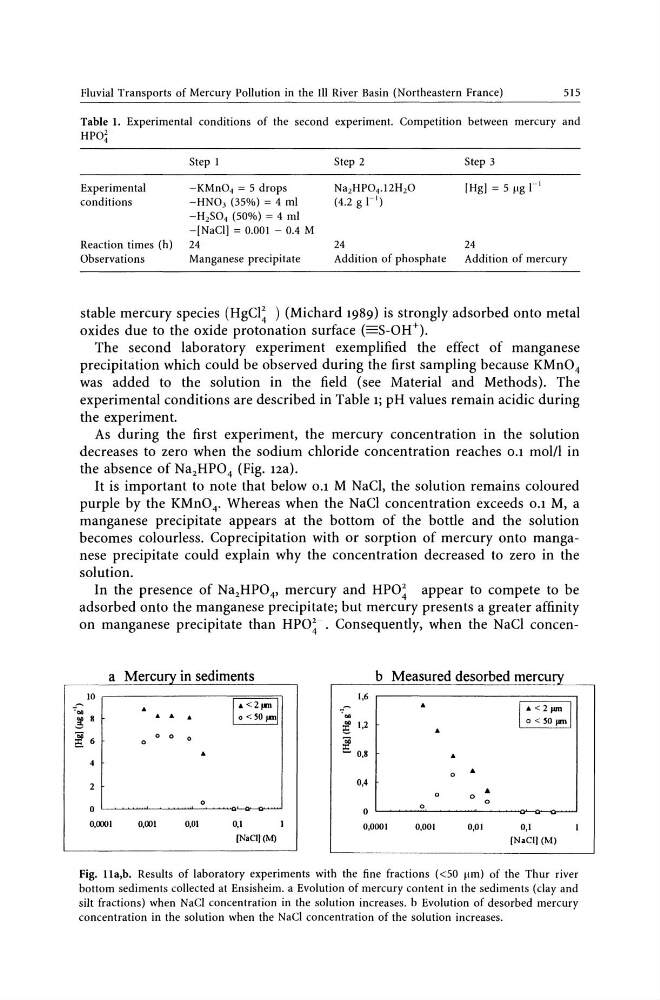
Fig. Ila,b. Results of laboratory experiments with the fine fractions «50 flm) of the Thur river
bottom sediments collected at Ensisheim. a Evolution of mercury content in the sediments (clay and
silt fractions) when NaCI concentration in the solution increases. b Evolution of desorbed mercury
concentration in the solution when the NaCl concentration of the solution increases.
SIS
Table 1. Experimental conditions of the second experiment. Competition between mercury and
HPO~
Step I
Step 2
Step 3
Experimental
-KMn04 = 5 drops
Na2HP04·12H20
[Hg) = 5 fig 1-'
conditions
-HN03 (35%) = 4 ml
(4.2 g 1-')
-H2S04 (50%) = 4 ml
-[NaCl) = 0.001 - 0.4 M
Reaction times (h) 24
24
24
Observations
Manganese precipitate
Addition of phosphate
Addition of mercury
stable mercury species (HgCI~ ) (Michard 1989) is strongly adsorbed onto metal
oxides due to the oxide proto nation surface (-S-OH+).
The second laboratory experiment exemplified the effect of manganese
precipitation which could be observed during the first sampling because KMn04
was added to the solution in the field (see Material and Methods). The
experimental conditions are described in Table 1; pH values remain acidic during
the experiment.
As during the first experiment, the mercury concentration in the solution
decreases to zero when the sodium chloride concentration reaches 0.1 molll in
the absence of Na2HP0 4 (Fig. 12a).
It is important to note that below 0.1 M NaCl, the solution remains coloured
purple by the KMn0 4 • Whereas when the NaCl concentration exceeds 0.1 M, a
manganese precipitate appears at the bottom of the bottle and the solution
becomes colourless. Coprecipitation with or sorption of mercury onto manganese precipitate could explain why the concentration decreased to zero in the
solution.
In the presence of Na2HP0 4 , mercury and HPO~ appear to compete to be
adsorbed onto the manganese precipitate; but mercury presents a greater affinity
on manganese precipitate than HPO~-. Consequently, when the NaCI concena Mereu in sediments
b Measured desorbed mereu
10
1,6
7 ..
. .
1"<2~.1
..
1"<2~,1
~ B
.. .. ..
0<50 ....
..
o<50pm
;; 1,2
~ 6
0
. .
0
~ 0,8
0
. .
. .
4
0
. .
2
0,4
..
0
0
0
0
0
0
0,0001
0,001
0,01
0,1
1
0,0001
0,001
0,01
0,1
[NaCII(M)
[NaCl1 (M)
Fig. Ila,b. Results of laboratory experiments with the fine fractions «50 flm) of the Thur river
bottom sediments collected at Ensisheim. a Evolution of mercury content in the sediments (clay and
silt fractions) when NaCI concentration in the solution increases. b Evolution of desorbed mercury
concentration in the solution when the NaCl concentration of the solution increases.