

-~
~
~
516
a Without Na2HP04.12H20
0
0.001
0,01
0.1 (NaCIJ(M)
100
~
80 3
60
40
20
J.L. Probst et al.
r-~====~--------------.70
o 0,05 0,1 O,IS 0,2 0,25 0,3 0,35 0,4
(NaCIJ(M)
60 ~
so !
40
30
20
10
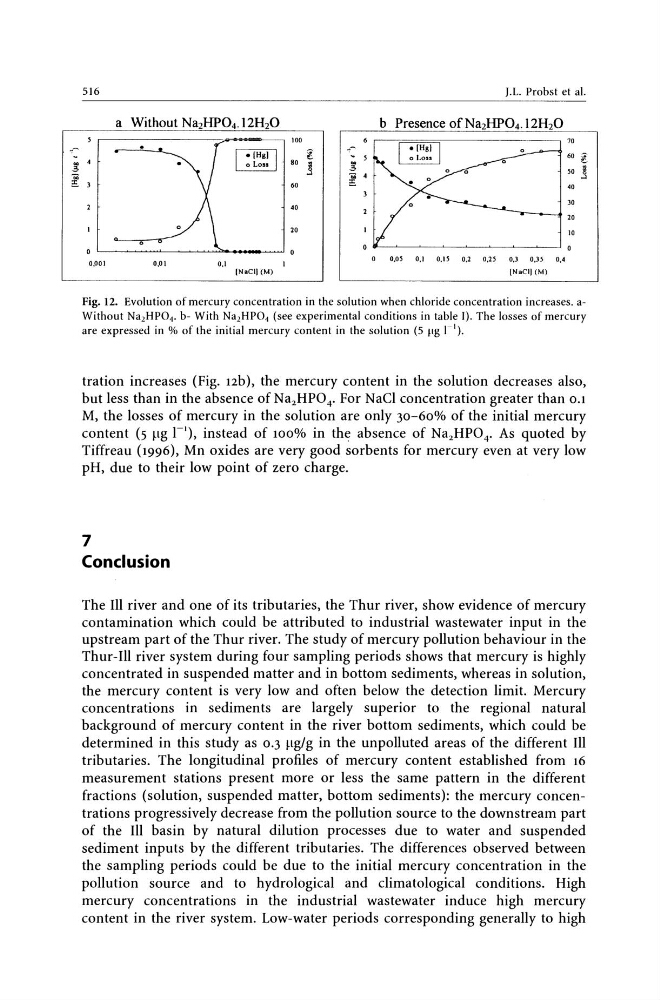
Fig. 12. Evolution of mercury concentration in the solution when chloride concentration increases. aWithout Na2HP04' b- With Na2HP04 (see experimental conditions in table I). The losses of mercury
are expressed in % of the initial mercury content in the solution (5 fIg 1~1).
tration increases (Fig. 12b), the mercury content in the solution decreases also,
but less than in the absence of Na2 HP0 4 • For NaCI concentration greater than 0.1
M, the losses of mercury in the solution are only 30-60% of the initial mercury
content (5 ~Lg I-I), instead of lOO% in the absence of Na2 HP0 4 • As quoted by
Tiffreau (1996), Mn oxides are very good sorbents for mercury even at very low
pH, due to their low point of zero charge.
7
Conclusion
The III river and one of its tributaries, the Thur river, show evidence of mercury
contamination which could be attributed to industrial wastewater input in the
upstream part of the Thur river. The study of mercury pollution behaviour in the
Thur~Ill river system during four sampling periods shows that mercury is highly
concentrated in suspended matter and in bottom sediments, whereas in solution,
the mercury content is very low and often below the detection limit. Mercury
concentrations in sediments are largely superior to the regional natural
background of mercury content in the river bottom sediments, which could be
determined in this study as 0.3 ~Lg/g in the unpolluted areas of the different III
tributaries. The longitudinal profiles of mercury content established from 16
measurement stations present more or less the same pattern in the different
fractions (solution, suspended matter, bottom sediments): the mercury concen~
trations progressively decrease from the pollution source to the downstream part
of the III basin by natural dilution processes due to water and suspended
sediment inputs by the different tributaries. The differences observed between
the sampling periods could be due to the initial mercury concentration in the
pollution source and to hydrological and climatological conditions. High
mercury concentrations in the industrial wastewater induce high mercury
content in the river system. Low~water periods corresponding generally to high
~
~
516
a Without Na2HP04.12H20
0
0.001
0,01
0.1 (NaCIJ(M)
100
~
80 3
60
40
20
J.L. Probst et al.
r-~====~--------------.70
o 0,05 0,1 O,IS 0,2 0,25 0,3 0,35 0,4
(NaCIJ(M)
60 ~
so !
40
30
20
10
Fig. 12. Evolution of mercury concentration in the solution when chloride concentration increases. aWithout Na2HP04' b- With Na2HP04 (see experimental conditions in table I). The losses of mercury
are expressed in % of the initial mercury content in the solution (5 fIg 1~1).
tration increases (Fig. 12b), the mercury content in the solution decreases also,
but less than in the absence of Na2 HP0 4 • For NaCI concentration greater than 0.1
M, the losses of mercury in the solution are only 30-60% of the initial mercury
content (5 ~Lg I-I), instead of lOO% in the absence of Na2 HP0 4 • As quoted by
Tiffreau (1996), Mn oxides are very good sorbents for mercury even at very low
pH, due to their low point of zero charge.
7
Conclusion
The III river and one of its tributaries, the Thur river, show evidence of mercury
contamination which could be attributed to industrial wastewater input in the
upstream part of the Thur river. The study of mercury pollution behaviour in the
Thur~Ill river system during four sampling periods shows that mercury is highly
concentrated in suspended matter and in bottom sediments, whereas in solution,
the mercury content is very low and often below the detection limit. Mercury
concentrations in sediments are largely superior to the regional natural
background of mercury content in the river bottom sediments, which could be
determined in this study as 0.3 ~Lg/g in the unpolluted areas of the different III
tributaries. The longitudinal profiles of mercury content established from 16
measurement stations present more or less the same pattern in the different
fractions (solution, suspended matter, bottom sediments): the mercury concen~
trations progressively decrease from the pollution source to the downstream part
of the III basin by natural dilution processes due to water and suspended
sediment inputs by the different tributaries. The differences observed between
the sampling periods could be due to the initial mercury concentration in the
pollution source and to hydrological and climatological conditions. High
mercury concentrations in the industrial wastewater induce high mercury
content in the river system. Low~water periods corresponding generally to high