

514
J.L. Probst et aI.
mercury solution prepared in our laboratory. In the first experiment, we wanted
to test the reactivity of a mercury-polluted sediment containing 10.4 ~Lg/g of
mercury to increasing NaCI concentration solutions by measuring the mercury
concentration in the sediment and in the solution at each step of the experiment.
The second experiment is not directly related to the field observations.
Nevertheless, it is important to test the competition between mercury (HgCI~-)
and HPO~- (which is well known to have a great affinity for particule surfaces;
Sposito 1989) present in the solution in order to be sure that mercury is really
trapped by manganese precipitate when the NaCI concentration of the solution
increases. This hypothesis could be verified by measuring the evolution of
mercury concentration when the NaCI concentration increases in the presence or
absence of Na2 HP0 4 •
The results obtained during the first experiment (Fig. lla, b) show that the
mercury des orbed from the sediment into the saline solution decreases when the
salinity increases. Nevertheless, it can be observed that for the silt fractions (250 ~m), the total mercury des orbed increases during the first three steps of
salinity increase, until 3.4 mmol/l of NaCI, and after decrease, as for the clay
fractions «2 ~Lm). It is surprising to note that when the NaCI concentration
increases, the mercury contents decrease, not only in the solution but also in the
sediments, and could not even be detected in the two phases when NaCI
concentration reaches 0.1 mo1!l. This behaviour could be explained by the
sorption of mercury onto metal (hydr)oxides when salinity increases; but
mercury trapped in this complex could not be detected. Indeed, the classical
chemical digestion with nitric and sulphuric acids did not allow the release of
mercury to be analyzed because at pHI and high chloride concentration, the
n ,--.----------------,
~60
'iii 48
e:.
36
24
o.s
l.s 2 2,5
[CI](mM)
L -_________________________ ~a
18 , - - - - - - - - - - - - - - - - - - - - ,
~
~1S
gl2
9
Hilh water 1995
Low water 1996
4 5 6
[CI](mM)
c
15 , - - - - - - - - - - - - - - - - - - - - , 25
20
15
10
5
[CI)(mM)
L -_ _ _ _ _ _ _ _ _ _ _ _ _ _ _ _ _ _ _ _ ~b
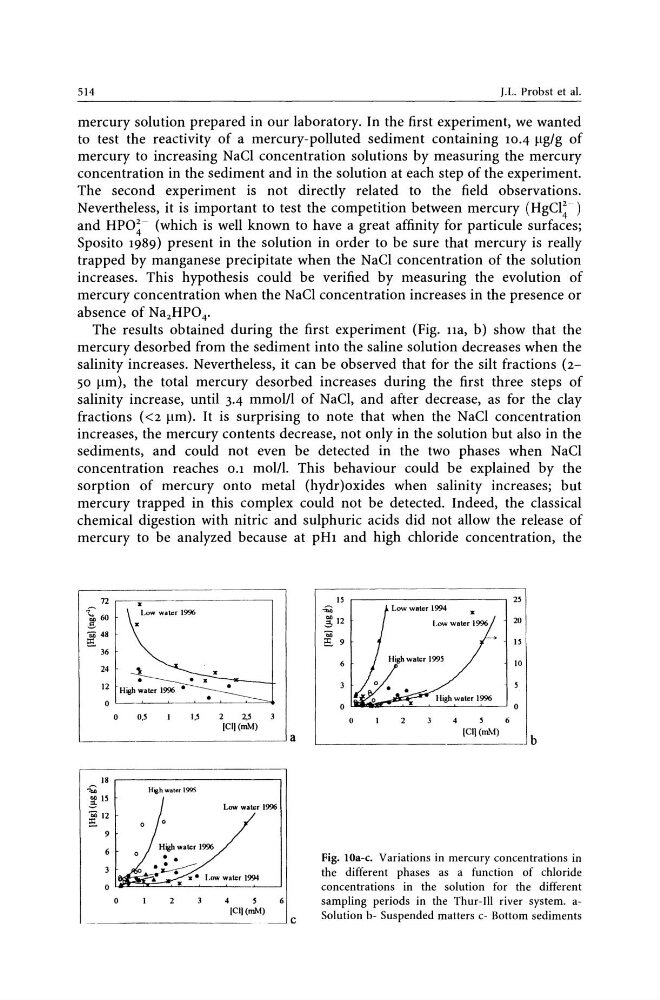
Fig. lOa-c. Variations in mercury concentrations in
the different phases as a function of chloride
concentrations in the solution for the different
sampling periods in the Thur-Ill river system. aSolution b- Suspended matters c- Bottom sediments
J.L. Probst et aI.
mercury solution prepared in our laboratory. In the first experiment, we wanted
to test the reactivity of a mercury-polluted sediment containing 10.4 ~Lg/g of
mercury to increasing NaCI concentration solutions by measuring the mercury
concentration in the sediment and in the solution at each step of the experiment.
The second experiment is not directly related to the field observations.
Nevertheless, it is important to test the competition between mercury (HgCI~-)
and HPO~- (which is well known to have a great affinity for particule surfaces;
Sposito 1989) present in the solution in order to be sure that mercury is really
trapped by manganese precipitate when the NaCI concentration of the solution
increases. This hypothesis could be verified by measuring the evolution of
mercury concentration when the NaCI concentration increases in the presence or
absence of Na2 HP0 4 •
The results obtained during the first experiment (Fig. lla, b) show that the
mercury des orbed from the sediment into the saline solution decreases when the
salinity increases. Nevertheless, it can be observed that for the silt fractions (250 ~m), the total mercury des orbed increases during the first three steps of
salinity increase, until 3.4 mmol/l of NaCI, and after decrease, as for the clay
fractions «2 ~Lm). It is surprising to note that when the NaCI concentration
increases, the mercury contents decrease, not only in the solution but also in the
sediments, and could not even be detected in the two phases when NaCI
concentration reaches 0.1 mo1!l. This behaviour could be explained by the
sorption of mercury onto metal (hydr)oxides when salinity increases; but
mercury trapped in this complex could not be detected. Indeed, the classical
chemical digestion with nitric and sulphuric acids did not allow the release of
mercury to be analyzed because at pHI and high chloride concentration, the
n ,--.----------------,
~60
'iii 48
e:.
36
24
o.s
l.s 2 2,5
[CI](mM)
L -_________________________ ~a
18 , - - - - - - - - - - - - - - - - - - - - ,
~
~1S
gl2
9
Hilh water 1995
Low water 1996
4 5 6
[CI](mM)
c
15 , - - - - - - - - - - - - - - - - - - - - , 25
20
15
10
5
[CI)(mM)
L -_ _ _ _ _ _ _ _ _ _ _ _ _ _ _ _ _ _ _ _ ~b
Fig. lOa-c. Variations in mercury concentrations in
the different phases as a function of chloride
concentrations in the solution for the different
sampling periods in the Thur-Ill river system. aSolution b- Suspended matters c- Bottom sediments