

Fluvial Transports of Mercury Pollution in the III River Basin (Northeastern France)
5 J3
..
,.
Vie.le .n .... 1 gll.hun
-
ito I-Lat..::hal llcnt.11Iem
;i,.
"
. .
"
..
"
• I
i'
i'
I
~
if
f
- ! ~ .
IIIsI ... -lZ7 18 .. "
a..u.a, ~ Ie fil'lIIcla:._
'-"
rh
10
• j • • • •
. « if f f
. !!
"
/11,,- '49, •
(h,dcl.,~,: fntCtu.
~
I I
!
~
1\
III,J ... - I S It!l ll
<1r1. •• bm;t; .... fl'1lclD.
.,
"
Qz..n:n _I ThIllYIIe
;r ..
, - -
,.
-
14
"
11
• •
I
1.
•
I
.?
t
· - ~ ~ .
IHe:I ... .. ' 6uU:'
o.lIl.liI;Il;t,-1Il (n",:I...,..
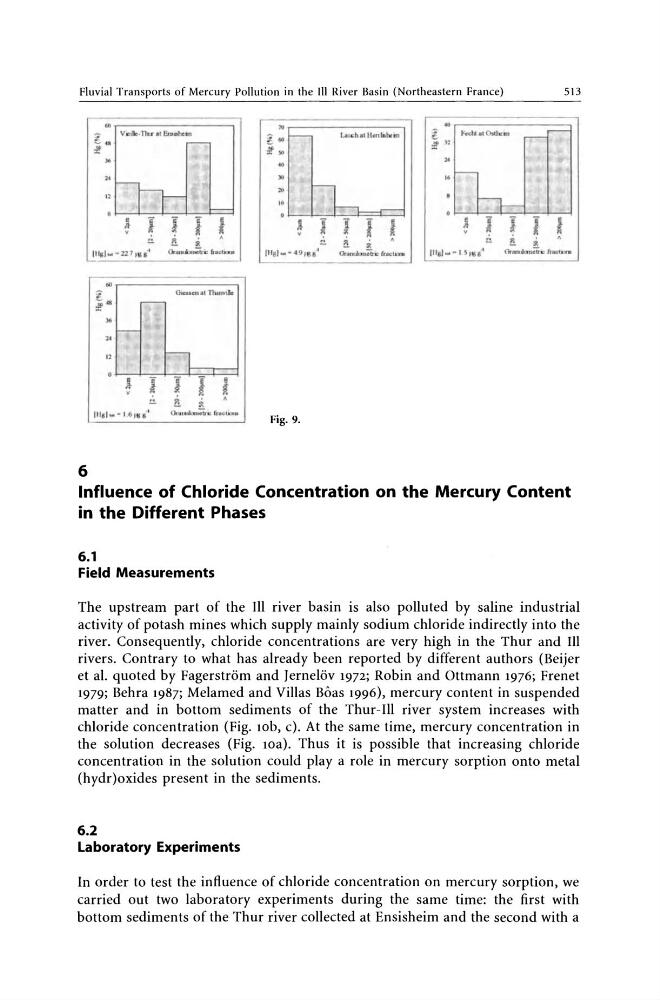
Fig. 9.
6
Influence of Chloride Concentration on the Mercury Content
in the Different Phases
6.1
Field Measurements
The upstream part of the III river basin is also polluted by saline industrial
activity of potash mines which supply mainly sodium chloride indirectly into the
river. Consequently, chloride concentrations are very high in the Thur and III
rivers. Contrary to what has already been reported by different authors (Beijer
et al. quoted by Fagerstrom and JernelOv 1972; Robin and Ottmann 1976; Frenet
1979; Behra 1987; Melamed and Villas Boas 1996), mercury content in suspended
matter and in bottom sediments of the Thur-Ill river system increases with
chloride concentration (Fig. lOb, c) . At the same time, mercury concentration in
the solution decreases (Fig. lOa). Thus it is possible that increasing chloride
concentration in the solution could playa role in mercury sorption onto metal
(hydr)oxides present in the sediments.
6.2
Laboratory Experiments
In order to test the influence of chloride concentration on mercury sorption, we
carried out two laboratory experiments during the same time: the first with
bottom sediments of the Thur river collected at Ensisheim and the second with a
5 J3
..
,.
Vie.le .n .... 1 gll.hun
-
ito I-Lat..::hal llcnt.11Iem
;i,.
"
. .
"
..
"
• I
i'
i'
I
~
if
f
- ! ~ .
IIIsI ... -lZ7 18 .. "
a..u.a, ~ Ie fil'lIIcla:._
'-"
rh
10
• j • • • •
. « if f f
. !!
"
/11,,- '49, •
(h,dcl.,~,: fntCtu.
~
I I
!
~
1\
III,J ... - I S It!l ll
<1r1. •• bm;t; .... fl'1lclD.
.,
"
Qz..n:n _I ThIllYIIe
;r ..
, - -
,.
-
14
"
11
• •
I
1.
•
I
.?
t
· - ~ ~ .
IHe:I ... .. ' 6uU:'
o.lIl.liI;Il;t,-1Il (n",:I...,..
Fig. 9.
6
Influence of Chloride Concentration on the Mercury Content
in the Different Phases
6.1
Field Measurements
The upstream part of the III river basin is also polluted by saline industrial
activity of potash mines which supply mainly sodium chloride indirectly into the
river. Consequently, chloride concentrations are very high in the Thur and III
rivers. Contrary to what has already been reported by different authors (Beijer
et al. quoted by Fagerstrom and JernelOv 1972; Robin and Ottmann 1976; Frenet
1979; Behra 1987; Melamed and Villas Boas 1996), mercury content in suspended
matter and in bottom sediments of the Thur-Ill river system increases with
chloride concentration (Fig. lOb, c) . At the same time, mercury concentration in
the solution decreases (Fig. lOa). Thus it is possible that increasing chloride
concentration in the solution could playa role in mercury sorption onto metal
(hydr)oxides present in the sediments.
6.2
Laboratory Experiments
In order to test the influence of chloride concentration on mercury sorption, we
carried out two laboratory experiments during the same time: the first with
bottom sediments of the Thur river collected at Ensisheim and the second with a