

452
J. TMming et al.
4.2.3
Electroleaching with In-Suspension Production of Leaching Agent (EL-IS)
During EL-IS, both the concentration of hypochlorite and dissolved mercury stay
low. This is due to consecutive reactions which are hypochlorite consumption by
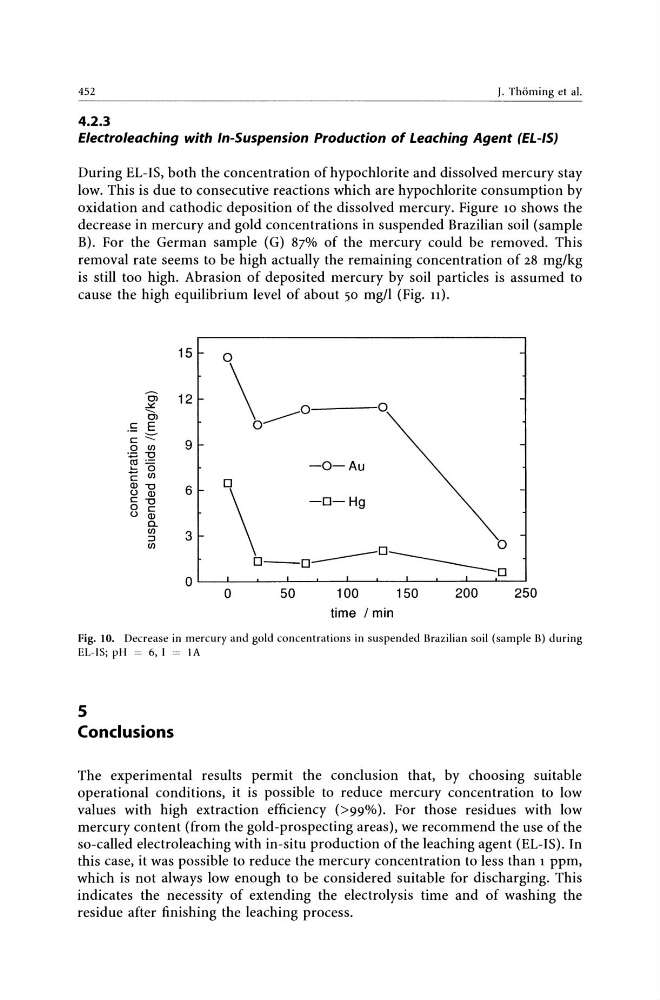
oxidation and cathodic deposition of the dissolved mercury. Figure 10 shows the
decrease in mercury and gold concentrations in suspended Brazilian soil (sample
B). For the German sample (G) 87% of the mercury could be removed. This
removal rate seems to be high actually the remaining concentration of 28 mg/kg
is still too high. Abrasion of deposited mercury by soil particles is assumed to
cause the high equilibrium level of about 50 mgll (Fig. 11).
~ Cl
.!: E
c::::::o !/l
:;:::i "'0
ca=
E ~
CIl"O
o CIl
C"O
o C
o CIl
a.
!/l
:J
!/l
15
12
9
6
3
\~---O o
-O-Au
0\ -O-Hg
o
0
0-0--- ____ o
o
50
100
150
200
250
time / min
Fig. 10. Decrease in mercury and gold concentrations in suspended Brazilian soil (sample B) during
EL-IS; pH = 6, I = lA
5
Conclusions
The experimental results permit the conclusion that, by choosing suitable
operational conditions, it is possible to reduce mercury concentration to low
values with high extraction efficiency (>99%). For those residues with low
mercury content (from the gold-prospecting areas), we recommend the use of the
so-called electroleaching with in-situ production of the leaching agent (EL-IS). In
this case, it was possible to reduce the mercury concentration to less than 1 ppm,
which is not always low enough to be considered suitable for discharging. This
indicates the necessity of extending the electrolysis time and of washing the
residue after finishing the leaching process.
J. TMming et al.
4.2.3
Electroleaching with In-Suspension Production of Leaching Agent (EL-IS)
During EL-IS, both the concentration of hypochlorite and dissolved mercury stay
low. This is due to consecutive reactions which are hypochlorite consumption by
oxidation and cathodic deposition of the dissolved mercury. Figure 10 shows the
decrease in mercury and gold concentrations in suspended Brazilian soil (sample
B). For the German sample (G) 87% of the mercury could be removed. This
removal rate seems to be high actually the remaining concentration of 28 mg/kg
is still too high. Abrasion of deposited mercury by soil particles is assumed to
cause the high equilibrium level of about 50 mgll (Fig. 11).
~ Cl
.!: E
c::::::o !/l
:;:::i "'0
ca=
E ~
CIl"O
o CIl
C"O
o C
o CIl
a.
!/l
:J
!/l
15
12
9
6
3
\~---O o
-O-Au
0\ -O-Hg
o
0
0-0--- ____ o
o
50
100
150
200
250
time / min
Fig. 10. Decrease in mercury and gold concentrations in suspended Brazilian soil (sample B) during
EL-IS; pH = 6, I = lA
5
Conclusions
The experimental results permit the conclusion that, by choosing suitable
operational conditions, it is possible to reduce mercury concentration to low
values with high extraction efficiency (>99%). For those residues with low
mercury content (from the gold-prospecting areas), we recommend the use of the
so-called electroleaching with in-situ production of the leaching agent (EL-IS). In
this case, it was possible to reduce the mercury concentration to less than 1 ppm,
which is not always low enough to be considered suitable for discharging. This
indicates the necessity of extending the electrolysis time and of washing the
residue after finishing the leaching process.