

Electroleaching: a Mobile Cleanup Process for Mercury Contaminated Materials
453
Ci
::J
-'"
C, 200
200
C,
~
•
solid c = 27 + 195 exp(t/34.1)
~
:E
"0
0
--0-- liquid
'5
'" 150
150 g.!:
.!:
0
c:
c:
0
0
~
~ 100
100 E
E
- - 0- - -- ----- __ 0--- _________ 0-- ____ 0
Q)
Q)
0
0
c:
c:
0-0
0
50
50 0
0
,
,
•
Ol
Ol
,
:r:
:r:
,
,
0
0
0
50
100
150
200
250
300
time t/ min
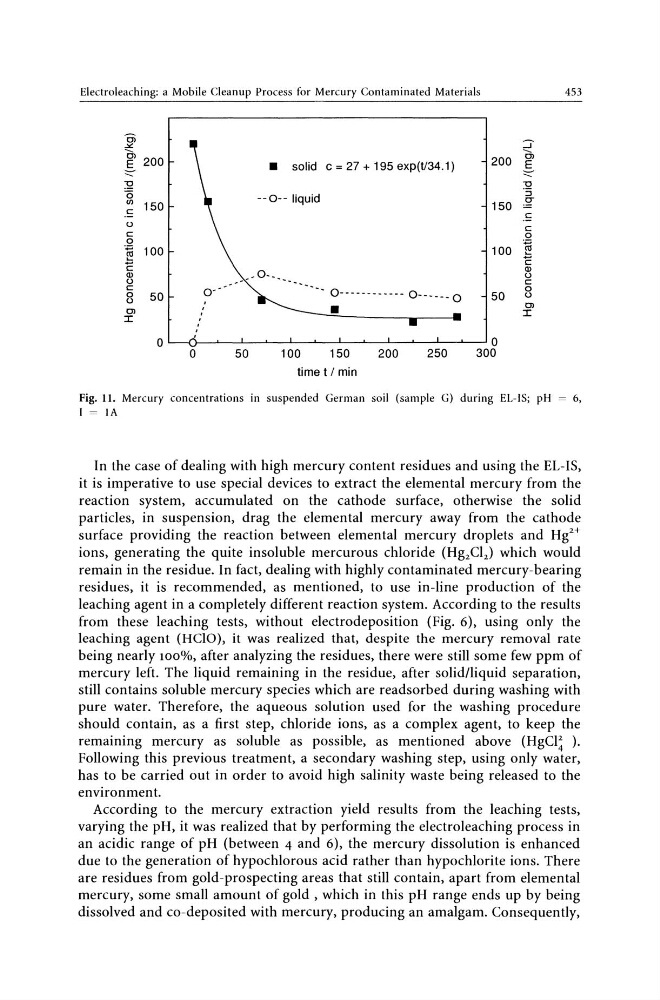
Fig. 11. Mercury concentrations in suspended German soil (sample G) during EL-IS; pH = 6,
1= lA
In the case of dealing with high mercury content residues and using the EL-IS,
it is imperative to use special devices to extract the elemental mercury from the
reaction system, accumulated on the cathode surface, otherwise the solid
particles, in suspension, drag the elemental mercury away from the cathode
surface providing the reaction between elemental mercury droplets and HgH
ions, generating the quite insoluble mercurous chloride (Hg2 CI2 ) which would
remain in the residue. In fact, dealing with highly contaminated mercury-bearing
residues, it is recommended, as mentioned, to use in-line production of the
leaching agent in a completely different reaction system. According to the results
from these leaching tests, without electrodeposition (Fig. 6), using only the
leaching agent (HeIO), it was realized that, despite the mercury removal rate
being nearly 100%, after analyzing the residues, there were still some few ppm of
mercury left. The liquid remaining in the residue, after solidlliquid separation,
still contains soluble mercury species which are reads orbed during washing with
pure water. Therefore, the aqueous solution used for the washing procedure
should contain, as a first step, chloride ions, as a complex agent, to keep the
remaining mercury as soluble as possible, as mentioned above (HgCI~ ).
Following this previous treatment, a secondary washing step, using only water,
has to be carried out in order to avoid high salinity waste being released to the
environment.
According to the mercury extraction yield results from the leaching tests,
varying the pH, it was realized that by performing the electroleaching process in
an acidic range of pH (between 4 and 6), the mercury dissolution is enhanced
due to the generation of hypochlorous acid rather than hypochlorite ions. There
are residues from gold-prospecting areas that still contain, apart from elemental
mercury, some small amount of gold, which in this pH range ends up by being
dissolved and co-deposited with mercury, producing an amalgam. Consequently,
453
Ci
::J
-'"
C, 200
200
C,
~
•
solid c = 27 + 195 exp(t/34.1)
~
:E
"0
0
--0-- liquid
'5
'" 150
150 g.!:
.!:
0
c:
c:
0
0
~
~ 100
100 E
E
- - 0- - -- ----- __ 0--- _________ 0-- ____ 0
Q)
Q)
0
0
c:
c:
0-0
0
50
50 0
0
,
,
•
Ol
Ol
,
:r:
:r:
,
,
0
0
0
50
100
150
200
250
300
time t/ min
Fig. 11. Mercury concentrations in suspended German soil (sample G) during EL-IS; pH = 6,
1= lA
In the case of dealing with high mercury content residues and using the EL-IS,
it is imperative to use special devices to extract the elemental mercury from the
reaction system, accumulated on the cathode surface, otherwise the solid
particles, in suspension, drag the elemental mercury away from the cathode
surface providing the reaction between elemental mercury droplets and HgH
ions, generating the quite insoluble mercurous chloride (Hg2 CI2 ) which would
remain in the residue. In fact, dealing with highly contaminated mercury-bearing
residues, it is recommended, as mentioned, to use in-line production of the
leaching agent in a completely different reaction system. According to the results
from these leaching tests, without electrodeposition (Fig. 6), using only the
leaching agent (HeIO), it was realized that, despite the mercury removal rate
being nearly 100%, after analyzing the residues, there were still some few ppm of
mercury left. The liquid remaining in the residue, after solidlliquid separation,
still contains soluble mercury species which are reads orbed during washing with
pure water. Therefore, the aqueous solution used for the washing procedure
should contain, as a first step, chloride ions, as a complex agent, to keep the
remaining mercury as soluble as possible, as mentioned above (HgCI~ ).
Following this previous treatment, a secondary washing step, using only water,
has to be carried out in order to avoid high salinity waste being released to the
environment.
According to the mercury extraction yield results from the leaching tests,
varying the pH, it was realized that by performing the electroleaching process in
an acidic range of pH (between 4 and 6), the mercury dissolution is enhanced
due to the generation of hypochlorous acid rather than hypochlorite ions. There
are residues from gold-prospecting areas that still contain, apart from elemental
mercury, some small amount of gold, which in this pH range ends up by being
dissolved and co-deposited with mercury, producing an amalgam. Consequently,