

Electroleaching: a Mobile Cleanup Process for Mercury Contaminated Materials
40.-----------------------------------,
:::::J
-o
E
E
-- c o
.~
C
Q)
()
c
o
()
o
o
I
35
30
25
o
•
residual Hg
0 HOCI
10
20
30
40
time I min
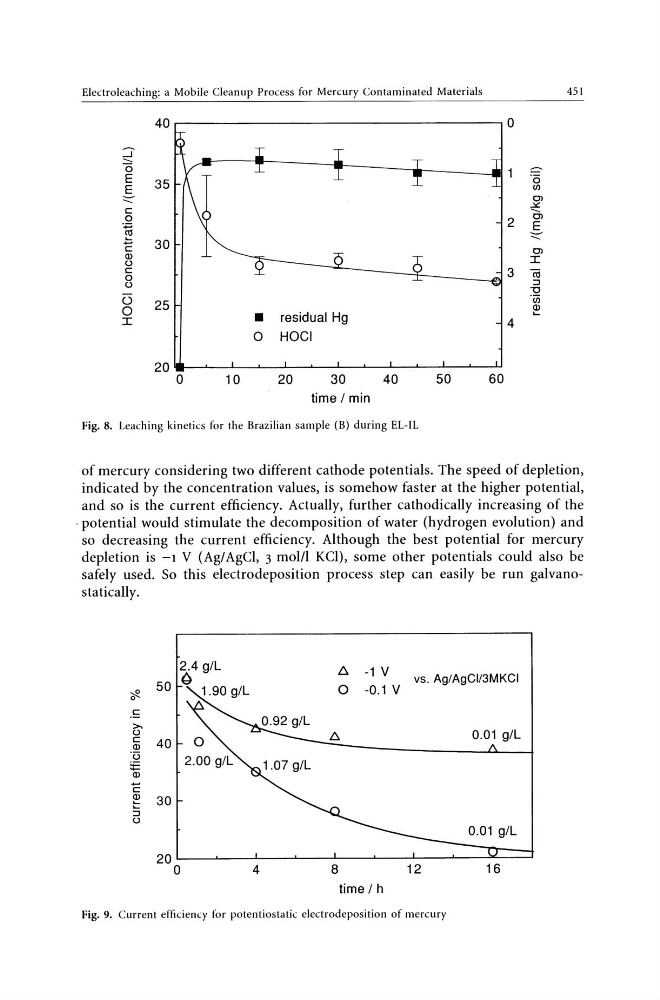
Fig. 8. Leaching kinetics for the Brazilian sample (B) during EL-IL
50
60
451
0
-
0
(/)
Ol
.><:
-2
Ol
.:
Ol
I
3 (U
::J
"0
·Vi
~
4
of mercury considering two different cathode potentials. The speed of depletion,
indicated by the concentration values, is somehow faster at the higher potential,
and so is the current efficiency. Actually, further cathodically increasing of the
. potential would stimulate the decomposition of water (hydrogen evolution) and
so decreasing the current efficiency. Although the best potential for mercury
depletion is -1 V (Ag/AgCl, 3 molll KCl), some other potentials could also be
safely used. So this electrodeposition process step can easily be run galva nostatically.
-;!2. o
c
>- ()
c
Q)
·0
;;::
ID
C
50
40
~ 30
::J
()
t::..
o
-1 V
vs. Ag/AgCI/3MKCI
-0.1 V
0.01 giL
0.01 giL
20L---~--~--~--~----~--~--~--~--~
o
4
8
12
16
time I h
Fig. 9. Current efficiency for potentiostatic electrodeposition of mercury
40.-----------------------------------,
:::::J
-o
E
E
-- c o
.~
C
Q)
()
c
o
()
o
o
I
35
30
25
o
•
residual Hg
0 HOCI
10
20
30
40
time I min
Fig. 8. Leaching kinetics for the Brazilian sample (B) during EL-IL
50
60
451
0
-
0
(/)
Ol
.><:
-2
Ol
.:
Ol
I
3 (U
::J
"0
·Vi
~
4
of mercury considering two different cathode potentials. The speed of depletion,
indicated by the concentration values, is somehow faster at the higher potential,
and so is the current efficiency. Actually, further cathodically increasing of the
. potential would stimulate the decomposition of water (hydrogen evolution) and
so decreasing the current efficiency. Although the best potential for mercury
depletion is -1 V (Ag/AgCl, 3 molll KCl), some other potentials could also be
safely used. So this electrodeposition process step can easily be run galva nostatically.
-;!2. o
c
>- ()
c
Q)
·0
;;::
ID
C
50
40
~ 30
::J
()
t::..
o
-1 V
vs. Ag/AgCI/3MKCI
-0.1 V
0.01 giL
0.01 giL
20L---~--~--~--~----~--~--~--~--~
o
4
8
12
16
time I h
Fig. 9. Current efficiency for potentiostatic electrodeposition of mercury